


Solution Center
Customized One-Stop Wood Processing Production Solutions for Global Furniture Factories
How Furniture Manufacturing Machinery Affects Unit Cost, Output, and Payback Period
Why does furniture manufacturing machinery matter beyond the purchase price?
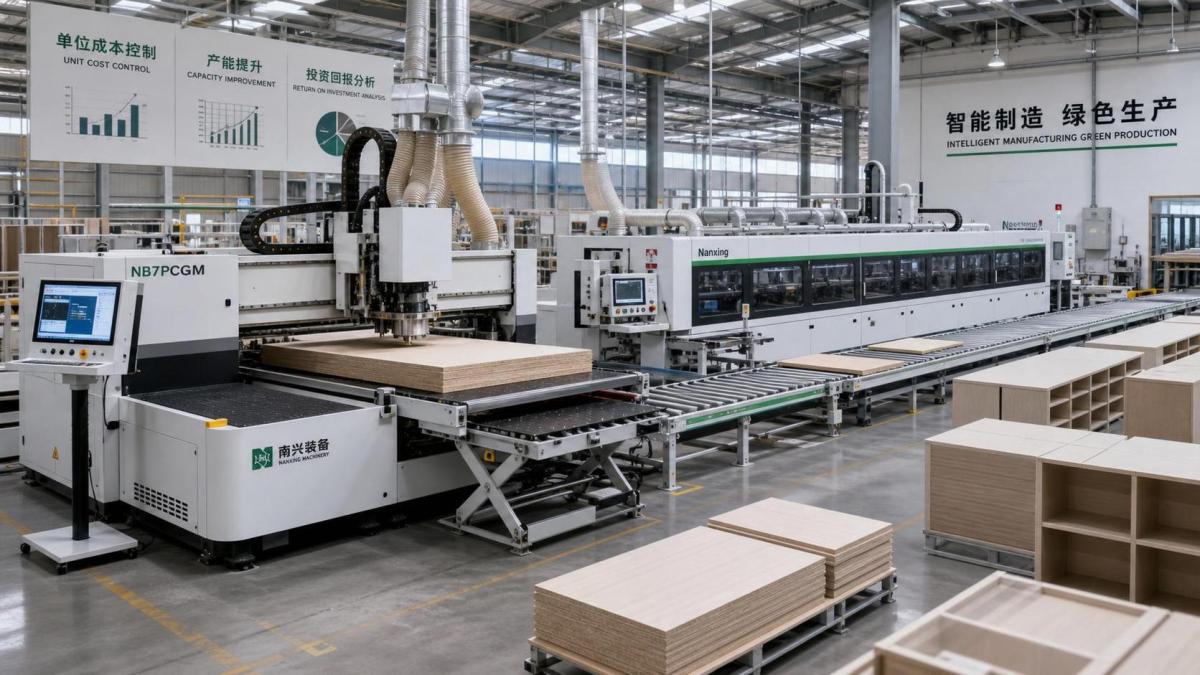
The first cost on a quotation is only the visible part of the decision.
In furniture production, furniture manufacturing machinery changes labor use, material waste, output stability, and delivery speed at the same time.
That means the machine affects unit cost long after installation.
A cheaper machine can look attractive upfront, yet create higher cost per panel, per cabinet, or per finished set.
Common reasons include slower feed speed, more manual correction, higher scrap rates, and unplanned downtime.
On the other hand, well-matched furniture manufacturing machinery can reduce handling steps and improve repeatability.
That is where cost control becomes practical rather than theoretical.
In real factories, the strongest returns often come from process balance.
For example, a fast cutting machine without matching edge banding capacity may only move the bottleneck downstream.
So the real question is not, “What does the machine cost?”
It is, “What does each finished unit cost after this machine enters production?”
That is why many buyers now review machinery in terms of throughput, labor substitution, maintenance exposure, and payback period.
Companies with long production cycles usually feel this effect more clearly.
Even a modest reduction in rework can create a meaningful annual gain.
Which parts of unit cost change most after investing in furniture manufacturing machinery?
Unit cost usually moves in five places, not one.
The obvious item is labor.
Automated cutting, drilling, sanding, and edge banding reduce manual intervention and lower dependency on highly skilled operators.
The second item is material utilization.
Accurate positioning and repeatable cutting patterns help reduce offcuts, panel damage, and dimensional errors.
The third is quality loss.
If machine consistency improves, fewer parts return for trimming, patching, or replacement.
Then there is energy and maintenance.
These costs may rise or fall depending on machine design, spare part availability, and operating discipline.
The final item is hidden capacity cost.
When output becomes more predictable, overtime, urgent outsourcing, and delayed shipments usually decrease.
A simple comparison table helps clarify where the gains usually come from.
This is also where supplier capability matters.
Qingdao Zhongding Machinery has spent more than 20 years in woodworking machinery, which matters because reliable support affects cost just as much as machine specification.
When spare parts and technical response are predictable, the total cost picture becomes easier to defend.
Will higher output always shorten payback, or can it create a new bottleneck?
Higher output helps only when the line can absorb it.
That sounds obvious, but it is one of the most common planning mistakes.
A new CNC router or panel saw may lift front-end productivity sharply.
If drilling, edge banding, assembly, or finishing cannot keep pace, work-in-progress increases instead of cash generation.
In that case, the machine is productive, but the investment still underperforms.
A stronger evaluation method is to measure line balance.
Look at cycle time per station, queue length, changeover frequency, and defect carryover.
Then estimate whether the new furniture manufacturing machinery removes the real constraint or simply shifts it.
Payback becomes faster when three conditions appear together:
- The machine replaces costly manual work or repeated corrections.
- The line has enough downstream capacity to convert output into shipments.
- The supplier can support installation, training, and stable operation quickly.
More cautious models also include ramp-up time.
Few factories reach designed output on day one.
Training, tooling adjustment, dust collection matching, and software integration usually take time.
So a realistic payback estimate should begin after stable production, not after delivery.
How should different machinery options be compared when the goal is lower risk?
Many proposals look similar on headline speed, motor power, or table size.
The lower-risk comparison usually goes deeper.
Start with process fit.
Does the machine match board materials, batch size, product mix, and finish requirements?
Then review reliability indicators.
Frame rigidity, control system stability, component brands, and local service arrangements often matter more than advertised top speed.
It is also useful to compare support depth.
An experienced woodworking machinery supplier should be able to discuss workflow, not only machine features.
That is one reason established exporters remain relevant.
A company such as Qingdao Zhongding Machinery, with long industry experience and complete woodworking solutions, can often reduce implementation uncertainty.
Before approval, a short decision table keeps the conversation grounded.
What mistakes tend to make furniture manufacturing machinery pay back slower than expected?
The most expensive mistakes are usually planning mistakes.
One is buying by peak specification rather than daily workload.
If the machine is oversized for actual order volume, depreciation pressure rises while utilization stays low.
Another common issue is ignoring the surrounding system.
Dust extraction, compressed air, tooling, software, and operator discipline all shape final results.
Some projects also underestimate maintenance routines.
A capable machine with poor lubrication, calibration, or cutter management quickly loses its financial advantage.
There is also a softer risk.
When process data is weak, expected savings become difficult to verify after installation.
That creates debate later, even if the machine is performing reasonably well.
A practical way to avoid this is to define baseline numbers before purchase:
- Labor hours per finished unit
- Scrap percentage by process
- Actual hourly throughput, not nameplate speed
- Downtime hours and repair response time
- Rework rate and customer complaint cost
Once these figures exist, furniture manufacturing machinery can be judged on evidence rather than assumption.
What is a sensible next step before approving a machinery investment?
A good next step is to build a short evaluation sheet around production reality.
List the current bottleneck, the expected unit cost reduction, the likely ramp-up period, and the support requirements.
Then compare two or three machinery options against the same operating assumptions.
This keeps the discussion focused on measurable business impact.
For woodworking lines, the best decisions usually connect machine performance with service reliability and process compatibility.
That is especially relevant when selecting furniture manufacturing machinery expected to support growth over several years.
Suppliers with long sector experience can be useful here because they understand how cutting, drilling, sanding, edge banding, and assembly interact.
Qingdao Zhongding Machinery has built its position on that broader view, combining equipment supply with technical support, spare parts, and responsive after-sales service.
That does not replace internal analysis, but it can improve confidence in the final numbers.
In practical terms, the strongest approval cases usually answer four points clearly:
- Which cost per unit will move first and by how much
- Whether the line can convert extra output into shipped orders
- How downtime and support risk will be controlled
- When stable production is likely to begin
When those answers are specific, the payback period becomes easier to estimate and easier to defend.
That is the right point to move from interest to structured comparison.
Send Your Inquiry
We welcome your cooperation and we will develop with you.