


News & Exhibitions
Latest Factory Updates, Industry Trends & Global Exhibition Information
When is a plastic recycling hot press machine suitable for film scrap?
Film scrap is a good candidate for hot pressing when its main problem is bulk rather than contamination. Loose polyethylene or polypropylene film occupies a disproportionate amount of floor space, catches air during handling, and is expensive to move in low-density loads. A hot press is suited to this situation when the material has already been collected, sorted to a workable level, and prepared for compression into stable blocks for storage, transport, or feeding into a later recycling stage.
The equipment is not a substitute for sorting, washing, drying, or pelletizing. Its strongest role is between those stages: it turns light, irregular film into a denser form that is easier to stack, count, protect, and transfer. The best applications are therefore defined by the condition of the scrap and the needs of the downstream process, rather than by the film material alone.
Start with the condition of the film
Clean production trim is often the clearest fit. Edge trim, rejected bags, off-spec printed film, packaging cutoffs, and similar factory scrap tend to arrive with a known material source and relatively limited contamination. If the film is reasonably dry and does not contain excessive foreign matter, compression can reduce its handling burden without introducing a difficult preparation step.
Washed post-consumer film can also be suitable, but only after moisture has been controlled. Surface water trapped inside a compressed block creates practical problems: it adds unnecessary weight, encourages odor during storage, and can produce steam when the block is later opened or reheated. A press should receive film that has passed through effective mechanical drying or another appropriate drying stage. Material that feels dry on the outside but still contains wet clumps at its center needs closer attention, because those pockets often remain hidden until after compaction.
Contamination changes the answer quickly. Sand, paper labels, food residue, metal fragments, rigid plastic pieces, and woven materials do not disappear under pressure. They remain in the block and can damage later equipment, reduce recyclate quality, or make a compacted package difficult to separate. When scrap quality varies sharply from load to load, a hot press may still be included in the line, but receiving inspection and pre-sorting need to be defined before the press rather than left to visual judgment at the discharge area.
Film type matters because heat does not affect every stream in the same way
Most film scrap contains polyolefins, yet mixed film is not automatically interchangeable. Low-density polyethylene film, linear low-density polyethylene film, high-density polyethylene film, polypropylene film, multilayer packaging, and laminated structures respond differently to heat and pressure. Their softening behavior, friction, trapped-air release, and tendency to fuse vary. A material stream with a narrow and documented composition is easier to press into repeatable blocks than a stream made from unknown packaging films.
For homogeneous in-house scrap, the pressing window is usually easier to establish. The temperature needs to soften contact points enough for the mass to consolidate, without turning the material into an over-melted slab that is difficult to break apart later. For mixed film, heat should be treated more cautiously. Some layers may soften early while other components remain stiff, causing uneven density or a hard outer skin around a springy core.
Printed film deserves separate review. Ink itself does not always prevent compaction, but heavy ink coverage, coatings, adhesives, and solvent residues can change odor, sticking, and heat response. Film that appears clean may still release fumes when heated if residual process chemicals are present. The material declaration, print process, and storage history are more useful than a quick visual check.
Dense blocks are useful only when the next step can accept them
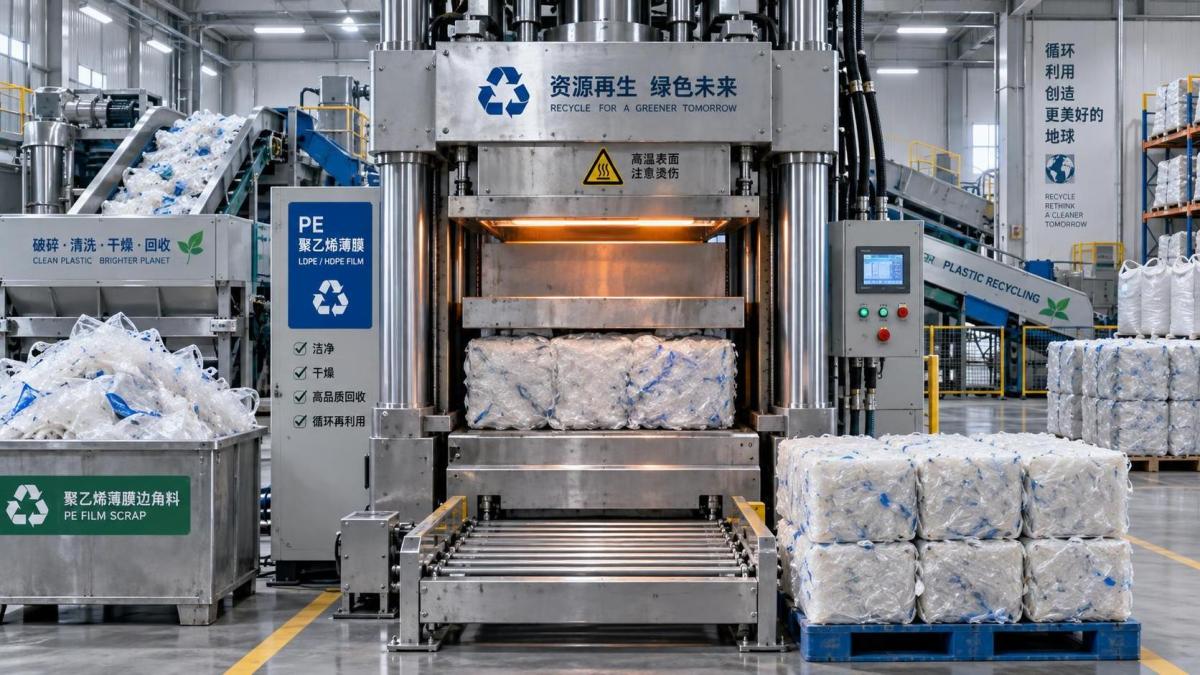
A Plastic Recycling Hot Press Machine is appropriate when densified blocks improve the next physical movement or processing step. This commonly includes warehouse storage, internal transfer by forklift, container loading, shipment to an external recycler, or controlled feeding to a shredder, cutter, agglomerator, or extrusion preparation system.
For transport, the advantage comes from reduced void space. Loose film shifts, expands, and leaves much of a truck body or container filled with air. Pressed blocks stack more predictably, provided their dimensions suit the pallet, container, and lifting arrangement. The expected shipping method should be considered before choosing block size. A block that is easy to make but awkward to load may create handling delays at every transfer point.
For downstream recycling, the key question is whether the block must be opened before processing. Some shredders and cutters can accept dense material only after it has been broken into manageable sections. If the planned feed system is designed for fluffy film, tightly consolidated blocks may bridge at the inlet or overload the initial cutting stage. The press is then not inherently unsuitable, but the line needs a block-breaking or metered feeding arrangement between storage and size reduction.
Compression is particularly valuable where film accumulates faster than it can be processed. A recycling line may operate in batches, while film scrap is generated every day. Densifying the material creates a more orderly buffer stock and prevents loose scrap from spreading into aisles or production areas. That benefit disappears when blocks remain stored so long that material identity, batch separation, or moisture condition is lost. Each block needs a practical identification method tied to source, polymer family, date, and any relevant cleaning status.
Throughput should be matched to the real accumulation pattern
Rated press capacity is easy to misread when evaluating a film application. A machine may be able to exert sufficient force, yet still be poorly matched to the flow of material arriving from sorting or washing. Film is bulky before compression, so the receiving hopper, pre-charge area, and material staging zone often determine whether the press runs smoothly. A small chamber filled repeatedly with loose film can consume more labor and time than expected, even when the final blocks are dense.
Consider the entire cycle: loading, air release, heating, pressing, dwell time, cooling or stabilization, discharge, and block removal. The press should be assessed against peak accumulation, not merely the average amount of scrap generated over a long period. Film scrap rarely arrives in a perfectly even stream. A bag-making line, packaging conversion run, cleaning shift, or warehouse receiving schedule may create large short-term surges.
Heat transfer is another practical limit. A thick charge does not heat uniformly from the outside inward. If the cycle is shortened too aggressively, the outer layers may appear consolidated while the center retains air and rebounds after discharge. Increasing pressure alone does not resolve that condition. It can create a dense shell that makes the internal problem less visible. Block consistency should be checked after it has stabilized, not only at the point of ejection.
There is also a point where hot pressing is unnecessary. Clean, dry film intended for immediate size reduction may be better transferred directly to the next machine if floor space and handling routes permit. Using heat solely because film is light can add energy use, cycle time, and an extra transfer operation without improving the line. Cold baling may be sufficient where a bale remains stable and downstream equipment is already designed to open it. Hot pressing becomes more persuasive when greater density, firmer block shape, or reduced rebound is required.
Separate air removal from material melting
Film compression involves two different effects that are often confused. First, the film folds, collapses, and releases trapped air. Second, heat softens the polymer surfaces so the mass holds its compressed form. Good block formation needs both effects in the right order. If loose film is forced down too rapidly, trapped air can resist compression and produce irregular layers. If heat is applied too strongly or for too long, the material can fuse beyond the needs of storage and handling.
Over-fused blocks create several downstream difficulties. They may require more cutting energy, produce large fragments instead of a controlled feed, and limit the ability to remove a contaminant that was missed before pressing. A glossy, very hard exterior is not always a sign of a good result. It can indicate that surface layers saw more heat than the core, especially when the charge was uneven.
Under-heated blocks present the opposite problem. They look compact while still in the chamber but expand after release, lose their square shape, or shed loose film during forklift movement. Rebound is especially common with highly elastic films and charges containing mixed thicknesses. The target is a block stable enough for the intended logistics route, not the maximum possible hardness.
Installation conditions can decide whether the arrangement is practical
A press reduces the volume of scrap, but it needs space around it for the material before and after compression. The floor plan should allow loose-film staging, safe loading, discharge clearance, block cooling where necessary, forklift access, and a route to the next processing point. Planning only around the press footprint often creates congestion because the incoming material occupies far more volume than the finished block.
Ventilation deserves attention where heated film, printed scrap, coatings, or residual wash chemicals are involved. The need is shaped by the actual material stream and operating temperature. Extraction points should capture emissions near the process instead of relying solely on general building ventilation. The same review should include electrical load, heating control, hydraulic service access, and clearance for opening guards or removing a block that fails to release properly.
Handling arrangements need to match block mass and surface condition. A dense block may be stable on a flat pallet but slip when tilted or transferred on smooth forks. Film blocks are often less forgiving than rigid bales because their surfaces can soften, deform, or become uneven. Pallet selection, stacking height, wrapping where appropriate, and separation between incompatible material grades should be established before regular production begins.
When the machine is a poor fit
Hot pressing is a weak choice for film scrap that is wet, heavily contaminated, chemically uncertain, or destined for immediate processing with no storage or freight constraint. It is also a poor fit where the material changes composition constantly and no reliable segregation is possible. In those conditions, compaction can hide quality problems inside a dense block and shift the burden to the next process.
Very thin film with adhesive contamination, multilayer barrier packaging, and mixed flexible materials require trials using representative scrap rather than sample pieces selected for appearance. The pressing result should be evaluated after cooling and after opening or feeding the block into the intended downstream equipment. A block that looks acceptable at discharge may still prove unsuitable when it reaches a cutter, extruder, or transport route.
A sensible evaluation begins with a defined material stream, representative moisture condition, expected daily accumulation, block dimensions, and the exact destination after pressing. Those details reveal whether hot pressing solves a real logistics or feeding problem, or merely adds another operation. When the film is clean or properly washed, dry, reasonably sorted, and held back by low bulk density, the process can create a controlled intermediate form that supports the rest of the recycling line.
Send Your Inquiry
We welcome your cooperation and we will develop with you.