


News & Exhibitions
Latest Factory Updates, Industry Trends & Global Exhibition Information
How to configure woodworking machines for small-batch production
Small-batch woodworking is rarely difficult because of one machine. It becomes difficult when a production team must switch from cabinet doors to custom panels, from solid wood parts to veneered boards, or from one client’s dimensions to another’s—all while protecting margins and promised delivery dates.
For project managers, effective Woodworking Machine Configuration is the practical answer to this challenge. The goal is not to fill a workshop with the most equipment possible. It is to build a production cell that can handle frequent changes, maintain repeatable accuracy, and avoid leaving expensive assets idle between short runs.
A well-planned configuration gives a workshop room to accept varied orders without creating a new setup problem every morning. It also makes capacity easier to forecast, operators easier to support, and quality problems easier to trace before they reach assembly or the customer.
Start with the order mix, not the machine catalogue
Before selecting or rearranging equipment, map the work that actually enters the factory. Small-batch production is often described as “flexible manufacturing,” but flexibility means different things in different workshops. A custom furniture producer may need rapid sizing and edge processing for many panel formats. A solid-wood workshop may place more value on profiling, drilling, sanding, and joinery. A contractor supplying hotel or retail projects may face fluctuating part volumes but strict consistency across repeated room sets.
Project leaders should review at least three groups of information:
- Part families: panels, doors, drawers, mouldings, frames, solid wood components, or mixed-material items.
- Variation drivers: dimensions, hole patterns, edge materials, surface finishes, grain direction, and hardware requirements.
- Production rhythm: average batch size, order frequency, peak periods, due-date pressure, and expected design revisions.
This exercise often reveals an important fact: the bottleneck is not necessarily the operation that looks slowest. A beam saw may cut quickly but create queues at edge banding. A CNC router may be highly capable but lose much of its available time to manual loading, program verification, or waiting for approved material. The right woodworking machine configuration follows the flow of parts, not the popularity of individual machines.
Build a flexible processing path around common operations
In a small-batch environment, each workpiece should move through as few unnecessary handoffs as possible. The most useful configuration is usually a balanced sequence of cutting, sizing or shaping, edge treatment, drilling or machining, sanding, and final inspection. Not every project requires every step, but the core path should be clear enough that operators do not need to improvise routing decisions for every new order.
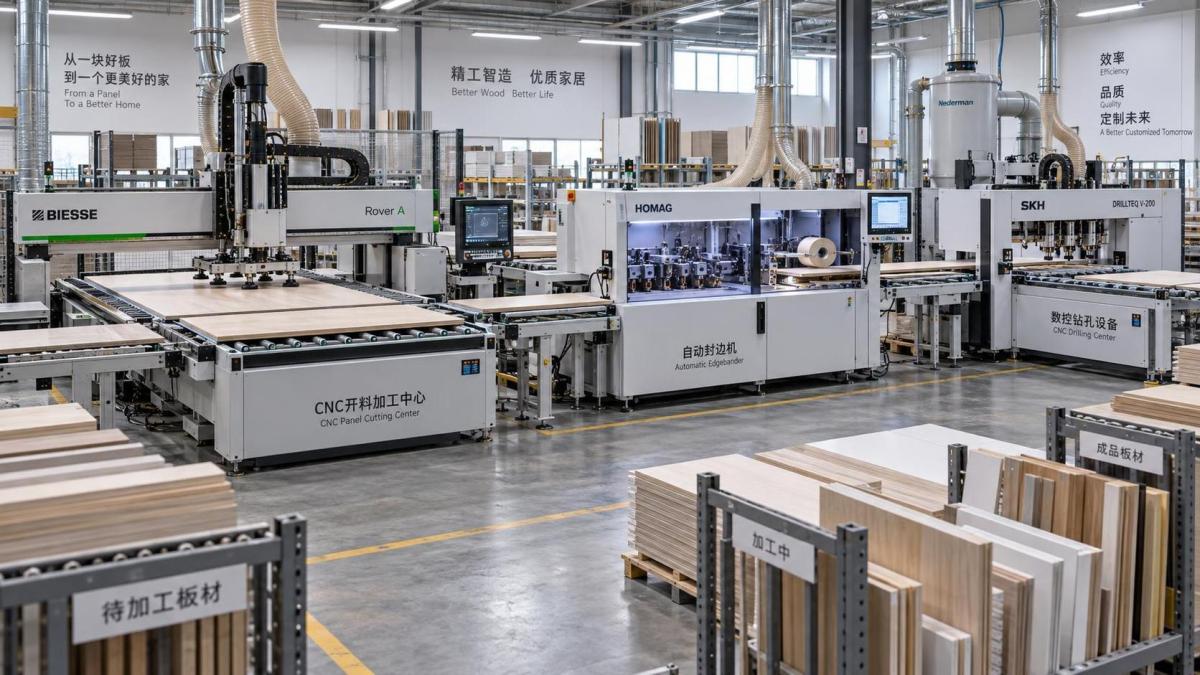
For panel furniture and cabinet production, a typical arrangement may include a panel saw or CNC nesting machine, an edge bander, a CNC drilling or machining center, and supporting material handling and inspection stations. For solid wood furniture, the center of the cell may shift toward a planer, thicknesser, sliding table saw, spindle moulder, CNC router, wide belt sander, and assembly support equipment.
The key is to choose the primary processing method based on the work mix:
A balanced line does not require identical cycle times at every station. It requires enough capacity and buffering that one station does not constantly force another to stop. For short production runs, a modest, controlled buffer between critical steps is often more useful than a theoretically continuous line that becomes unstable whenever the product changes.
Quick changeovers are where small-batch profitability is won or lost
When batches are small, setup time becomes part of the product cost. A machine that runs fast after a 45-minute adjustment may be less suitable than a slightly slower machine that can move from one job to another in ten minutes with reliable results.
Changeover planning should cover more than machine settings. It includes tool selection, program loading, material identification, fence or guide adjustment, dust extraction readiness, quality samples, and communication between upstream and downstream stations. If any one of these steps is unclear, the “quick” changeover becomes a sequence of avoidable interruptions.
Project managers can improve this process by separating tasks into external and internal setup activities. External tasks are completed while the current order is still running: preparing the next tool set, confirming drawings, checking material, generating labels, and reviewing the CNC program. Internal tasks require the machine to stop: changing tooling, setting references, loading parameters, and producing the first approved piece.
The first goal is not to rush operators. It is to remove uncertainty before the machine stops. A simple setup sheet that shows part number, material, thickness, tool list, reference face, edge specification, program version, and first-piece inspection points can prevent a surprising amount of waste.
Use common references across the workshop
Many short-run quality issues begin with inconsistent datum choices. One operator may reference the front edge, another the back edge, while a third follows a drawing that has not been updated after a design revision. The result may be individually accurate parts that do not assemble together.
Establish a clear rule for reference faces, reference edges, panel orientation, labeling position, and part flow. This is especially important when a part moves between cutting, edge banding, drilling, and CNC machining. Standard references reduce the need for operator memory and make digital programs more dependable across shifts.
Decide what must be automated—and what should remain deliberately manual
Automation is valuable in small-batch woodworking when it removes repetitive, error-prone work or preserves accuracy across many product variants. Automatic tool changing, programmable fences, barcode-driven program selection, servo positioning, and parameter recall can significantly reduce setup burden. Yet not every manual task is a problem waiting to be automated.
Manual inspection, visual grain matching, special assembly fitting, and the handling of fragile or unusual pieces may still need experienced human judgment. Over-automation can create a rigid system that is difficult to adapt when a custom project introduces an unexpected material or non-standard design feature.
A practical rule is to automate the operations that repeat frequently across different jobs, while keeping rare and highly variable tasks in a controlled manual process. For example, a CNC machine may handle recurring drilling patterns and complex profiles, while a trained operator manages final fitting for special hardware or hand-selected timber parts.
When evaluating machinery, ask not only, “What can this machine do?” Ask, “How easily can our team make it do the next job?” The answer depends on interface clarity, program management, calibration procedures, tooling availability, maintenance access, and local technical support—not just the specification sheet.
Match machine capability with tooling, extraction, and material flow
A woodworking machine configuration is only as stable as its supporting systems. It is common to invest in a capable machine and then discover that tool preparation, dust extraction, compressed air, power supply, or material staging limits its output.
Tooling deserves particular attention. Small batches can create frequent tool changes, which raises the risk of selecting the wrong cutter, using a worn edge, or running a tool outside its intended material range. A controlled tooling system should identify each tool, its application, maintenance status, and storage location. For CNC equipment, tool libraries need to match the physical tools actually available on the shop floor.
Dust extraction is equally operational, not merely environmental. Inadequate extraction can affect cut quality, reduce visibility, contaminate edge-banding zones, and increase cleaning time between jobs. Confirm airflow requirements across the full operating combination of machines, not one machine in isolation.
Material flow should also be visible on the layout. Sheets, boards, and semi-finished parts need defined staging areas. If operators repeatedly walk around machines to find the next stack, production time disappears in small fragments that are difficult to measure but easy to feel. Use clear locations for incoming material, cut parts awaiting processing, rework items, approved components, and finished assemblies.
Plan capacity through constraints, not nameplate output
Nameplate speed is useful, but it does not represent real small-batch capacity. Actual output includes loading, unloading, setup, first-piece approval, cleaning, tool changes, minor adjustments, program confirmation, and occasional rework. Project managers need a planning method that reflects these realities.
For each major operation, estimate the total time per order rather than only the time per part. A short batch may require five minutes of machining but twenty minutes of preparation and verification. This changes the decision about whether to group similar jobs, run one-piece flow, or create a planned sequence of orders using the same tooling and material.
Grouping should be done carefully. Combining all similar material jobs may reduce setups, but it can delay urgent work and create confusion if parts from several projects are mixed. A better approach is to create short, manageable production windows: group compatible work where it makes sense, retain project identity through labels and traveler documents, and leave capacity for priority changes.
Keep one controlled path for urgent changes
Custom projects often change after production has started. Hardware may be substituted, dimensions corrected, or finish requirements revised. Without a controlled process, these changes become verbal instructions that bypass planning and generate scrap.
Define who can release a revised drawing, who verifies the affected program, how old labels are removed, and where stopped parts are held. The aim is not to make change difficult; it is to make it visible. A machine cell configured for small batches should absorb legitimate revisions without allowing outdated information to travel unnoticed.
Quality checkpoints should protect the next operation
Inspection works best when it happens where an error is cheapest to correct. Checking panel dimensions immediately after cutting prevents unsuitable parts from reaching edge banding. Confirming edge adhesion and trim quality before drilling avoids machining components that will later be rejected. Verifying hole location or profile dimensions before assembly protects the final schedule.
First-piece approval is especially valuable after a new setup, material change, or CNC program revision. The approved sample should be compared against the current drawing and retained or clearly documented as the reference for the run. For recurring products, a small library of quality standards—acceptable edge appearance, hole tolerance expectations, grain orientation, finish-ready sanding criteria—helps teams make consistent decisions without waiting for management intervention.
Do not treat rework as a separate, invisible activity. Record its cause: incorrect program, setup error, damaged material, tool wear, handling damage, or drawing ambiguity. Over time, these records show whether the configuration problem lies in equipment capability, process discipline, or upstream engineering.
A scalable configuration does not mean buying everything now
For many growing workshops, the best path is a phased layout. Start with machines that cover the highest-volume and highest-risk operations, then reserve physical space, electrical capacity, extraction connections, and material routes for later additions. This prevents an early investment from blocking future automation or a larger machine footprint.
Qingdao Zhongding Machinery Co., Ltd. supports woodworking businesses with machinery and production-oriented guidance shaped by more than 20 years in the industry. For project managers, the value of working with an experienced equipment partner is not only access to individual machines. It is the ability to discuss machine compatibility, workflow sequencing, spare-parts planning, operator needs, and the practical service requirements that affect long-term uptime.
Before finalizing a purchase or layout, share representative drawings, material types, batch sizes, expected product changes, and available workshop dimensions. A configuration discussion based on real workpieces is far more useful than one based on general capacity assumptions.
Final checklist before commissioning the cell
- Can the proposed flow handle the most frequent part families without excessive manual rerouting?
- Are setup instructions, tooling, programs, and labels prepared before each batch begins?
- Does the layout provide safe, visible space for material staging and quality checks?
- Are the likely bottlenecks supported by adequate labor, buffer capacity, and maintenance attention?
- Can operators identify the correct datum, drawing revision, and program version without guesswork?
- Have extraction, power, compressed air, tooling storage, and spare-parts needs been included in the plan?
- Is there a documented route for engineering changes and urgent project adjustments?
The strongest Woodworking Machine Configuration for small-batch production is not the one with the most automation or the highest theoretical output. It is the one that gives project teams control: control over changeovers, part identification, quality, capacity, and future growth. When machines, people, and information follow the same production logic, a workshop can take on varied work with greater confidence—and turn flexibility from a daily disruption into a dependable operating strength.
Send Your Inquiry
We welcome your cooperation and we will develop with you.