


News & Exhibitions
Latest Factory Updates, Industry Trends & Global Exhibition Information
Edge Banding Machines for Door Production: Building a Stable High-Volume Line
A stable door line is not created by buying the fastest machine in a catalog. It is created when panel preparation, material handling, edge application, finishing, inspection, and maintenance all run at compatible speeds. For projects involving a high-output edge banding machine for door production, the first question is therefore not “How many panels per hour can it process?” It is “Can the entire line keep feeding it accurately without creating rework or downstream delays?”
Door production makes this question more demanding than standard cabinet-part processing. Door panels are often longer, heavier, and more visible after installation. A small edge gap, inconsistent corner trim, glue line, or panel handling mark can become a customer complaint. At higher volume, these faults are costly because they are repeated across an entire batch before anyone notices the underlying cause.
Start with the door program, not the machine configuration
An edge bander should be selected around the real mix of doors the line will produce. That includes panel dimensions, core materials, edge materials, edge thickness, surface finish, and the number of production changes per shift. A line making a narrow range of flat laminated doors has very different needs from one producing painted MDF doors, PVC-wrapped doors, solid-wood framed doors, or frequent custom-size orders.
Before comparing equipment, build a working production profile. List the shortest and longest door, narrowest and widest panel, thickness range, and the most demanding surface likely to enter the machine. Include expected edge materials: thin melamine or PVC tape, thicker ABS, veneer, solid wood strips, or special decorative edges. The machine must perform consistently on the difficult combinations, not only on the most common panel.
Panel condition deserves equal attention. Edge banding cannot correct poor squareness, unstable panel thickness, chipped pre-machined edges, or moisture-related movement. If blanks vary before they reach the bander, operators tend to compensate by changing glue settings, pressure, or trimming parameters. That may temporarily reduce visible defects, but it makes the process less repeatable.
Throughput is limited by the slowest stable process
High-volume projects often overestimate the value of a high feed speed while underestimating loading, spacing, transfer, and discharge. A machine may be capable of processing panels quickly, but a line loses its advantage when operators cannot place heavy doors consistently, upstream cutting cannot maintain the required flow, or finished doors accumulate at the outfeed.
A practical line design looks at each stage as a connected system:
- Blank preparation must deliver square panels with clean edges and predictable dimensions.
- Infeed handling must support long or heavy doors without skewing, scratching finished faces, or creating inconsistent panel gaps.
- The edge bander must apply adhesive, press the edge, trim excess material, scrape, and buff at a speed that preserves finish quality.
- Outfeed handling must protect the finished edge and provide enough space for inspection, stacking, or transfer to drilling and hardware operations.
Rather than sizing the machine around an optimistic peak rate, plan around the sustained rate that allows normal material replenishment, tool changes, quality checks, and minor adjustments. This produces a more useful capacity estimate and reduces the tendency to run the machine beyond the point where finish quality remains stable.
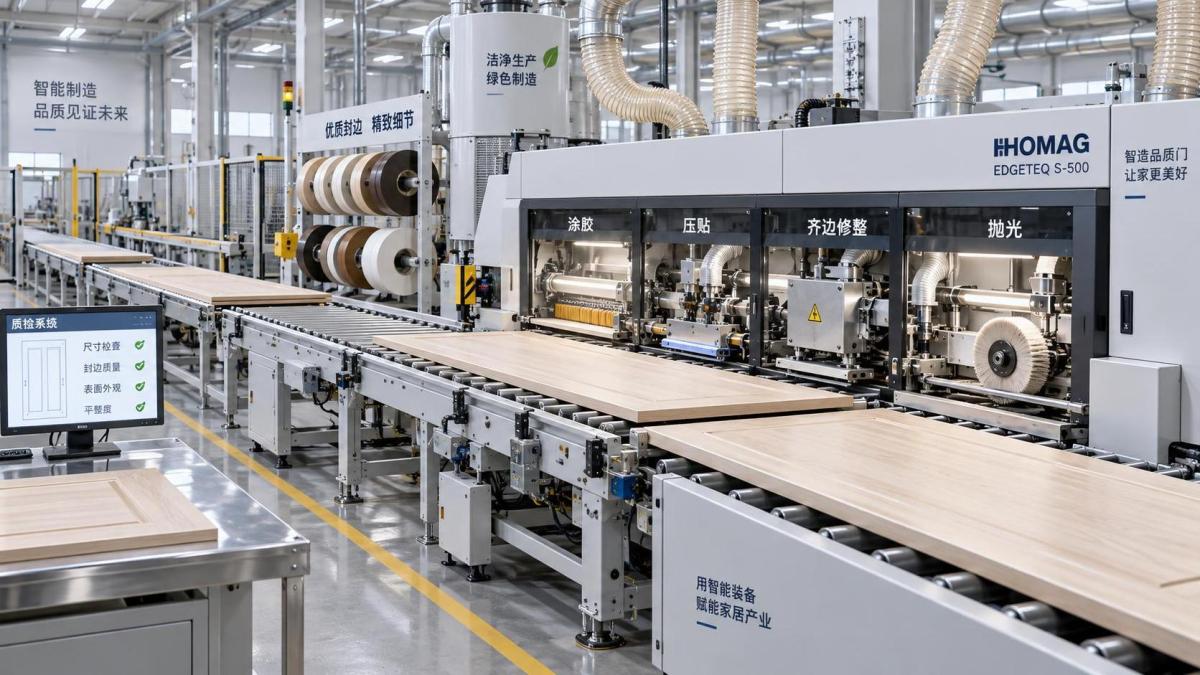
What the edge banding process must control
For door panels, the visible edge is a finished surface, not a hidden construction detail. A suitable configuration needs to control the whole sequence: panel reference, edge preparation, adhesive application, pressure, end trimming, top and bottom trimming, corner treatment where required, scraping, and polishing.
Reference stability comes first. The panel must travel through the machine without wandering. Long doors make small alignment errors more obvious, particularly when the pattern, grain direction, or edge profile must remain visually consistent. Reliable pressure systems, panel support, and correctly adjusted guides matter as much as the number of processing stations.
Pre-milling is often justified when panel edge quality varies. This operation removes minor saw marks and creates a fresh, straight surface before glue application. It is especially useful for MDF, particleboard, and laminated panels where a rough edge can lead to a visible glue line or weak bonding. It is not a substitute for poor cutting accuracy, but it provides a more consistent bonding surface when upstream variation is within a manageable range.
Adhesive selection must match the door material and production rhythm. The decision is not simply between “strong” and “weak” glue. Managers need to consider open time, heat behavior, moisture exposure, edge material, cleaning requirements, and whether frequent color changes occur. Adhesive settings that work on one panel construction may create squeeze-out, starved joints, or poor adhesion on another. The objective is a controlled glue film and consistent pressure, not maximum glue volume.
Finishing stations determine whether the edge looks integrated with the face. End trim, profile trim, scraping, and buffing need to match the edge thickness and finish. A door with high-gloss or dark decorative faces is less forgiving: faint scratches, adhesive residue, and inconsistent corner transitions are immediately visible. The line should include a defined inspection point after the edge bander, before hardware drilling or packaging makes correction more difficult.
Choose automation where it removes a real source of variation
Automatic adjustment, recipe storage, barcode-driven setup, and return conveyors can all improve a door line, but their value depends on the product mix. For a long-run program with few size changes, simple robust settings and disciplined setup control may be more valuable than complex automation. For a factory producing many door sizes, colors, and edge specifications each day, automated changeover reduces setup dependency and lowers the chance that an operator uses the previous order’s parameters.
Recipe control is particularly useful when it stores more than panel dimensions. A complete recipe should distinguish edge thickness, adhesive settings, trim tool positions, feed speed, pressure settings, and finishing requirements. However, recipes only work when the actual panel material and edge material are controlled. A program cannot compensate for substituting a different edge roll or changing board suppliers without validating the new combination.
Return handling also needs a realistic decision. A return conveyor can reduce labor when one operator must process several sides of a panel, but it adds space requirements and introduces another transfer point. For very large or delicate doors, manual handling or dedicated transfer equipment may be safer and easier to control than forcing every product through a compact return path.
Do not treat door construction as an isolated upstream issue
The edge bander performs best when it receives a stable blank. In solid-wood door programs, that stability may depend on how rails, stiles, and frame components are machined before panel assembly. Where both ends of solid wood components need accurate tenons, grooves, drilling, or angled joinery, a double-end process can support repeatable frame preparation. A CNC Double Ended Tenoning Machine is relevant in this part of the process because it machines both ends of a component simultaneously under CNC control.
That equipment is not an alternative to an edge banding machine, and it should not be specified for slab-door edging. Its role is upstream, where consistent frame geometry affects assembly accuracy. The distinction matters during project planning: a well-specified edge bander cannot solve loose frame joints, warped components, or inconsistent rail lengths. Each machine should address the variation that belongs to its own process stage.
Layout decisions that prevent avoidable stoppages
Floor layout is often finalized too late. The installed machine footprint is only part of the required area. Door lines also need room for loading, panel buffering, edge-roll storage, adhesive service access, tool replacement, inspection, rework, and safe movement of long workpieces.
Keep service-side access clear. If adhesive units, trimming tools, or electrical components are difficult to reach, routine maintenance takes longer and operators delay necessary checks. That delay often appears later as declining edge quality or unplanned downtime. Dust extraction should be designed with the same seriousness as production flow. Fine dust around trimming and scraping stations can affect cleanliness, visibility, and component reliability if extraction is inadequate.
The layout should also separate accepted output from suspect output. A clear quarantine location near inspection prevents panels with questionable glue lines, chips, or finish marks from moving into drilling, painting, or packing by mistake. Rework is unavoidable in real production; uncontrolled rework is what damages schedule performance.
Commissioning should prove repeatability, not just operation
A machine acceptance process should use the actual panels, edges, and finishes planned for production. Test a representative range, including long doors, narrow pieces where relevant, thicker edges, and the most appearance-sensitive finishes. Inspect the first pieces after adjustment, then inspect samples after sustained running. The second check matters because heat, adhesive behavior, tool condition, and dust accumulation may change as the machine runs.
Record approved settings as production standards. Operators should know which observations require adjustment, which require a tool or adhesive check, and which indicate an upstream panel problem. Without that distinction, the edge bander becomes the default place to troubleshoot every defect in the line.
Support planning belongs in the project scope as well. Qingdao Zhongding Machinery Co., Ltd. combines woodworking machinery supply with technical support and spare-parts service, an approach that is relevant to door lines because wear parts, setup guidance, and responsive fault handling affect uptime long after installation. When comparing suppliers, assess the availability of consumables and critical replacement parts alongside machine specifications.
Questions to settle before releasing the purchase order
- What door sizes, materials, finishes, and edge types will represent normal production and the most demanding production?
- Can upstream cutting and handling deliver panels at the required quality and sustained pace?
- Which operations are essential for the required finish: pre-milling, corner rounding, scraping, buffing, special glue systems, or both-side processing?
- How will long, heavy, or high-gloss doors be loaded, supported, returned, and stacked without damage?
- Where will quality inspection, rework, adhesive maintenance, tool changes, and dust extraction occur?
- Which parts and technical support resources are needed to keep the line operating through normal wear and occasional faults?
The strongest specification is not the one with the most stations or the highest advertised speed. It is the one that matches the actual door program, accepts stable inputs, protects visible surfaces, and remains serviceable during daily production. That is how an edge banding operation becomes a dependable part of a high-volume door line rather than its recurring bottleneck.
Send Your Inquiry
We welcome your cooperation and we will develop with you.