


News & Exhibitions
Latest Factory Updates, Industry Trends & Global Exhibition Information
Which import requirements affect woodworking machine delivery to Germany?
Which Import Requirements Affect Woodworking Machine Delivery to Germany?
Planning woodworking machine delivery to Germany involves more than choosing the right machine and arranging freight. For a technical evaluator, the real work begins before the purchase order is released: confirming CE conformity, checking whether the electrical design suits the intended factory, preparing German-language documentation, defining customs responsibilities, and making sure the installation site can safely receive the equipment.
A machine can arrive at a German port on schedule and still become a difficult project if the documentation is incomplete, the importer is unclear about its obligations, or the machine cannot be commissioned under local operating conditions. This is particularly relevant for automated woodworking equipment, where moving tools, dust extraction, pneumatic systems, safety guards, electrical cabinets, and control logic all need to be assessed as one system.
The key point is simple: compliance should be reviewed as part of the technical specification, not treated as a shipping document exercise at the end.
CE Conformity Is the Starting Point, Not the Whole Approval Process
Most industrial woodworking machines placed on the German market must meet the applicable EU product legislation and carry CE marking. For machinery currently placed on the market, the Machinery Directive 2006/42/EC remains a central framework. The newer EU Machinery Regulation 2023/1230 is scheduled to apply from January 2027, so buyers working on long-lead projects should check the legal timing carefully rather than relying on an old compliance checklist.
CE marking is not simply a label fixed to the electrical cabinet. It should be supported by a conformity assessment process, a documented risk assessment, a technical file, operating instructions, and an EC Declaration of Conformity. Depending on the machine configuration, other legislation may also apply, including the Electromagnetic Compatibility Directive and the Low Voltage Directive. The exact combination depends on the equipment and how its electrical system is designed.
For an importer, the practical question is not “Does the machine have CE?” but “Can the supplier demonstrate why this exact machine configuration is CE-compliant?” A generic declaration that does not clearly identify the model, serial number or relevant directives can create unnecessary exposure for the German importer.
Technical reviewers should ask to see the declaration before shipment, not after the machine is already on the water. It should identify the manufacturer, machinery model, applicable legislation, authorized signatory, and issue date. The nameplate details, invoice description, packing list, manuals, and declaration should also describe the machine consistently. Small inconsistencies are common, but they become much harder to correct once customs, insurance, and site acceptance are involved.
Documentation Must Be Usable at the German Factory
Germany expects safety-related instructions to be available in German when machinery is placed on its market. In practice, a buyer should require German operating instructions, maintenance guidance, warning labels where applicable, and a German version of the EC Declaration of Conformity. English documentation may be useful for an engineering team, but it does not replace the local-language documentation needed by operators and maintenance personnel.
This is where delivery projects often become more complicated than expected. A translated manual should not be a short sales brochure with a few safety pages attached. It needs to address the actual delivered machine: intended use, foreseeable misuse, startup procedure, emergency-stop functions, tool and glue-system hazards where relevant, cleaning, fault diagnosis, lockout procedures, maintenance intervals, residual risks, and spare-parts identification.
For machinery delivered as separate modules, the distinction between a complete machine and partly completed machinery also matters. A production line containing conveyors, feeding equipment, extraction interfaces, or automation may need a system-level assessment after installation. It is risky to assume that CE documentation for each individual module automatically proves conformity for the assembled line.
A capable supplier should be willing to clarify the boundary of supply: what is included in the machine’s declared conformity, what must be completed by the installer, and which interfaces remain the customer’s responsibility. Qingdao Zhongding Machinery Co., Ltd., for example, has developed its woodworking machinery business over more than two decades around not only machine production but also technical support, spare-parts supply, and longer-term service. That approach is useful because documentation questions do not always end at shipment.
Electrical Compatibility Needs an Early Check
German industrial sites commonly operate on 400 V, three-phase, 50 Hz power systems, but the incoming supply, earthing arrangement, fuse capacity, cable route, and site-specific protective devices should be confirmed by the buyer’s electrical team. A machine built for a different voltage or frequency may require modifications that affect motor selection, transformers, drives, heating circuits, control components, and the conformity documentation itself.
It is worth checking far beyond the headline voltage. Technical evaluators should confirm:
- rated voltage, frequency, phase arrangement, and total connected load;
- main isolator, emergency-stop circuit, protective earth connection, and cabinet ingress protection;
- availability of wiring diagrams and component lists;
- compatibility of PLC, inverter, safety relay, sensors, and control components with local service expectations;
- compressed-air demand, operating pressure, and air-quality requirements;
- connection points for dust extraction and whether the factory system can handle the expected airflow and dust load.
For woodworking machinery, dust extraction deserves more attention than it sometimes receives during quotation review. The machine may be technically sound, yet the installation can remain unsafe or impractical if the buyer’s extraction ducting, fan capacity, fire protection concept, or dust collection arrangement is not suitable for the process. German workplace and operational safety requirements are generally assessed at the user site, so a supplier’s CE declaration does not remove the employer’s responsibility for the final working environment.
Machine Specifications Affect Transport and Installation Risk
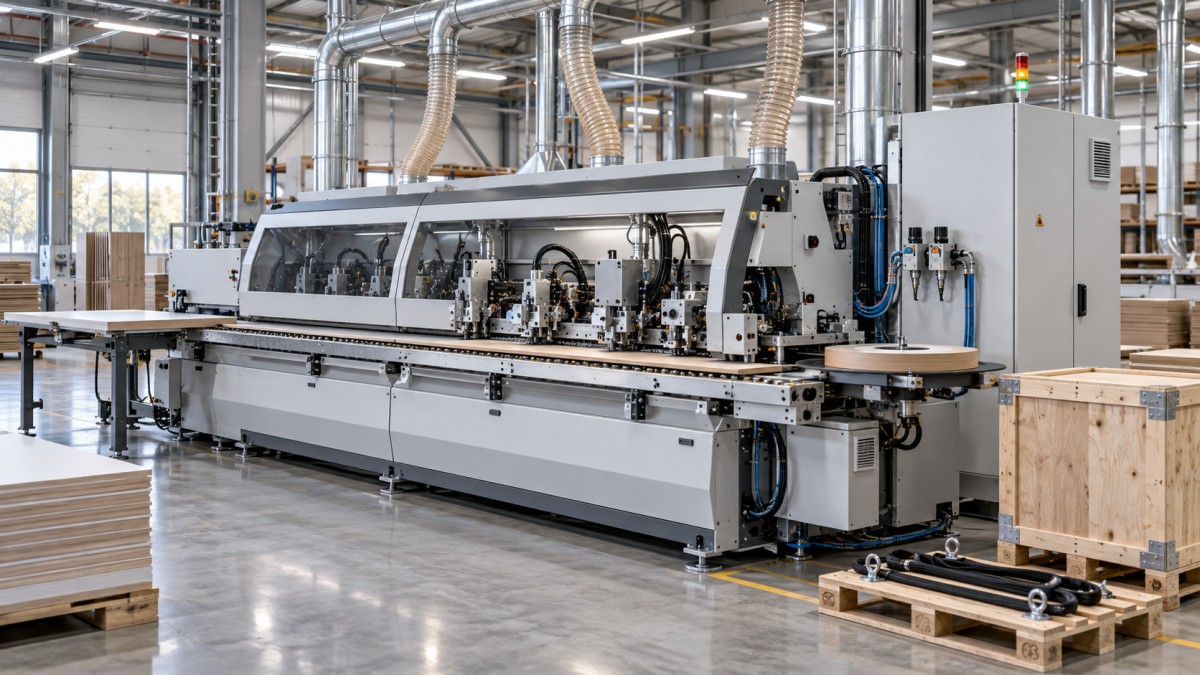
Large edge-banding equipment illustrates why a technical and logistics review should happen together. The Straight&Beveling edge banding machine ZD450ZX has overall dimensions of 10000 × 950 × 1850 mm. A ten-metre machine is not simply another crate on a container loading plan. The buyer needs to verify unloading equipment, access width, turning space, door height, floor condition, assembly area, and the route from the unloading point to the final position.
Its stated total power is 28 kW and operating air pressure is 0.6 MPa. Those figures are useful for initial site planning, but they should be checked against the final electrical drawing and installation layout. In a cabinet or furniture factory, a high-output edge bander may also need coordinated space for panel infeed and outfeed, operator access, maintenance access, material handling, and extraction hoses. A machine that fits on a floor plan can still be difficult to service if clearance around glue units, trimming stations, or electrical cabinets has been ignored.
The ZD450ZX is designed for straight and bevel edge processing, including trimming and polishing. Its stated straight feed speed is 15–20 m/min, while bevel processing is listed at 15 m/min. Such output-related parameters should be considered alongside the customer’s panel formats, edge-band materials, and production mix. For example, a buyer using PVC, ABS, veneer, or different panel thicknesses should confirm that the proposed configuration corresponds to the actual material range rather than selecting a machine only on nominal throughput.
Customs, EORI and Import Tax Responsibilities Must Be Defined
The commercial side of woodworking machine delivery to Germany is usually managed through the importer of record, customs broker, freight forwarder, and supplier. The German or EU importer generally needs an EORI number for customs declarations. The customs tariff classification determines the duty treatment, while import VAT may be payable at import unless an applicable procedure or arrangement is used.
Neither the supplier nor the buyer should guess a tariff code from a product brochure. Woodworking machinery can vary significantly in function, automation, tooling, and intended use. Classification should be checked against the actual machine and its accessories, ideally with advice from a qualified customs specialist where the commercial value or project complexity justifies it.
Incoterms need equally careful attention. Under an arrangement such as FOB, CIF, DAP, or DDP, the division of cost and risk changes, but the buyer should still identify who is responsible for export clearance, main carriage, cargo insurance, import declaration, duties, VAT, inland delivery, and unloading. “Delivered to Germany” is not a sufficiently precise instruction for a large industrial machine.
Invoices and packing lists should accurately state the machine model, quantity, value, country of origin, package count, net and gross weight, and commercial terms. If a shipment includes free spare parts, tools, samples, or separate electrical accessories, these should be described properly rather than grouped vaguely as “machine parts.” Clear paperwork reduces questions at the border and makes later asset registration easier for the purchaser.
Packaging Rules and Damage Prevention Are Related but Different Issues
Wooden crates, pallets, and dunnage used in international shipping normally need to meet ISPM 15 requirements when applicable. The marking should be visible and the timber should be properly treated. This is a practical issue: non-compliant wood packaging can lead to inspection problems, re-export requirements, or delays that have nothing to do with the machine itself.
Germany also has packaging-law obligations that may affect companies placing packaged goods on the market. The exact obligations depend on the packaging type and the company’s role in the supply chain. For industrial machinery, transport packaging and commercial packaging should be reviewed with the importer or a German compliance adviser rather than assuming consumer-goods rules apply in the same way.
From a delivery perspective, the packaging specification should state how sensitive assemblies are protected. Edge banders and other precision machines may include guide systems, trimming assemblies, polished surfaces, electrical panels, pneumatic components, and control interfaces that should not be exposed to moisture, impact, or shifting loads. Buyers should request photographs before dispatch, crate dimensions, lifting-point information, center-of-gravity markings where relevant, and a parts list for accessories packed separately.
Commissioning Creates a Second Compliance Checkpoint
Once the machine reaches the factory, the operator still needs to ensure safe use under German workplace rules. This may involve site risk assessment, employee instruction, electrical connection by qualified personnel, verification of guarding and emergency functions, and any inspections required for the installed equipment. The German Ordinance on Industrial Safety and Health is relevant to the operation of work equipment, even though it is not a customs document.
A sensible acceptance process should record the delivered serial number, condition on arrival, installed safety devices, electrical test results where applicable, training completion, and outstanding issues. If the buyer alters guards, changes controls, links machines into an automated line, or modifies the intended operating mode, the original conformity position may need to be reconsidered. This is especially important where several machines are integrated under one control system.
The most reliable approach is to create a pre-shipment matrix covering conformity documents, language requirements, power supply, pneumatic supply, extraction, customs data, packaging, unloading, and installation responsibilities. It may feel administrative, but it is far less costly than discovering a missing German manual or incompatible electrical design after a machine has reached the factory floor.
For German buyers, a compliant delivery is not merely a machine that clears customs. It is a machine that can be unloaded, connected, documented, operated, maintained, and integrated safely in the production environment for which it was purchased.
Send Your Inquiry
We welcome your cooperation and we will develop with you.