


News & Exhibitions
Latest Factory Updates, Industry Trends & Global Exhibition Information
When does woodworking clamping equipment need hydraulic pressure control?
Hydraulic pressure control becomes necessary in Woodworking Clamping Equipment when a pressing operation can no longer depend on an operator’s judgment, a fixed pneumatic setting, or uneven mechanical screw force. The decision is rarely about choosing the “most powerful” clamp. It is about controlling force well enough to create dependable glue joints, keep panels flat, protect veneers and edge profiles, and repeat the same result through an entire production shift.
For a technical evaluator, this distinction matters. A clamp that produces sufficient force on one batch may still create quality problems if its pressure varies from station to station, changes as material thickness changes, or cannot be reduced for fragile assemblies. Hydraulic systems are most valuable where force must be both substantial and repeatable—especially in furniture factories, panel plants, door manufacturing, laminated component production, and other operations where clamping is a production-critical step rather than an occasional bench task.
The practical threshold: when clamping becomes a controlled process
Manual clamps remain appropriate for prototypes, repair work, custom joinery, and low-volume assembly. They are simple, economical, and flexible. Yet their output depends heavily on the person using them. One operator may tighten a screw clamp until squeeze-out appears; another may apply much more force in an effort to avoid a weak joint. On a wide glued panel, that difference can affect flatness, glue-line quality, and subsequent machining stability.
Pneumatic clamping is often a useful step up. It provides faster cycling and can be adequate for light assemblies or workpieces with relatively consistent dimensions. However, compressed air is inherently more elastic than hydraulic oil. Pressure can fluctuate with demand elsewhere in the plant, and air-based systems may not provide the force density or finely stable load required for larger presses, dense hardwoods, multilayer panels, or precision laminating tasks.
Hydraulic pressure control should enter the selection discussion when clamping must be treated as a measurable manufacturing parameter. In other words: if the required force, pressure distribution, dwell time, and release sequence influence product acceptance, hydraulics deserve serious consideration.
Situations where hydraulic control is usually justified
1. Large glued panels and wide-area pressing
Tabletops, cabinet side panels, stair components, solid-wood panels, laminated boards, and veneered assemblies need pressure distributed over a considerable area. In these applications, a few isolated contact points are not enough. The press must maintain force across the workpiece while preventing one section from being over-compressed and another from receiving too little pressure.
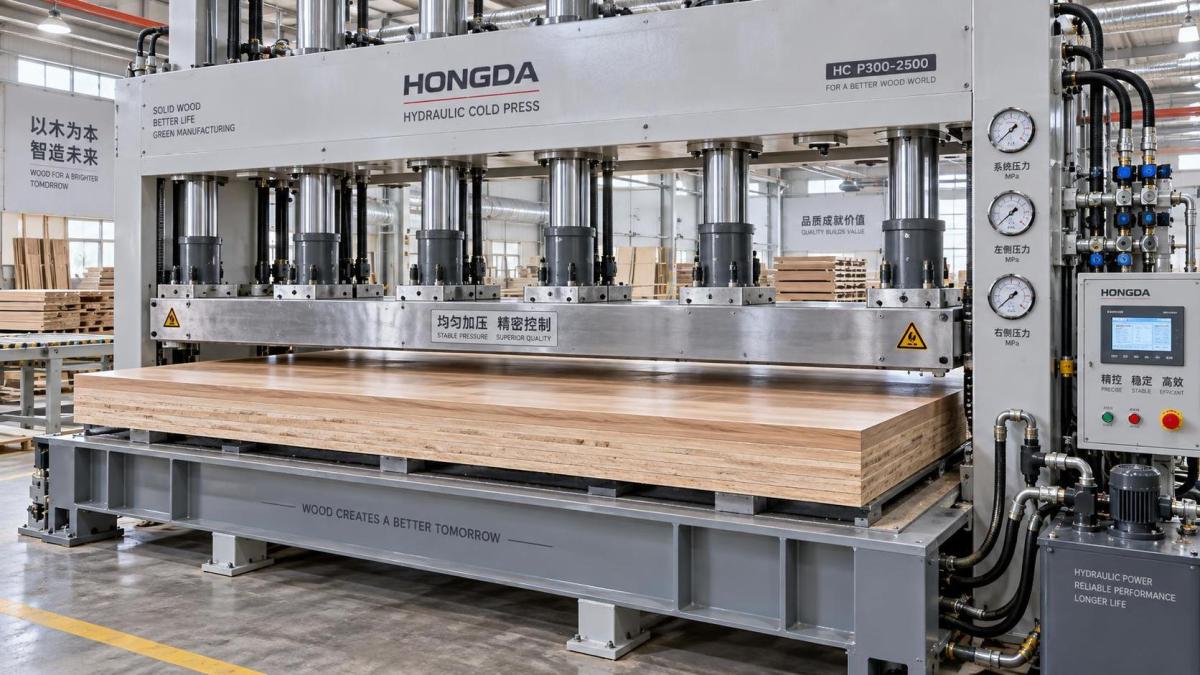
Hydraulic cylinders can apply high force within a compact machine layout. More importantly, a properly designed hydraulic circuit can supply balanced pressure to multiple cylinders, helping the platen or clamping beam engage the work evenly. This is particularly useful where variations in stock thickness would otherwise leave gaps or concentrate loading at the highest points.
2. Hardwoods, engineered boards, and demanding glue lines
Material type changes the clamping requirement. Dense hardwoods may need higher and more consistent pressure than softer woods to bring joint surfaces fully into contact. At the same time, engineered materials such as MDF, particleboard, plywood, and laminated boards can be damaged by excessive localized loading. Their surface layers, cores, veneers, or decorative films may react differently under pressure.
A hydraulic system with adjustable pressure allows the plant to set a repeatable clamping recipe for each material family. That does not eliminate the need for correct adhesive selection, moisture control, machining accuracy, and assembly fit. It does make the pressure portion of the process less dependent on instinct. Where multiple substrates run on the same line, this adjustability is often the point at which hydraulic control pays for itself.
3. Repetitive production with limited tolerance for variation
In a small workshop, an occasional defective glue-up may be noticed and corrected before shipment. In a production line making hundreds of similar cabinet doors, laminated frames, or furniture panels, variation travels quickly. A press setting that is slightly wrong can create a day’s worth of joints that look acceptable at first but later show gaps, spring-back, telegraphing, or distortion.
Hydraulic Woodworking Clamping Equipment is well suited to repeatable work because pressure can be set, monitored, and retained from cycle to cycle. When combined with controlled closing speed and a defined holding period, it provides a more stable process window. This reduces the temptation to compensate for uncertain force by simply increasing pressure—a common practice that can create its own defects.
4. Assemblies with fragile faces or complex geometry
High force alone is not a sign of good clamping. A veneered door, a profiled frame, a curved component, or a panel with delicate edge banding may require firm but carefully limited pressure. Too much load can leave clamp marks, crush soft cores, distort rails and stiles, or force adhesive out of a joint that needs a controlled glue line.
Hydraulic regulation is valuable here because it permits pressure to be tuned rather than treated as an all-or-nothing action. The evaluator should look beyond nominal tonnage and ask whether the machine allows practical adjustment by zone, whether pressure remains stable during dwell, and whether the contact tooling supports the component without concentrating load on vulnerable areas.
What hydraulic pressure control actually adds to the machine
The central benefit is not simply “more pressure.” It is the ability to convert required pressing force into a repeatable operating setting. Hydraulic systems use pressurized fluid to move cylinders. Because the fluid is comparatively incompressible, the system can deliver controlled force with less spring-like behavior than compressed air. In a clamping frame, cold press, laminating press, door press, or assembly press, that force can be applied through one cylinder or through a coordinated group of cylinders.
For technical review, it helps to separate four elements that are often discussed together but should be evaluated individually:
- Available force: Can the press generate enough load for the largest workpiece, material, and bonding method planned?
- Pressure regulation: Can operators set a lower or higher pressure accurately and repeatably for different jobs?
- Pressure distribution: Does the frame, platen, beam, and cylinder arrangement spread force across the work instead of loading only a few areas?
- Cycle behavior: Does the equipment close smoothly, hold pressure for the required dwell period, and release without damaging or shifting the assembly?
These points are interconnected. A press with impressive rated force may still be unsuitable if its platens are not rigid enough for the panel size, if hydraulic pressure is not easily adjustable, or if the fixture arrangement allows workpieces to move during closing. Conversely, a moderate-capacity hydraulic clamp can be the better choice when it matches the actual work envelope and offers reliable control.
A force calculation is a starting point, not a purchase decision
Evaluators commonly begin with pressure requirements expressed per unit area, then calculate total force based on the effective bonded area. This is a sensible first step, but it should not be mistaken for a final machine specification. The working area is not always equal to the full platen area. A frame assembly contacts the press differently from a solid panel; a curved component may require dedicated cauls; and a workpiece with uneven geometry may need separate pressure zones.
Also consider how the force is transferred. Hydraulic pressure inside a cylinder, cylinder area, mechanical leverage, cylinder spacing, and platen stiffness all influence the actual load reaching the workpiece. A supplier should be able to discuss these relationships clearly rather than relying only on a broad “tonnage” label.
The safest approach is to define representative production conditions: the largest and smallest parts, material species or board types, joint design, adhesive system, expected daily throughput, and permissible surface marking. A clamping solution should be assessed against those conditions, including the least forgiving component—not only the easiest one.
Signs that pneumatics or manual clamping may still be the better fit
Hydraulics are not automatically the right answer. A technical team can avoid unnecessary cost and complexity by recognizing situations where simpler equipment remains appropriate. If parts are small, glue area is limited, cycle volume is modest, and assemblies vary too widely for a fixed press fixture, manual or pneumatic clamps may provide better flexibility. They are also easier to reposition for one-off jobs and may be more practical in a workshop where floor space changes frequently.
Pneumatic equipment can be effective for light-duty holding, positioning, small frame assembly, and rapid handling operations. Its speed is attractive where the clamp’s role is to secure a part during machining or joining rather than to create a high-quality structural glue bond across a large area.
The decision changes when operators begin adding extra clamps “just in case,” when panel flatness becomes unpredictable, or when quality staff see recurring variation between shifts. Those are not always glue problems. They can be evidence that clamping force is no longer under adequate process control.
Questions to ask before specifying a hydraulic press or clamp system
A productive equipment review goes deeper than capacity, dimensions, and price. The following questions help reveal whether hydraulic pressure control will support real production conditions:
- What are the maximum workpiece dimensions, thickness range, and expected product mix?
- Which materials will be pressed, and how sensitive are their faces, veneers, or cores to compression?
- Is uniform pressure needed across a full panel, or only at defined joint locations?
- Can pressure be adjusted without difficult manual intervention, and can settings be documented for repeat jobs?
- How are cylinders arranged, and are independent zones needed for uneven or multi-part assemblies?
- What prevents platen deflection, workpiece shifting, and localized pressure peaks?
- Does the closing speed allow safe alignment before full force is applied?
- How will hydraulic oil, seals, hoses, valves, and filters be inspected and maintained?
- Can the supplier provide technical guidance on matching the machine, tooling, and process conditions?
Maintenance deserves attention during selection, not after installation. Hydraulic systems require clean oil, correct fluid levels, sound seals, and periodic inspection for leaks or pressure loss. These are manageable responsibilities, but they should be included in the plant’s maintenance plan. A well-designed system with accessible components and available spare parts is far easier to keep stable than a machine whose service points are difficult to reach.
Do not use pressure to compensate for poor preparation
One of the most costly misconceptions in woodworking is that more clamping pressure can cure poor machining or a poorly fitting joint. It cannot. If mating surfaces are inaccurate, stock moisture varies excessively, adhesive spread is inconsistent, or parts are warped before pressing, additional force may hide the issue temporarily while introducing new stress into the assembly.
Hydraulic control is most effective when it supports a disciplined upstream process. Parts should enter the press with consistent dimensions, correct adhesive application, appropriate open time, and fixtures that locate them accurately. In this environment, pressure control becomes a reliable finishing stage in the bonding sequence rather than an emergency correction tool.
Selecting a partner for the complete clamping application
For factories expanding furniture or panel output, the best evaluation is rarely limited to the press itself. It includes loading and unloading flow, fixture needs, operator access, safety arrangements, downstream machining, and service support over the machine’s working life. Qingdao Zhongding Machinery Co., Ltd. approaches woodworking machinery with this broader production perspective, drawing on more than two decades of experience serving workshops and industrial manufacturers.
When reviewing hydraulic Woodworking Clamping Equipment, technical teams benefit from discussing the actual component and process rather than selecting from a generic capacity range. The intended product, material behavior, required output, and acceptable defect risk should guide the configuration. With suitable pressure control, a robust structure, and practical technical support, clamping becomes less of a variable to manage manually and more of a stable part of the manufacturing system.
The clearest answer is therefore simple: hydraulic pressure control is needed when consistency matters as much as force. If a woodworking operation requires repeatable bonding pressure across varied materials, larger surfaces, sensitive finishes, or continuous production cycles, hydraulic clamping provides the control needed to make sound selection decisions—and to protect the quality built into every panel, frame, and finished piece.
Send Your Inquiry
We welcome your cooperation and we will develop with you.