


News & Exhibitions
Latest Factory Updates, Industry Trends & Global Exhibition Information
When a CNC door lock milling machine improves door hardware accuracy
For technical evaluators, a CNC Door Lock Milling Machine becomes a serious consideration when door hardware accuracy, repeatability, and throughput need to improve at the same time. The question is rarely whether CNC machining is more precise in theory. The real question is whether the existing process has reached the point where manual routing, separate drilling stations, and operator-dependent setup are creating measurable production risk.
In a door manufacturing environment, a lock case that sits a little too deep, a handle bore that drifts off center, or a backset position that varies from door to door can lead to more than rework. It can interrupt assembly, complicate hardware installation, trigger quality disputes, and weaken confidence in the finished product. These issues become especially visible on flush doors, painted doors, laminated door blanks, and high-volume interior door programs where visual consistency matters as much as functional fit.
A CNC-based lock milling solution is not automatically the right answer for every workshop. For low-volume custom work, skilled manual machining may remain practical. But once product repetition, specification diversity, labor consistency, or hardware complexity begins to strain the process, CNC lock milling can change how a factory controls quality.
The moment accuracy becomes a production-system issue
Many factories first notice a machining problem at final assembly rather than at the milling station. A lock body does not enter the pocket smoothly. A handle spindle binds. The strike alignment requires adjustment. Operators may solve each issue individually, but the accumulated cost appears later: rejected doors, added fitting time, hardware damage, or a production line waiting for corrections.
Manual lock routing depends on several variables working together: template condition, clamp position, tool sharpness, operator technique, measuring discipline, and the consistency of the door blank itself. A capable operator can achieve excellent work. The difficulty is maintaining that result across shifts, product variants, and hundreds of doors.
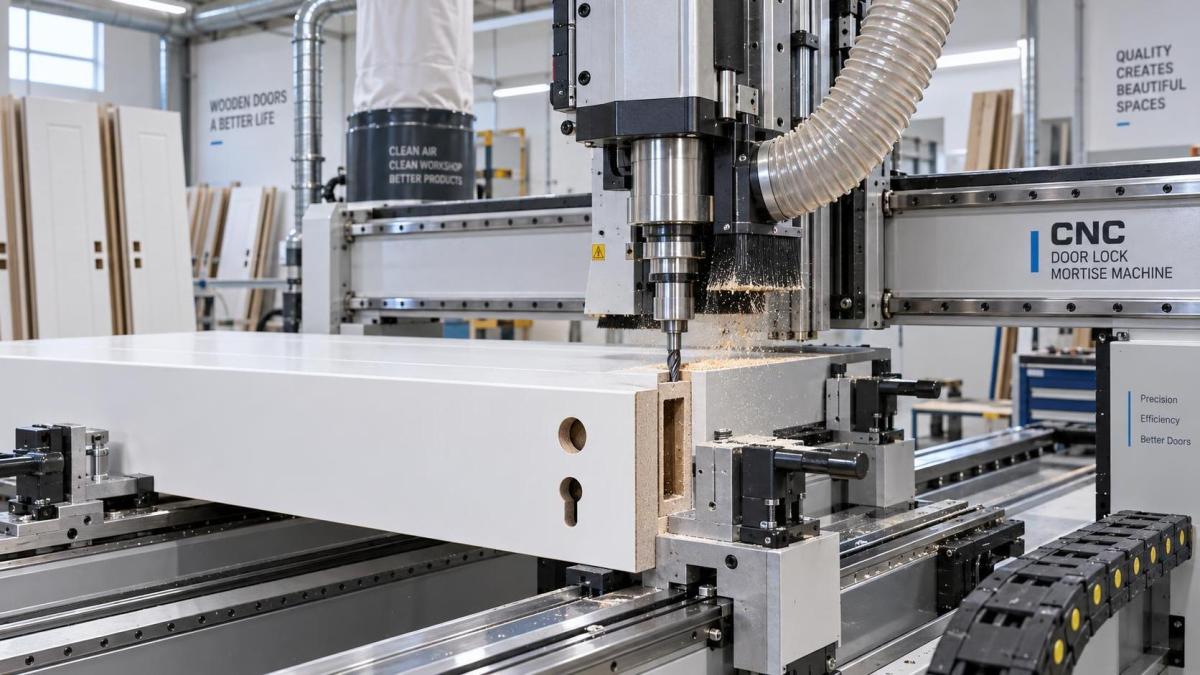
A CNC Door Lock Milling Machine is most valuable when the factory no longer wants quality to depend primarily on individual judgment at each cycle. By using programmed coordinates, controlled tooling paths, and repeatable clamping references, the machine turns a sensitive fitting operation into a more stable manufacturing process.
This shift matters most when the door and the hardware must behave as one system. The lock pocket, cylinder hole, handle hole, latch preparation, edge machining, and related drilling operations all need to relate accurately to common datums. Treating them as isolated manual tasks often introduces small positional differences that are difficult to see until installation.
Where CNC lock milling changes the outcome
The strongest application case is not simply “higher speed.” It is the ability to hold critical hardware relationships more consistently while simplifying production flow. Depending on the machine configuration and door design, a CNC machining center for door locks may be used for lock-body mortising, handle and cylinder drilling, edge bores, latch preparation, hinge-related operations, and other defined hardware patterns.
For evaluators, the important distinction is between nominal dimensions and assembled function. A pocket can measure correctly in isolation and still cause trouble if its depth, centerline, or relation to the face drilling is wrong. CNC programming helps maintain those relationships from one process to the next.
- Lock pocket position: The mortise is located against defined door references rather than estimated from a template or marked line.
- Depth control: Consistent Z-axis control reduces the risk of shallow pockets that obstruct installation or overly deep pockets that weaken the edge section.
- Face-to-edge alignment: Handle, cylinder, and lock case features can be coordinated from one program and one workholding strategy.
- Repeatable hardware patterns: Frequently used lock models and door configurations can be stored as programs, minimizing repeated layout work.
- Controlled changeover: New door heights, lock centers, and hardware specifications can be introduced through verified parameters rather than improvised adjustments.
These capabilities are particularly relevant when a factory supplies projects with strict door schedules. Hotels, apartments, schools, hospitals, office buildings, and standardized furniture or partition systems often require numerous doors with matching hardware locations. In such work, a single recurring error can be replicated many times. CNC machining does not eliminate the need for inspection, but it reduces the likelihood of reproducing an uncontrolled error at scale.
Not every accuracy problem is caused by the machine
Before specifying a CNC Door Lock Milling Machine, it is worth separating machining problems from upstream variation. If door blanks have inconsistent width, thickness, squareness, or edge quality, even a well-programmed machine may produce results that appear inconsistent. The machine references what it is given. A sound evaluation therefore begins with the full process, not only the CNC specification sheet.
Technical teams should look closely at the reference strategy. Does the door locate from the hinge edge, lock edge, face, bottom, or a combination of surfaces? Is the datum aligned with the dimensions used on the drawing and hardware schedule? Can the clamping system hold warped or slightly bowed doors without damaging decorative surfaces? These questions often matter more than headline spindle power.
Door construction also changes the evaluation. Solid timber, MDF, particleboard-core doors, plywood doors, veneer-faced products, laminated surfaces, and composite fire-rated assemblies can respond differently to routing and drilling. Tool selection, feed settings, dust extraction, and workpiece support all influence edge cleanliness and dimensional stability. A CNC system should be evaluated as part of a material-specific process plan.
A practical threshold: when manual routing starts costing more than it appears
Manual equipment can look economical because the initial investment is lower and the process is familiar. Yet the visible labor time is only part of the calculation. Technical evaluators should include setup time, measuring time, template maintenance, tool changes, training requirements, correction work, internal movement, inspection effort, and the cost of doors that cannot be repaired invisibly.
The following operating conditions usually indicate that CNC lock milling deserves closer review:
- Lock, handle, or cylinder positions vary between operators or shifts.
- The plant processes multiple hardware brands, lock case sizes, or backset requirements.
- Door volume is growing, but experienced routing labor is difficult to retain.
- Hardware fitting creates a bottleneck before finishing, packaging, or site delivery.
- Rework is not always recorded, yet assembly teams regularly make adjustments.
- Project specifications demand consistent dimensions across large batches.
- The business wants to reduce layout work for repeat orders without sacrificing flexibility for special doors.
A machine is especially compelling when these conditions appear together. A workshop making a small number of highly varied bespoke doors may prioritize flexibility and manual craftsmanship. A producer manufacturing recurring door types with scheduled hardware is more likely to gain from stored programs, defined positioning, and predictable cycle planning.
Evaluating the machine through the hardware schedule
A productive evaluation does not begin with the question, “Which CNC machine has the most features?” Start with the actual door and hardware schedule. Collect representative drawings and list the lock cases, handle sets, cylinder arrangements, latch types, door sizes, handedness requirements, and edge conditions that occur most often.
Then identify which operations must be completed in one clamping cycle and which can reasonably remain separate. Fewer handling steps can improve positional consistency, but only if the machine supports the required tooling, access angles, and workpiece orientation. A compact system may suit standardized interior doors very well, while a more configurable solution may be necessary for diverse door designs or integrated machining cells.
When reviewing a proposed CNC door lock machining process, consider these technical checkpoints:
Program management and parameter control
Programs should be easy to identify by door type and hardware specification, with clear control over variables such as lock center height, backset, door thickness, handing, and drilling pattern. The goal is not to give every operator unrestricted editing authority. It is to make approved changes traceable and routine changes simple without risking the core geometry.
Workholding and surface protection
Clamping must resist movement during routing while protecting finished or delicate faces. This is critical for painted, veneered, laminated, or pre-finished doors. Ask how the machine accommodates different widths and thicknesses, whether support is adequate for heavy doors, and how operators verify that the blank has seated correctly against the references.
Tooling access and chip evacuation
Deep lock pockets generate chips that can affect finish quality and cutting stability if extraction is poor. Tool access must suit the required pocket dimensions and drilling directions. The right cutter geometry, spindle speed, feed rate, and extraction capacity will vary by material. A CNC system delivers its best result when machining parameters are developed for the actual door construction rather than copied from a generic setting.
Safety, ergonomics, and loading flow
Door panels are large, awkward workpieces. The loading method, support height, operator reach, and unloading path influence both safety and realistic cycle time. A technically capable machine can still become an inefficient station if surrounding material flow is poorly planned.
Accuracy should be verified in assembled form
It is tempting to approve a machine after measuring a clean sample pocket. That is useful, but incomplete. A more meaningful acceptance process includes fitting the intended lock body, spindle, cylinder, handle set, and any associated hardware. The door should be checked for smooth operation, hardware seating, face alignment, edge appearance, and repeatability across several pieces.
Evaluators should also inspect the first-off procedure after a program change. Can the operator run a safe verification cycle? Is there a clear method for checking tool length, locating a new door blank, and confirming the handedness of the machining pattern? Many preventable mistakes occur not during stable production, but during changeover and setup.
Another useful practice is to inspect samples from different points in a shift. This reveals whether tool wear, chip buildup, thermal changes, or operator handling affect the result. The objective is not merely to demonstrate that the CNC machine can cut accurately once; it is to confirm that the process can remain stable under normal operating conditions.
Integrating CNC milling without disrupting the door line
Adopting a CNC Door Lock Milling Machine does not require rebuilding an entire factory, but it does require thoughtful integration. Door blanks need a predictable route to the machine. Hardware data must reach programming in a controlled form. Finished parts need identification so that the correct lock set is paired with the correct door.
In many operations, the best starting point is a focused cell that handles the most repetitive and quality-sensitive hardware operations. Once programs, tools, inspection routines, and operator training are established, the same approach can be expanded to additional door families. This staged approach often produces clearer feedback than attempting to automate every door type on day one.
Reliable support also matters after commissioning. Woodworking machinery is not only a capital asset; it is part of an operating process that depends on maintenance, spare parts, technical guidance, and timely troubleshooting. Qingdao Zhongding Machinery Co., Ltd., with more than two decades of experience in woodworking machinery manufacturing and export, approaches equipment selection with this longer operating life in mind. For door manufacturers, the value of a machine is closely tied to how confidently it can be maintained, adjusted, and supported as production requirements evolve.
The decision is really about controlled repeatability
A CNC lock milling solution is justified when door hardware preparation needs to become less dependent on memory, manual marking, and individual routing technique. It gives manufacturers a way to convert approved door-and-hardware specifications into repeatable machining instructions, while retaining the flexibility to manage different models and project requirements.
For technical evaluators, the most useful conclusion is straightforward: assess the machine against the defects, changeovers, materials, and hardware schedules that the factory handles every week. If inaccurate lock fitting is creating hidden labor, unreliable assembly, or inconsistent finished doors, a CNC Door Lock Milling Machine can be more than a faster routing station. It can become the control point that brings door machining, hardware installation, and final quality into closer alignment.
Send Your Inquiry
We welcome your cooperation and we will develop with you.