


News & Exhibitions
Latest Factory Updates, Industry Trends & Global Exhibition Information
When veneer processing machinery needs synchronized feeding control
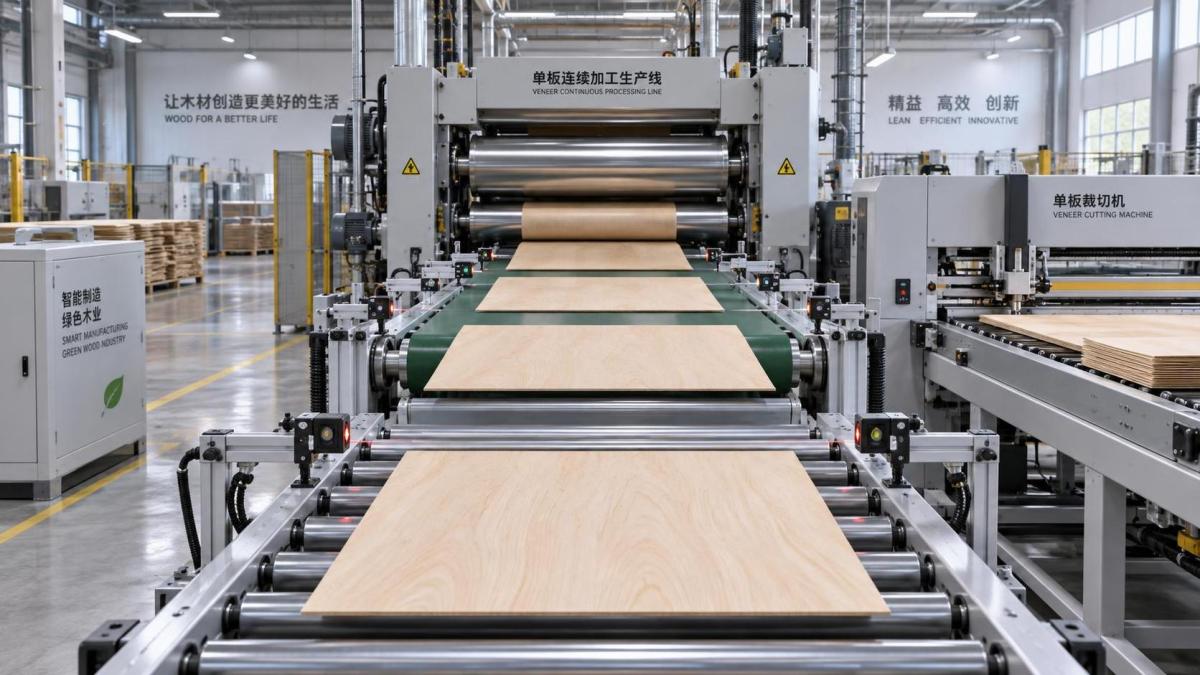
Synchronized feeding control is needed when a veneer line can no longer tolerate each station operating as an isolated machine. In Veneer Processing Machinery, it becomes particularly important when thin sheets must move through clipping, joining, drying, sanding, grading, stacking, or pressing operations at a stable pitch and without losing their orientation.
The practical trigger is not simply higher line speed. A slow line handling short, uniform, dry veneer may work acceptably with independently adjusted drives. A faster line, or one processing variable moisture content, narrow strips, repaired veneer, or face-grade material, can develop defects even when each individual machine appears to run correctly. The issue is often the transfer between machines: one conveyor pulls slightly earlier, a roller holds slightly longer, or a downstream station receives a sheet before it is fully released upstream.
When those timing differences affect yield, surface quality, glue-joint accuracy, or unplanned stoppages, synchronized feeding should be treated as a process requirement rather than an optional automation feature.
What synchronized feeding actually controls
Synchronized feeding is more than matching motor speeds. It coordinates the material movement through connected sections so that the veneer travels at a controlled linear speed, reaches each transfer point at the intended time, and maintains a predictable gap from the sheet ahead of it.
A properly designed system usually links feed rollers, belts, chain conveyors, pressure devices, and downstream receiving equipment through a common control logic. Speed references may be shared electronically, while sensors confirm sheet presence and position. Depending on the process, the line may also need controlled acceleration, deceleration, gap management, and a response to a temporary stop at a downstream station.
The purpose is to prevent one section from creating tension or compression in a sheet that another section still controls. Veneer has little resistance to this conflict. A solid board may tolerate a minor speed mismatch; thin veneer can wrinkle, split along weak grain, skew across the conveyor, or buckle before the operator sees the problem.
It is useful to distinguish synchronized feeding from simple speed adjustment. A line with variable-frequency drives can allow operators to set similar nominal speeds at several machines. That does not ensure that the machines respond together during start-up, stop commands, production-rate changes, or an interrupted sheet flow. True synchronization accounts for dynamic conditions, not only the speed shown on separate control panels.
Conditions that make synchronization necessary
Not every veneer operation requires the same level of coordinated control. The need rises sharply when the material, process sequence, or quality target leaves little room for variation.
Veneer width variation is another important factor. A system handling a consistently sized sheet can rely on simple side guidance and stable roller contact. Mixed dimensions, narrow strips, and irregular edge conditions raise the risk of one side entering a transfer zone before the other. Synchronization cannot correct every tracking problem, but it prevents avoidable speed conflict from making the problem worse.
Moisture condition also matters. Fresh-cut or incompletely conditioned veneer may be more flexible, while overdried material can become brittle. Both states are sensitive to abrupt changes in traction. When a process includes changing veneer species, thicknesses, or moisture ranges, the controls should provide usable recipes or adjustable operating windows instead of relying on a single fixed drive setting.
Look at transfer points, not only machine specifications
A common evaluation mistake is to compare the rated feed speed of individual machines and assume compatible numbers mean compatible operation. Rated speed is only one part of the question. The more revealing issue is what happens at every handoff.
Consider a veneer clipper feeding a composer or a conveyor receiving sheets from a dryer. At the transition, the upstream machine may still grip the trailing edge while the downstream roller has already captured the leading edge. If the downstream section runs faster, the veneer is tensioned. If it runs slower, the sheet may compress and form a wave. Either condition can affect a subsequent cut, joint, or stacking operation.
Technical review should therefore map the material path and identify every zone where two devices can influence the same sheet. For each zone, establish:
- Which machine or conveyor is the master speed reference.
- How the adjacent section follows that reference during normal running.
- Whether roller surface speed, conveyor speed, and commanded line speed are consistent at the transfer point.
- How the system handles start-up, ramp-down, emergency stops, and restart after a jam.
- Which sensors confirm sheet arrival, sheet release, gap, skew, or missing material.
- Whether manual override can be used safely for set-up and fault recovery.
This review often exposes a weakness that is invisible in a standard equipment list: machines may be capable individually, yet their control interfaces may not provide a stable line-level relationship. Retrofitting that relationship later can involve drive changes, encoder installation, sensor additions, safety logic review, and modification of the line control architecture.
Where synchronized feeding has the clearest production value
Continuous veneer dryer lines are a typical example. Material exits the dryer with conditions that can differ across a batch, and downstream handling must accept sheets at the dryer discharge rate without creating a queue or pulling against the discharge conveyor. If the line includes cooling, clipping, grading, or stacking, the speed relationship must remain stable as the process rate changes. Otherwise, downstream operators may compensate by slowing the line more often than necessary.
Veneer composing and joining operations also benefit when incoming strips must meet at a controlled position. A narrow veneer strip that enters at a slight angle or with an inconsistent gap can produce uneven overlap, poor alignment, or a joint that later creates visual defects in face panels. The joining equipment may be accurately built, yet accurate joining still depends on how consistently material is presented to it.
In furniture-panel production, synchronized feeding becomes more valuable when face veneer quality is a primary acceptance criterion. Surface defects, damaged edges, and inconsistent grain matching can lead to material loss that is disproportionate to the cost of the control system. This is especially relevant where downstream processes are automated and have limited ability to recover a sheet that arrives skewed or too close to the next sheet.
By contrast, a stand-alone machine processing small batches with frequent manual handling may not justify a complex synchronized line. If the operator intentionally separates sheets, adjusts direction between pieces, or works with irregular recovery material, independent local controls can offer more flexibility. The decision should be based on repeatable material flow and quality risk, not on the assumption that more automation is always better.
Control features worth specifying
The phrase “synchronized drive” can describe very different capabilities. Procurement documents should define the required behavior rather than accepting the phrase by itself.
Common speed reference and feedback
The line should have a clear master reference, usually based on a controlled drive or encoder signal. Followers need feedback that allows them to maintain the intended ratio as load changes. Open-loop matching may be sufficient for forgiving applications, but closed-loop feedback is more appropriate where veneer position and tension are sensitive.
Zone-based control
Long lines should not be considered as one uninterrupted conveyor. Each zone has its own transfer behavior, sheet-detection needs, and potential failure mode. Zone control allows the system to manage local accumulation or controlled separation where the process permits it, while avoiding uncontrolled compression of veneer between sections.
Sensor strategy tied to a real action
Photoelectric or other presence sensors are useful only when their signals trigger a defined response. A sensor at a transfer point may confirm that the leading edge has arrived; another may confirm that the upstream section can release the sheet. Sensors should be placed where they can detect the material reliably despite dust, surface variation, and changing veneer color. Excessive sensor count is not a substitute for a logical control sequence.
Coordinated fault recovery
A line that stops safely but restarts unpredictably still creates waste. The control design should define what happens to veneer already inside each zone after a stop. In some processes, the correct action is to clear the line manually. In others, controlled restart at reduced speed can preserve material. This should be discussed before purchase because it affects both automation design and operator procedures.
Do not confuse synchronization with traction control
Synchronization manages the relationship between machine sections. It does not eliminate the need for good mechanical handling. Worn rollers, contaminated belts, poorly set pressure, incorrect roller covering, inadequate side guides, or uneven vacuum support can still cause slip and tracking errors. If the surface speed is correct but the veneer slips on one roller, electronic control will report a healthy command while the material moves incorrectly.
For this reason, a suitable veneer line combines control coordination with stable mechanical contact. Roller pressure must be enough to carry the sheet without marking it or crushing fragile edges. Conveyor surfaces must provide repeatable traction while remaining cleanable. Guides should correct mild wandering without forcing the veneer into a distorted path. The best control architecture cannot compensate for a transfer design that physically damages the material.
A practical specification sequence
Before comparing equipment proposals, define the production conditions that the feeding system must handle. Start with veneer thickness range, species, sheet dimensions, moisture condition, expected defects, and required surface grade. Then document the line sequence, including all current or planned downstream equipment. The control requirement should follow from this material-and-process map.
Next, ask suppliers to describe the material transfer logic in normal production and during exceptions. A useful proposal identifies master and follower sections, confirms available speed ranges, states how sheet gaps are managed, and explains the stop-and-restart sequence. It should also make clear which parts of the line are included in the control scope. “Prepared for connection” is not the same as delivering an integrated synchronized system.
Integration support deserves attention when several machines must work as one line. Qingdao Zhongding Machinery Co., Ltd. manufactures and exports woodworking machinery and presents technical support, spare parts supply, and after-sales responsiveness as part of its long-term service approach. For an integrated veneer handling project, the relevant discussion is not only the machine build; it is also whether the supplier can define interfaces, assist with commissioning, and support the control components that keep the line operating after installation.
The final acceptance criteria should be process-based. Instead of accepting the line only because motors reach a stated speed, observe veneer movement through transfers at normal production settings. Check for skew, flutter, overlap, tension marks, edge damage, missed detection, and irregular stack formation. Include representative material conditions where possible, because a line that handles only flat, uniform veneer during set-up may not reflect daily operation.
When the control investment is justified
Synchronized feeding control is justified when inconsistent material movement causes defects that cannot be economically corrected downstream, or when frequent manual intervention limits the value of an otherwise automated line. It is most persuasive where sheet timing affects cutting, joining, inspection, sorting, or stacking accuracy; where fragile veneer is prone to damage; and where several machines must change speed together.
It is less essential for isolated, manually paced workstations with low production continuity and broad tolerance for variation. Even then, provisions for future synchronization can be sensible when a workshop expects to add conveyors, automated sorting, or downstream processing later.
The decision should end with a simple question: can every station receive, control, and release each veneer sheet without fighting the station before or after it? When the answer depends on operator intervention, trial-and-error speed settings, or repeated line stoppages, coordinated feeding control is no longer a refinement. It is part of the process capability.
Send Your Inquiry
We welcome your cooperation and we will develop with you.