


News & Exhibitions
Latest Factory Updates, Industry Trends & Global Exhibition Information
What causes springback after hot pressing bent plywood?
Springback after hot pressing bent plywood occurs because the veneers still contain elastic bending stresses when the mold releases them. The bonded layers resist that recovery, but they do not necessarily eliminate it. Excessive springback develops when the layup stores too much stress, the adhesive has not developed enough strength at release, or moisture and temperature changes move the panel after pressing.
The most useful troubleshooting distinction is when the shape changes. A curve that opens immediately points toward elastic recovery, bond-line movement, or inadequate restraint during setting. A panel that changes over the following hours requires closer attention to cooling, moisture redistribution, and adhesive strength development. Increasing pressure or extending the cycle without making this distinction can leave the actual cause unresolved.
Separate springback from warping and bond failure
True springback is movement back toward the veneers’ original, flatter shape. For a simple curved panel, the radius increases after release. Twisting, cupping across the width, or one edge lifting more than the other indicates an additional imbalance in the layup, moisture distribution, heating, or tooling contact.
Delamination is a different defect, although it can occur alongside springback. Visible gaps, blisters, or separation between veneers indicate that the bond has failed locally. A panel can also lose curvature through movement in a weak bond line without showing an obvious open gap. Shape inspection alone therefore cannot confirm adequate bonding.
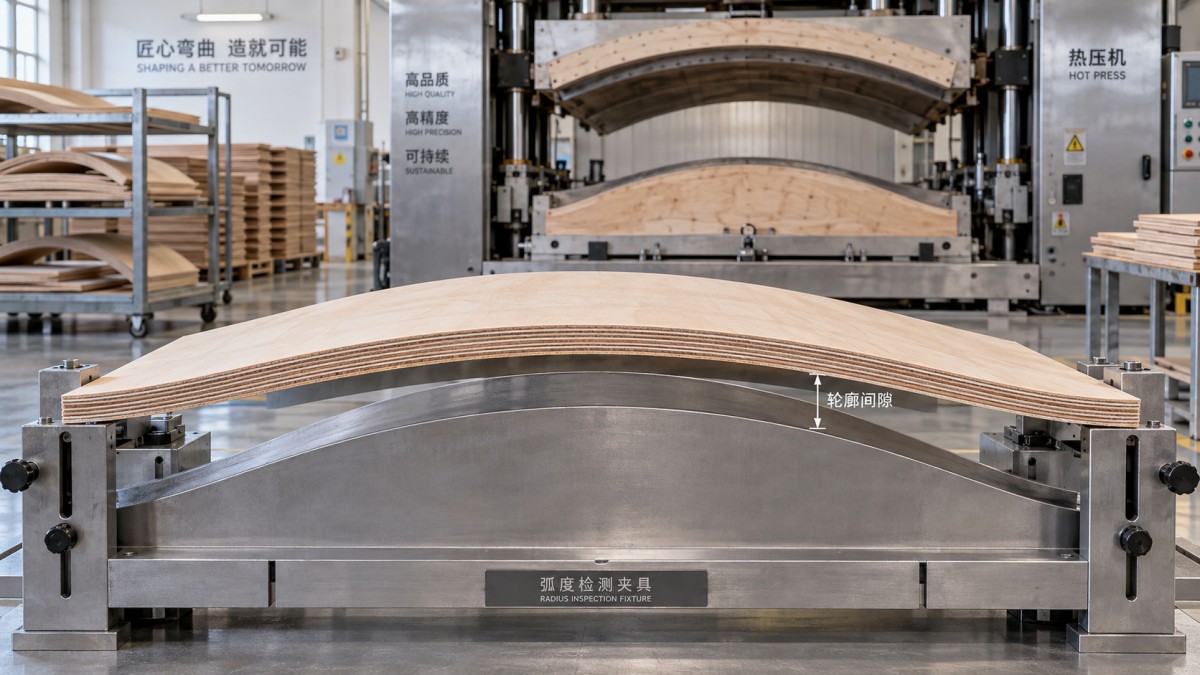
Record the curve at consistent stages: shortly after safe removal, after cooling, and after a defined conditioning period. Use the same supports, measuring locations, and panel orientation each time. A flexible part can change shape under its own weight, making inconsistent measurement look like process variation.
For a simple arc, a fixed-span checking fixture can track the rise at the center. Reduced rise over the same span indicates a flatter curve. For complex parts, use defined reference points or a checking template rather than judging the profile by eye.
The veneers retain a tendency to straighten
Inside the mold, the outside of a bend is stretched while the inside is compressed. Heat and moisture make wood easier to deform, but hot pressing does not automatically remove all of these stresses. Once the mold opens, the veneers try to recover, while the adhesive and laminated structure resist that movement.
Individual veneer thickness matters, not just finished panel thickness. For a given bend radius, thicker veneers experience greater bending strain through their thickness. Replacing several thin veneers with fewer thick ones can therefore change springback even when the finished panel dimensions remain similar. Tighter radii further increase the forming demand and can introduce cracking or compression damage.
Check whether a springback problem began after a change in veneer thickness, species, supplier, or grain quality. Density, stiffness, grain deviation, and defects affect forming behavior. A press recipe qualified for one veneer specification should not be assumed suitable for another.
The layup also determines how these stresses balance. Grain direction changes bending stiffness, and an unbalanced arrangement can couple springback with twist. Where the part design permits, symmetry about the panel’s mid-plane helps reduce imbalance. Decorative faces, crossbands, and structural layers should follow the approved construction rather than being rearranged to make loading easier.
If a soundly bonded panel repeatedly opens by a similar amount, the issue may be the expected recovery of that particular construction—not an unstable press. That distinction matters before changing a previously reliable adhesive or machine setting.
Moisture affects both forming and dimensional stability
Veneer moisture influences flexibility, heat transfer, adhesive behavior, and movement after pressing. Very dry veneers can resist tight forming and develop damage. Excess moisture can complicate curing, increase vapor pressure, and leave the panel vulnerable to dimensional change as it dries.
Uniformity is as important as the average reading. A stack containing dry face veneers and wetter inner layers can have an acceptable average while still behaving unevenly. Differences between the two faces, or between areas of the same sheet, create unequal shrinkage and stress.
Measure representative veneers before glue spreading, including material from different positions within stored stacks. Use a method suitable for thin veneer, with the appropriate species and temperature corrections. Meter readings on thin sheets can be influenced by the material underneath, so keep the measurement procedure consistent and verify questionable results with an appropriate reference method.
Do not adopt a universal moisture target from an unrelated plywood process. The acceptable range depends on the wood, adhesive, panel construction, and qualified pressing schedule. Water introduced by the adhesive also matters, particularly when spread rate changes.
Delayed movement provides a useful clue. If the curve is stable after cooling but changes during storage, compare the storage conditions with the panel’s moisture condition. Unequal exposure of the two faces—for example, one face against a surface and the other exposed to moving air—can produce distortion that is mistaken for purely mechanical springback.
Platen temperature does not prove that the glue lines have cured
On a hot wood press for bent plywood, the displayed temperature describes the sensor location, not necessarily the coldest glue line. Heat must travel through the tooling and veneer assembly. Panel thickness, initial material temperature, mold construction, and contact quality all influence how quickly internal layers reach the conditions required for curing.
A panel can therefore have hot outer surfaces while its inner bonds remain insufficiently cured. If restraint is removed at that point, stored bending stresses can move the layers before the adhesive develops adequate resistance.
Where internal temperature needs checking, use a properly positioned sensor in a controlled trial or sacrificial assembly. Follow machine safety procedures and a measurement method that does not create a misleading gap in the bond line. Compare the temperature history with the adhesive supplier’s requirements; do not treat merely reaching a stated temperature as proof of a complete cure.
Adhesive preparation and application deserve the same scrutiny as heating:
- Confirm the specified resin, hardener ratio, mixing procedure, and usable pot life.
- Check spread by measurement rather than visual appearance alone.
- Keep open and closed assembly times within the adhesive’s processing limits.
- Inspect veneer surfaces for contamination, poor wetting, or excessive roughness.
- Use an appropriate bond-quality check to distinguish insufficient cure from other bonding defects.
Too little adhesive can leave incomplete coverage. Excessive spread can add water or produce a bond-line condition outside the qualified process. Longer pressing is not a dependable correction for an incorrect mix, expired adhesive, or unsuitable surface preparation.
Pressure must create contact—not simply a higher gauge reading
Pressure brings veneers and glue lines into intimate contact and holds the assembly against the intended contour. Insufficient or uneven pressure can leave areas that are poorly bonded or incompletely formed. A correct hydraulic reading, however, does not establish that every part of a curved panel receives adequate pressure.
Hydraulic system pressure is not the same as pressure at the workpiece. The relationship depends on cylinder area, machine geometry, tooling, and the effective loaded area. Curved molds introduce further variation because load direction and local contact differ across the profile.
Inspect mold fit, alignment, cleanliness, wear, and the fully closed condition. An assembly can bridge across a tight section while other areas reach firm contact. Veneer overlaps, trapped debris, or thickness variation can also concentrate load and leave neighboring areas under-compressed.
Raising pressure indiscriminately can crush wood, alter thickness, or excessively displace adhesive. Likewise, hotter settings can damage material or exceed the adhesive’s processing window. Changes should stay within the machine, mold, wood, and adhesive limits established for the application.
Release and cooling can change an otherwise sound result
A hot panel is not mechanically equivalent to a cooled panel. Wood stiffness and adhesive behavior vary with temperature, and some adhesive systems have limited resistance to sustained stress while hot. A bond may be sufficiently developed for one handling condition but not for immediate unsupported storage under the panel’s restoring forces.
If shape loss is concentrated between press opening and complete cooling, evaluate the release and handling sequence. A matching cooling fixture can help retain geometry where the process requires it. It should support the intended contour without imposing a different curve or causing uneven cooling.
Cooling under restraint is not a substitute for adequate cure. It also cannot prevent later movement caused by a large moisture change. Its value should be verified by comparing otherwise identical panels cooled with and without controlled support.
Check for unintended handling loads as well. Leaning a warm part against a wall, stacking parts that do not nest correctly, or supporting only the ends can change the profile while the assembly is still vulnerable to deformation.
Use the defect pattern to choose the next check
Springback measurements become more useful when linked to location and timing. The following patterns help narrow the investigation, but none is a diagnosis by itself.
Stabilize the process before compensating the mold
Start a controlled trial from a documented baseline: veneer specification and moisture range, layup sequence, adhesive batch and spread, assembly times, press settings, actual cycle timing, and cooling method. Measure more than one panel so that normal variation is not mistaken for improvement.
Change one relevant variable at a time. If insufficient internal heating is suspected, investigate the temperature history and cure schedule without simultaneously changing veneer construction and pressure. If moisture variation is suspected, compare conditioned material under the same qualified pressing conditions. This keeps the result interpretable.
Some repeatable springback can remain even with suitable veneers, sound bonds, and controlled processing. In that case, tooling compensation—forming to a slightly tighter curve—may be appropriate. The correction must be established for the actual layup and measured after the agreed cooling and conditioning period; it is not a universal percentage.
Compensating an unstable process only builds its variation into the tooling. The practical target is a curve that remains within tolerance after release, cooling, and conditioning, with verified bond integrity. Once those conditions are repeatable, any remaining geometric correction has a dependable basis.
Send Your Inquiry
We welcome your cooperation and we will develop with you.