


News & Exhibitions
Latest Factory Updates, Industry Trends & Global Exhibition Information
What Woodworking Machines Does a Small Joinery Workshop Actually Need?
A small joinery workshop needs reliable ways to cut components, prepare accurate faces and edges, make joints, and control wood dust. For a shop working mainly in solid timber, that usually points to a suitable saw, a surface planer and thicknesser, a router or spindle moulder, drilling equipment, and extraction. A workshop making cabinets from purchased panels needs a different starting point: accurate sheet cutting, drilling, and edge finishing take priority over timber preparation.
The sensible equipment list therefore depends on what arrives at the workshop and what leaves it. Rough-sawn hardwood for doors demands different machinery from prefinished board for fitted wardrobes. Before comparing machine menuisier listings, decide which operations you will perform in-house, which you can buy already completed, and how much work each machine will receive.
Start with the material and the work you expect to repeat
“General joinery” can cover very different production routes. A shop making occasional bespoke furniture may need flexibility more than speed. A business producing repeated door components needs consistent sections and dependable setups. An installer assembling cabinets from externally cut panels may have little immediate use for a large stationary saw.
Follow one representative job from incoming material to assembly. Record where you must establish a straight edge, produce a parallel face, cut to final size, form a joint, or finish an exposed edge. Those steps reveal the essential equipment more clearly than a catalogue package.
- Solid-timber furniture and interior joinery: prioritise stock preparation, accurate sawing, and repeatable joint cutting.
- Cabinetry from sheet materials: prioritise panel handling, clean cuts, consistent drilling, and suitable edge finishing.
- Mixed bespoke work: choose a compact core of versatile machines and outsource operations that occur too rarely to justify dedicated equipment.
Buying prepared timber or cut-and-edged panels can reduce the initial machinery requirement. However, check the tolerances, delivery times, minimum quantities, and ability to obtain replacements. Outsourcing saves workshop capacity only while the supplied components fit your assembly process.
The machines that earn their place first
A cutting system suited to the stock
Accurate cutting is essential, but a table saw is not automatically the first purchase for every shop. For solid timber, a suitable table saw provides controlled ripping and many sizing operations. A sliding-table saw can improve support and repeatability when processing panels, provided the workshop has enough room to use its travel safely.
For lower volumes of sheet work, a plunge saw with a guide rail and a stable cutting table can be a practical starting point. Its limitations become more apparent when many identical narrow parts must be produced or repeated setups consume too much time. A mitre saw is useful for crosscutting longer stock, but it does not replace equipment for ripping boards or sizing large panels.
Assess the complete cutting arrangement: support before and after the blade, fence stability, suitable guarding, extraction, and safe handling of the largest workpiece. A machine that physically fits against a wall may still be unusable with the stock you intend to process.
A surface planer and thicknesser for rough timber
If rough-sawn timber is a regular input, accurate preparation deserves early investment. A surface planer, also called a jointer, establishes a flat reference face and a straight edge. A thicknesser then brings the opposite face parallel to the reference face and produces a consistent thickness.
A thicknesser alone does not reliably straighten twisted or bowed stock. Its feed system can press a distorted board down during cutting, allowing some distortion to return afterwards. Workshops buying prepared timber may be able to delay a surface planer, but they still need a workable response when supplied material moves or falls outside the required tolerance.
Choose capacity around the parts you make repeatedly. Working width matters, but so do table length, support for long boards, adjustment accuracy, and extraction requirements. Buying extra width for a hypothetical future project can consume money and floor space without improving everyday production.
Routing or moulding equipment for joints and profiles
A handheld router, used with suitable guides and jigs, can handle many early joinery tasks. A properly equipped router table adds support and repeatability for compatible operations. These tools can cover grooves, rebates, edge profiles, and some joint work without immediately committing to a spindle moulder.
A spindle moulder becomes more attractive when repeated profiles, larger tooling, or regular production justify its setup and tooling costs. Its safe use depends on suitable guarding, workpiece control, compatible cutters, and operator competence. Power feeding can improve consistency and control on appropriate operations, but it does not make every cut suitable or safe.
For a small shop, the purchase decision should follow the recurring operation. If most jobs require straightforward grooves and occasional edge profiles, routing equipment may be sufficient. Repeated frame components or mouldings can support a stronger case for a dedicated machine.
Drilling equipment matched to the joint
A drill press is useful for controlled vertical drilling, repeatable depths, and fixtures that hold components consistently. It is a versatile addition, although some assembly work is better served by portable drills and accurate jigs.
Dedicated mortisers, hinge-boring machines, and multi-spindle drills belong on the list when the relevant joint or hole pattern recurs often enough. A cabinet workshop repeatedly drilling hinges has a different need from a furniture maker cutting occasional mortises. Avoid purchasing several specialised machines before choosing the construction methods that will support your main products.
Dust extraction from the beginning
Extraction belongs in the initial workshop plan. Planing produces substantial chips; sawing, routing, and sanding generate dust that must be captured effectively at the source. Machine performance, housekeeping, and worker exposure all depend on a system suited to the connected equipment.
Match extraction to the airflow and pressure requirements of each machine, the duct layout, and the number of machines operating together. A portable dust extractor designed for handheld tools and a chip extractor serving stationary machinery can have very different operating characteristics. Hose diameter alone does not establish compatibility.
Fine dust capture, filtration, collection capacity, and safe waste handling deserve attention before installation. Follow equipment instructions and applicable local requirements, and use competent advice where the system design demands it. Room air cleaning and respiratory protection may supplement source extraction; neither replaces it.
Check the working space before choosing separate or combination machines
A combination machine can bring several core operations into a smaller footprint. A planer-thicknesser is particularly relevant to a small solid-timber workshop because both functions form part of the same preparation sequence. Machines combining sawing, planing, and moulding can extend that space saving further.
The compromise is changeover. Moving tables, changing guards, repositioning fences, or resetting tooling takes time and may disturb an established setup. For one operator working in batches, that can be manageable. If one person needs to plane while another cuts components, shared functions can become a bottleneck.
Separate machines offer more freedom to preserve settings and organise simultaneous work. They also require more floor area, service connections, and extraction branches. Neither arrangement is inherently the better investment: the answer depends on staffing, batch size, and how often work moves between operations.
Draw the layout using actual stock lengths and panel sizes. Include loading space, infeed and outfeed zones, access for maintenance, assembly benches, and temporary storage. Trace how a board moves from the rack through preparation and cutting to the bench.
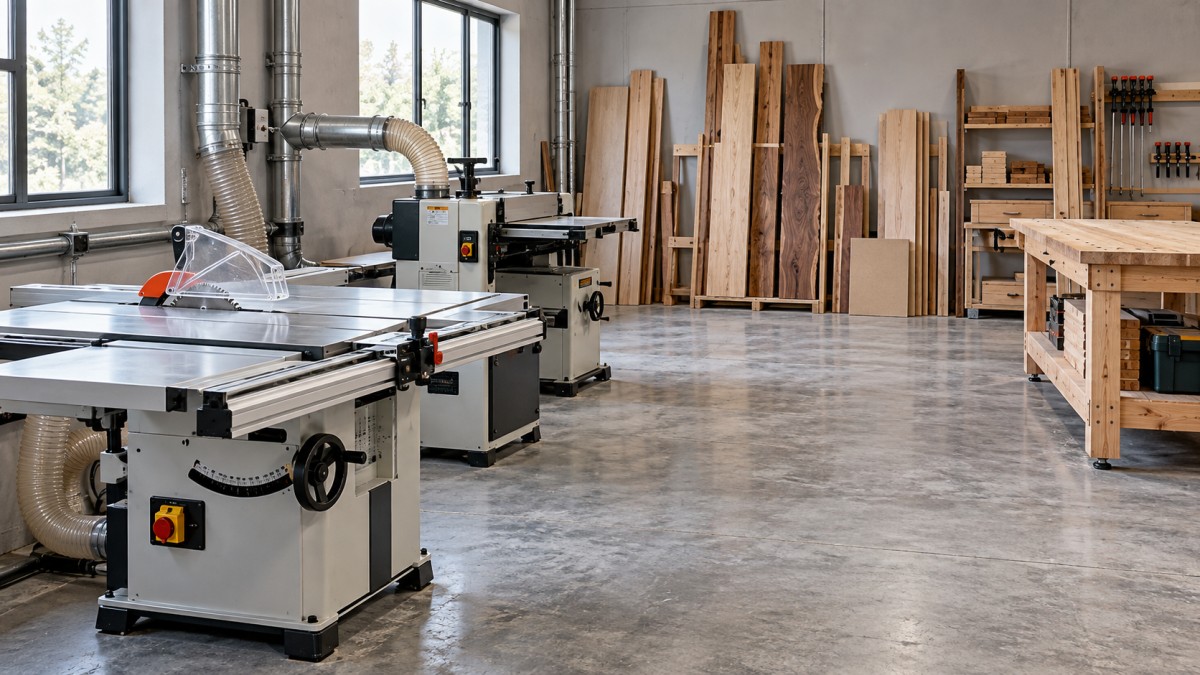
Look especially for operations that require material to cross a doorway, pass through an assembly area, or force another operator to stop. A compact machine can still demand a large working envelope. Check electrical supply, delivery access, floor suitability, and the route for removing chips before finalising the purchase.
Which purchases can wait?
A bandsaw is valuable for curved work, resawing, and certain rough-sizing tasks. It may deserve an early place in a furniture workshop using those processes regularly. For a shop mainly assembling rectangular panel cabinets, it can wait. It also does not remove the need for subsequent preparation when a straight, smooth, accurately sized surface is required.
Sanding is unavoidable in many workshops, but large sanding machinery is not always an opening purchase. Portable sanders with effective extraction can support varied, lower-volume work. A wide-belt sander becomes easier to justify when repeated flat components create a measurable sanding bottleneck. Its working width, abrasive requirements, power supply, extraction, and handling space must all fit the production plan.
An edgebander follows a similar logic. Frequent exposed panel edges can make mechanised application and trimming worthwhile. Occasional cabinet work may be served by bought-in edged components or a suitable manual process. Judge the complete result, including trimming, corners, glue-line appearance, and rework, rather than application speed alone.
CNC equipment can combine cutting, drilling, and routing operations, but it introduces programming, workholding, tooling, extraction, and production-planning requirements. It deserves consideration when a defined workload can use those capabilities consistently. An uncertain future product range is a weak basis for making it the centre of a new workshop.
Buy the complete capability, then expand around a proven bottleneck
The machine price is only part of the cost of making a usable component. Blades, cutterheads, cutters, guards, jigs, measuring equipment, extraction connections, installation, and operator training all affect whether a machine is ready to work. Leave room for benches, clamps, and assembly space as well: accurate machining provides limited benefit if components move during glue-up or cannot be checked properly.
When comparing equipment, connect specifications to an actual job. Consider the smallest and largest parts you need to handle, how settings are established and repeated, and whether the machine can produce the required finish using suitable tooling. For used equipment, assess mechanical condition, safety provisions, adjustment mechanisms, and the availability of parts and documentation. A low purchase price can lose its appeal if restoring reliable operation requires substantial work.
A practical starting arrangement for a solid-timber shop might therefore include a suitable saw, planer-thicknesser, routing equipment, drilling capability, portable sanders, and matched extraction. A panel-focused shop might begin with supported sheet cutting, drilling jigs or boring equipment, an appropriate edging method, and extraction. Either can operate effectively without owning every machine discussed here.
Once work begins, record where time and material are being lost. Repeatedly resetting one operation may justify a separate machine. A queue at sanding may support investment there. Frequent delays from externally supplied components may justify bringing that process in-house. The next purchase becomes much easier to defend when it solves a recurring production problem with known consequences for quality, labour, or delivery.
Send Your Inquiry
We welcome your cooperation and we will develop with you.