


News & Exhibitions
Latest Factory Updates, Industry Trends & Global Exhibition Information
How to avoid port delays when shipping woodworking machines to Brazil
How to Avoid Port Delays When Shipping Woodworking Machines to Brazil
For a project manager, a delayed machine is rarely just a shipping problem. It can hold up electrical work, foundation preparation, operator training, commissioning, and the first production run. This is especially true when a woodworking line includes several interdependent machines: one missing component can leave an otherwise complete workshop unable to operate.
Woodworking machine shipping to Brazil needs to be planned as a project milestone, not treated as a final administrative task after production is complete. The ocean voyage may be predictable enough; the more difficult part is controlling the handovers before loading and after arrival. Documentation, cargo classification, wood packaging, destination-port handling, customs preparation, and inland transport all need to match the actual machine configuration.
After more than 20 years in woodworking machinery manufacturing and export, Qingdao Zhongding Machinery has found that most avoidable delays are not caused by one dramatic mistake. They usually come from several small mismatches: a packing list that does not reflect split shipments, a technical description that is too general, a container loaded without considering unloading access, or a consignee that begins customs preparation only when the vessel is close to Brazil.
Start With the Installation Date, Then Work Backward
The purchase order should not be the beginning and end of the logistics discussion. Before a machine is released for shipment, build a reverse schedule from the planned installation date. Include factory completion, inspection, export packing, port cut-off, vessel departure, estimated arrival, customs clearance allowance, port release, inland trucking, unloading, positioning, and commissioning.
This sounds obvious, but a common planning error is using the sailing time as the delivery lead time. A machine can arrive at a Brazilian port and still be unavailable to the project team. Customs formalities, document review, possible inspections, terminal appointments, and road transport may all take additional time. The schedule should therefore distinguish between “vessel arrival” and “machine delivered to site.” They are not the same milestone.
The destination also affects the plan. A factory near São Paulo may have a different port and inland-delivery logic than a project in the South, Northeast, or interior. The cheapest ocean freight option is not automatically the lowest-risk choice if it creates a difficult truck route, requires transshipment, or leaves oversized cargo waiting for specialized transport.
Treat Product Classification as a Technical Task
Customs clearance begins with an accurate description of what is actually being imported. “Woodworking equipment” is too broad for a serious import file. The Brazilian importer and customs broker normally need enough information to determine the proper tariff classification and prepare the import process correctly. That requires the supplier’s input well before the cargo sails.
Provide a plain-language equipment description alongside the commercial description. Identify the machine’s function, operating principle, principal components, motor information where relevant, intended industrial use, and whether it is a stand-alone machine or part of a production line. If auxiliary equipment is included—such as electrical cabinets, hydraulic units, spare parts, tools, guards, or separate conveyors—list those items clearly rather than hiding them under one broad line item.
For machinery with hydraulic and electrical systems, technical documents should be consistent with the invoice. If the invoice says one model but the nameplate, packing list, and manual refer to a different configuration, the importer may have to spend time explaining a discrepancy that should never have existed. Model references, serial numbers, quantities, and values deserve a final cross-check before original shipping documents are released.
It is also wise to confirm, through the importer and local broker, whether the machine’s intended use triggers any Brazilian safety, electrical, registration, or licensing considerations. Requirements can depend on the product category, project use, and current local interpretation. Do not assume that a document package used for another country will be sufficient in Brazil.
Build the Document Pack Around What Customs and the Site Team Need
A workable document pack does more than satisfy the shipping line. It allows the broker to prepare clearance and allows the receiving team to identify every crate once it reaches the factory. In most machinery shipments, the core documents include the commercial invoice, detailed packing list, bill of lading, technical specifications, operating manuals, and documents relating to origin or freight terms when applicable to the transaction.
The packing list is often underestimated. For a woodworking machine, it should show crate numbers, dimensions, gross and net weights, and the contents of each package. This becomes critical when the main frame, electrical cabinet, hydraulic station, tooling, and accessory boxes are packed separately. A project site cannot sensibly plan crane capacity or unloading sequence if it only receives a total shipment weight.
Send draft documents to the importer and customs broker before cargo departure whenever possible. That gives them time to review names, addresses, commercial terms, descriptions, quantities, and values. Correcting a draft is straightforward. Correcting an issued bill of lading or an invoice after cargo arrival can involve extra cost, time, and confusion among several parties.
One practical rule is worth keeping: the invoice, packing list, machine nameplate data, and technical manual should tell the same story. If they do not, pause and resolve the inconsistency before loading.
Packaging Is Part of Customs Readiness, Not Just Damage Prevention
Woodworking machinery contains surfaces and assemblies that do not tolerate rough handling well: precision rails, control panels, hydraulic fittings, cylinders, motors, sensors, and machined reference faces. Good export packing protects them from movement, moisture, salt air, and forklift impact. But packing also needs to make inspection and inland handling practical.
Where timber is used for pallets, blocking, or crates, confirm the current phytosanitary and marking expectations for wood packaging entering Brazil. International wood-packaging rules are commonly relevant, but the importer or broker should verify the applicable requirement for the specific shipment. Unclear, damaged, or improperly marked wood packaging can create trouble that has nothing to do with the machine itself.
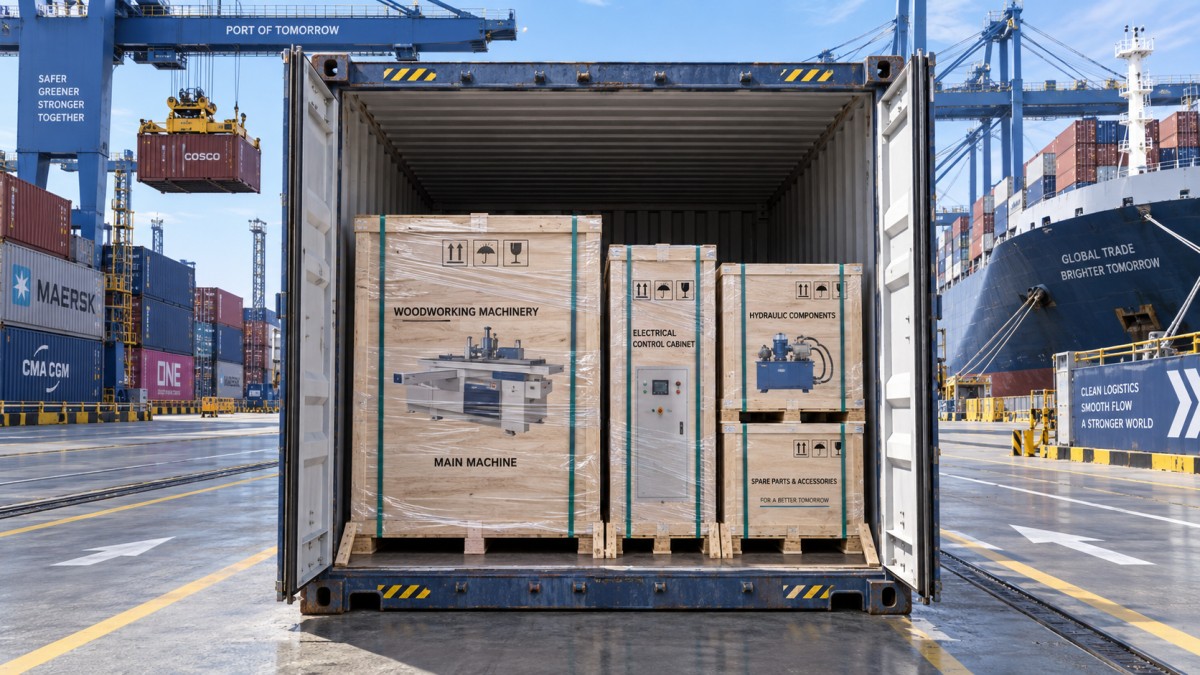
Crates should be numbered in a sequence that supports installation. It is frustrating when a site unloads accessory boxes first, then discovers that the base machine frame is trapped behind them or that the lifting points are inaccessible. Mark center of gravity, lifting positions, package weight, handling orientation, and any “do not stack” instruction where relevant. These markings are not decoration; they help terminal staff, truckers, and installation crews make safer decisions quickly.
Container planning should be done with real dimensions, not estimates taken from an early layout drawing. If a shipment uses multiple containers, decide whether they must arrive together for installation. If yes, avoid a plan that makes one critical container dependent on a later sailing without clearly communicating that risk to the customer.
Match the Shipping Method to the Machine, Not to a Generic Freight Quote
Full-container loading is often easier to control for complete machinery packages because the crates are handled less frequently than in a consolidated shipment. That does not mean it is always the right choice. Small accessory shipments may be suitable for consolidation, while heavy frames, long tables, or sensitive electrical cabinets may need a dedicated container plan. The decision depends on dimensions, handling risk, shipment value, port options, and whether the project can tolerate partial arrival.
For example, a hydraulic panel composer is not simply a single crate. A model such as the Clamp Carrier Hydraulic Composer may be supplied in MJ2500-6, MJ2500-8, or MJ2500-20 configurations, with sections, clamping components, and hydraulic equipment that need to remain traceable through packing and unloading. Its working capacity—up to 2500 mm in length, 1250 mm in width, and material thicknesses from 10 to 90 mm—also tells the logistics team that the receiving site must confirm door clearance, forklift capacity, and internal movement paths before delivery.
The same discipline applies to all furniture-production equipment. A short conversation about the plant entrance, floor loading, crane availability, and unloading zone can prevent a machine from sitting on a truck because the site assumed a standard forklift would be enough.
Keep the Importer, Broker, Forwarder, and Supplier in One Working Loop
Port delays often become worse when every party has only part of the information. The supplier knows the machine details. The freight forwarder knows vessel schedules and container cut-offs. The customs broker understands the import process. The project manager knows which machine is critical to the installation sequence. These parties do not need endless meetings, but they do need a shared timeline and a clear escalation path.
Before shipment, agree on who is responsible for each decision: approving draft documents, arranging cargo insurance if required under the commercial terms, monitoring arrival notices, paying destination charges, providing customs information, booking inland transport, and receiving cargo. Ambiguity is expensive once containers are at the terminal and storage charges begin to accumulate.
A useful checkpoint is to hold a document-and-delivery review shortly before dispatch. Confirm the final packing list, container numbers, seal numbers after loading, sailing details, consignee contacts, broker contacts, and the site’s unloading readiness. This review is especially valuable for first-time shipments or projects where equipment is arriving from more than one supplier.
Do Not Wait for Arrival to Plan Inland Delivery
Brazil is a large country, and the distance from port to factory can be a separate logistics project. Confirm the vehicle type, route constraints, delivery booking requirements, unloading equipment, and working hours before the cargo is released. For oversized or heavy packages, the local transporter may need detailed dimensions and weights early enough to allocate the right equipment.
Site readiness matters just as much. The receiving team should know which crates must be opened immediately, where they will be stored, how moisture-sensitive components will be protected, and whether installation technicians need serial-number photographs before assembly begins. If the machine is not being installed at once, keep electrical cabinets, manuals, tooling, and hydraulic parts identifiable and protected rather than scattering them across the warehouse.
Reliable woodworking machine shipping to Brazil is built on early technical clarity. A supplier can produce accurate packing data, machine documents, and export preparation; the importer and broker can prepare the local side; the project team can make the site ready. When those tasks are connected before the vessel sails, port delays become far easier to prevent than to explain later.
Send Your Inquiry
We welcome your cooperation and we will develop with you.