


News & Exhibitions
Latest Factory Updates, Industry Trends & Global Exhibition Information
VCI film or oil for anti-rust packaging of woodworking machines?
VCI film or oil for anti-rust packaging of woodworking machines?
Should you choose VCI film or protective oil to prevent rust on woodworking machines during storage and shipment? The answer depends less on which material sounds more advanced and more on what happens between final inspection and the first production run. Exposed cast-iron tables, precision guideways, shipment conditions, and commissioning requirements all influence the choice.
For woodworking machine anti rust packaging, VCI film can reduce cleanup when correctly specified and sealed. Protective oil provides a direct barrier, but may need removal before operation. Neither compensates for wet surfaces, poor cleaning, or damaged packaging. In some shipments, the practical answer is a combination: compatible protection on vulnerable metal surfaces, enclosed within a properly designed packaging system.
Start with the surfaces that must arrive ready for use
A woodworking machine is not a uniform metal object. A panel saw may combine a bare cast-iron table, painted steel framing, aluminum components, electrical equipment, and polymer parts. A planer or spindle moulder adds its own concerns around cutter assemblies, adjustment mechanisms, and sliding surfaces. One treatment applied everywhere can create unnecessary cleanup or compatibility problems.
The most important distinction is between corrosion that affects appearance and corrosion that affects function. Rust on a precision reference surface or guideway can require careful assessment before operation. Aggressive cleaning may damage the finish or alter a critical surface. Protecting those areas deserves more attention than coating every painted panel.
Before comparing packaging prices, mark the machine’s unpainted ferrous surfaces and identify which ones contact timber, support alignment, or require lubrication. Also identify areas where preservative must not enter, such as drive belts, friction surfaces, sensors, and electrical assemblies. This surface map makes the packaging specification far more useful than a general instruction to “apply rust protection.”
What VCI film does—and what it cannot do
VCI stands for volatile corrosion inhibitor. Suitable compounds released within an enclosure help inhibit corrosion on compatible metal surfaces. The film also forms part of the physical packaging envelope, although its moisture-barrier performance depends on the film construction. A VCI bag should not automatically be treated as a high-barrier moisture-control bag.
Its main attraction for woodworking equipment is reduced removal work. Where the specified system provides protection without an applied oil coating, unpacking can be cleaner, particularly around tables and other surfaces that will contact workpieces. That does not mean every machine can be operated immediately after opening: inspection, lubrication, and the manufacturer’s commissioning checks still apply.
The limitation is dependence on the enclosure. Tears, poorly closed openings, repeated access, and unsuitable bag dimensions can undermine protection. Internal covers and tightly packed components may also restrict inhibitor access. Film selection must therefore account for the metals present, enclosure volume, internal arrangement, and the supplier’s application limits—not simply whether the roll is labelled “VCI.”
VCI is not a rust remover or a substitute for drying. Existing corrosion, machining residues, fingerprints, and trapped moisture should be addressed before packing. Mixed-metal assemblies require particular care because formulations differ in their suitability for ferrous and nonferrous metals.
Protective oil offers direct coverage, with a cleanup trade-off
A purpose-selected corrosion-preventive oil leaves a protective film directly on the treated surface. This can be useful for accessible cast-iron tables, exposed shafts, and other vulnerable areas, especially when the outer enclosure may be opened during storage or inspection. Its performance still depends on surface preparation, coverage, product selection, and whether the coating remains intact.
Ordinary lubricating oil should not be assumed to provide the same storage protection as a specified corrosion preventive. Products differ in viscosity, film characteristics, removability, and suitability for particular storage conditions. A coating that drains away from vertical surfaces may leave gaps; an unnecessarily heavy treatment may collect contamination and increase cleanup.
Woodworking makes the removal question especially important. Residue transferred from a machine table to timber can interfere with downstream finishing or bonding, depending on the chemistry and process. The receiving team needs clear instructions covering where the preservative was applied, which cleaner is permitted, and what lubrication must be restored afterward.
Applying more oil is not a reliable way to compensate for an uncertain shipping environment. Excess can migrate into unwanted areas, contaminate packaging, and complicate installation. The aim is a controlled protective film, not a visibly wet machine.
Match the system to the journey, not just the transit time
The protection period begins when the machine is packed and ends when it is unpacked under suitable conditions. Factory storage, port delays, customs inspection, destination warehousing, and installation scheduling all belong in that period. A short voyage followed by uncertain warehouse storage may be more demanding than a longer, well-controlled shipment.
Temperature cycling can bring metal surfaces below the surrounding air’s dew point and cause condensation. Coastal exposure and contaminated handling can add corrosion risks. Neither VCI film nor oil should be evaluated in isolation from the outer crate, moisture control, and handling protection.
For a sea-freight package, the design may need an appropriate moisture barrier and correctly sized desiccant provision alongside the corrosion treatment. Desiccant quantity cannot be chosen responsibly from machine weight alone: enclosed volume, barrier properties, packing humidity, duration, and moisture introduced by packaging materials all matter. Damp timber or cushioning inside an enclosure can defeat an otherwise careful design.
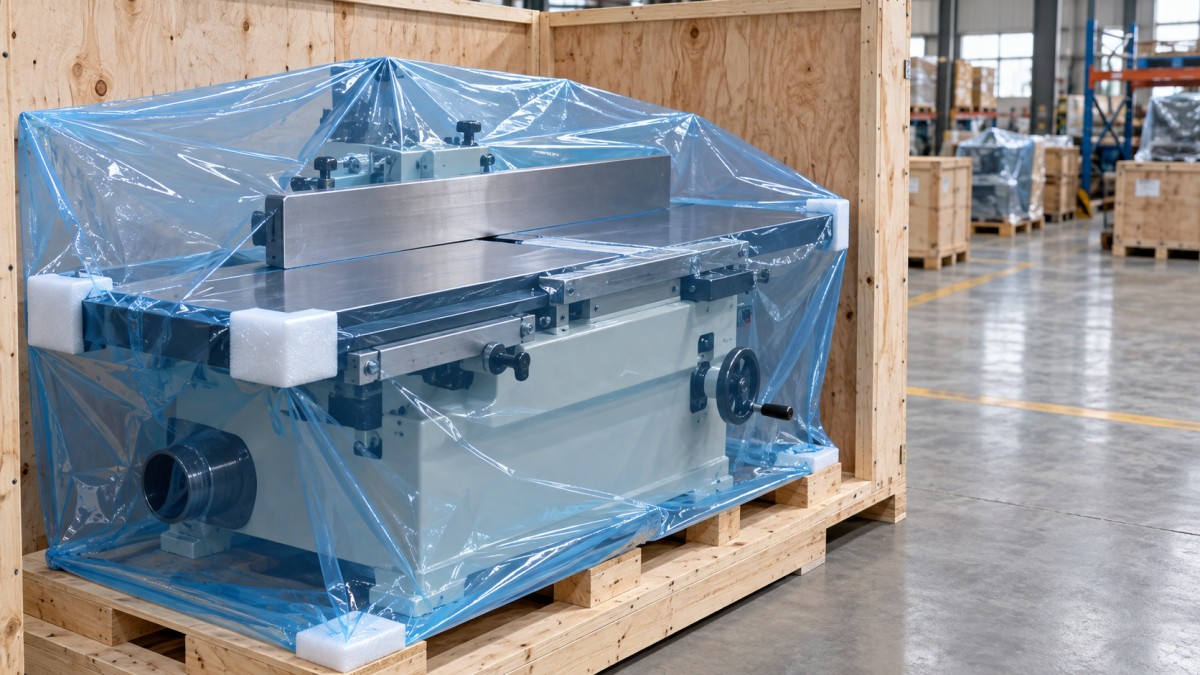
At packaging review, inspect the complete arrangement: protected metal surfaces, cushioning over sharp edges, enclosure seams, access points, and the surrounding crate. A good inhibitor cannot protect reliably if a table corner punctures the bag during transport. Corrosion protection and mechanical restraint need to be designed together.
When each approach makes sense
Favor a VCI-led system when clean commissioning is important, the machine can remain properly enclosed, and the selected formulation is suitable for the exposed metals. This is particularly worth evaluating where removing oil from broad workpiece-contact surfaces would delay installation. Confirm how inspections will be handled, because opening and loosely rewrapping the package changes the protection conditions.
Favor an oil-led system when vulnerable surfaces are accessible for treatment and later cleaning, or when repeated access makes a continuously closed VCI enclosure difficult. The receiving site must have the materials, labor, and procedures to remove the coating safely. Outer protection against moisture, dust, and handling damage remains necessary.
Consider a combined system for demanding or uncertain routes, with targeted preservative on critical surfaces and a suitable enclosing system. However, do not assume any oil works with any VCI film. An incompatible coating may affect inhibitor access or introduce material concerns. Obtain compatibility guidance from the packaging suppliers and machine manufacturer before specifying the combination.
There is no defensible universal claim that one method protects for a fixed number of months. Any duration claim needs stated conditions, including preparation, enclosure integrity, environment, and access frequency.
Ask for evidence that matches the proposed package
A useful technical review should go beyond the material datasheet. Laboratory corrosion testing can support product selection, but a test result does not automatically establish performance for a complete machine in a shipping crate. Ask what was tested, which metals were used, and how the conditions relate to your route and storage plan.
- Request the VCI film specification, metal compatibility, closure requirements, and stated application limits.
- For oil, request application guidance, material compatibility, removal instructions, and the relevant safety data sheet.
- Agree on pre-packing checks for cleanliness, dryness, existing corrosion, and coverage of critical surfaces.
- Define what happens after an inspection opening: who reseals the package and whether moisture-control materials need reassessment.
- Record acceptance criteria and unpacking instructions so the receiving team can distinguish preservative residue from a defect.
For an unfamiliar route or a changed packaging design, a representative trial with documented inspection can be more informative than selecting the lowest material quotation. Critical surfaces should be photographed before packing and checked at receipt before anyone removes evidence through cleaning.
Compare the cost through commissioning
The relevant cost includes preparation, application, enclosure materials, inspection, unpacking, cleaning, waste handling, and potential rework. A lower-priced oil treatment may require substantial removal labor. A VCI enclosure may reduce that work but needs careful sizing, sealing, and puncture protection. Neither approach is automatically cheaper across the complete delivery process.
Qingdao Zhongding Machinery Co., Ltd. manufactures and exports woodworking machinery, drawing on more than 20 years of industry experience. Its technical support, spare-parts supply, and after-sales service make packaging and commissioning a connected discussion: the people advising on protection should understand which surfaces must be cleaned, which mechanisms need lubrication, and how the machine will enter production.
Before approving a shipment, agree on a surface-specific protection plan, the complete storage period, expected environmental exposure, and the receiving site’s cleanup capability. Choose VCI film where a controlled enclosure and reduced residue offer a practical advantage; choose protective oil where direct coverage and manageable removal suit the job. Use both only when compatibility is confirmed. The decision is complete when the package protects the machine and the receiving team knows exactly how to put it into service.
Send Your Inquiry
We welcome your cooperation and we will develop with you.