


News & Exhibitions
Latest Factory Updates, Industry Trends & Global Exhibition Information
How much hot press pressure is needed for laminated bamboo panels?
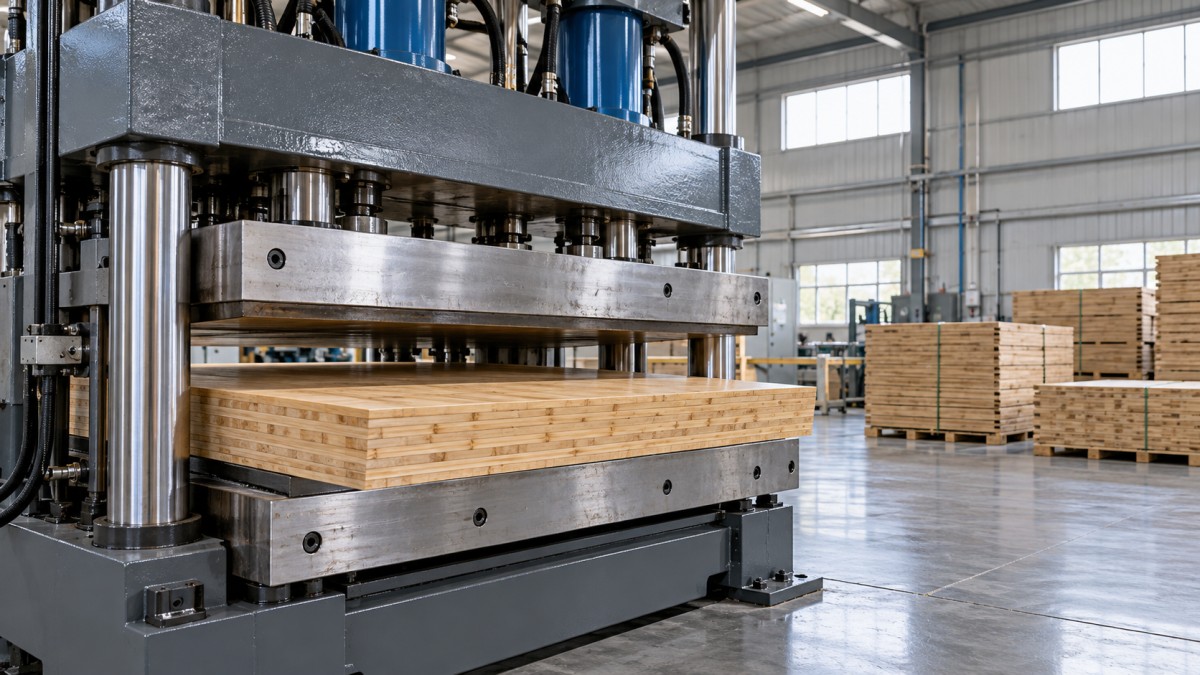
The required hot press pressure for laminated bamboo panels is the pressure that closes the intended glue lines and holds them in contact through adhesive cure without unacceptable compression or adhesive loss. There is no single pressure setting that applies to every bamboo panel. The production specification must come from the adhesive requirements and trials using the actual bamboo strips, moisture condition, and panel construction—not from the press’s maximum tonnage.
For machine sizing, convert the required panel pressure into total force using force = pressure × loaded panel area. For example, a 1,220 × 2,440 mm panel pressed at an illustrative 1.5 MPa requires approximately 4,465 kN, or 455 metric tonnes-force. That is a calculation example, not a recommended bamboo pressing recipe. Confusing panel pressure with hydraulic gauge pressure can produce a substantially incorrect equipment specification.
Define which bamboo panel—and which glue lines—are being pressed
“Laminated bamboo panel” can describe edge-glued strips, face-laminated boards, or multilayer constructions with different strip orientations. These constructions do not necessarily need the same pressing arrangement. Densified bamboo made from resin-treated bundles is a different process and should not be used as the basis for sizing a strip-lamination press.
The first technical question is whether the press applies force perpendicular to the glue lines that need consolidation.
In a face-laminated assembly, the main platen force acts across the broad bonding surfaces. In an edge-glued strip assembly, vertical platen pressure may hold the strips flat but cannot replace the lateral force needed to close the joints between adjacent strips. A panel combining edge joints and face bonds may require controlled pressure in both directions.
This distinction matters when evaluating a hot wood press for bamboo panels. A machine can have sufficient vertical tonnage yet still lack the side-pressure system necessary for the intended construction. The vertical and lateral pressing requirements should therefore be specified separately rather than combined into one headline capacity.
Panel pressure, hydraulic pressure, and press force are different quantities
Panel pressure is the average compressive stress applied over the loaded panel footprint. Hydraulic pressure is the fluid pressure acting inside the cylinders. Total press force is the resulting mechanical load transmitted through the press structure.
The basic sizing relationship is:
F (N) = p (N/mm²) × A (mm²)
Because 1 MPa equals 1 N/mm², the calculation is straightforward when panel dimensions are expressed in millimetres. For a 1,220 × 2,440 mm panel, the loaded area is 2,976,800 mm².
These values show how strongly the pressure target affects machine capacity. They are not a validated operating range. The correct row—or a value outside this illustration—must be established for the actual bonding process.
Hydraulic pressure is related to force through the combined effective area of the active cylinders. Cylinder arrangement, the pressurised side of each piston, and mechanical losses affect the relationship. A gauge reading of 15 MPa does not mean the panel receives 15 MPa. The machine supplier should provide a verified conversion between hydraulic gauge pressure and delivered force.
What determines the required bonding pressure?
Strip geometry and surface preparation
Pressure must bring mating surfaces into sufficiently close contact for the selected adhesive. Thickness variation, bowed strips, machining ridges, and poor squareness increase the force needed to close an assembly. However, raising pressure to overcome poor geometry can compress high spots while leaving other areas inadequately bonded.
The relevant measurements are therefore not limited to nominal strip thickness. Thickness variation across and along strips, flatness, edge straightness, and joint fit all affect the pressing window. Bamboo’s outer and inner surface conditions, along with any residual surface layers or contamination, also influence adhesion. Pressure cannot correct an unsuitable bonding surface.
Adhesive requirements and assembly time
The adhesive supplier’s technical instructions should define the starting conditions for pressure, application rate, assembly time, temperature, and cure. Where those instructions cover timber but not the intended bamboo substrate, additional validation is necessary.
Pressure and adhesive behaviour are linked. An adhesive that remains mobile during closure can be displaced differently from one that has already thickened. Excessive pressure can drive adhesive from the joint or compress the substrate without improving the bond. Insufficient pressure can leave gaps that the adhesive is not designed to bridge.
Visible squeeze-out is not a reliable acceptance criterion by itself. It confirms that some adhesive has moved, but does not establish adequate coverage or cure throughout the panel. Likewise, increasing adhesive spread is not a dependable substitute for accurate machining and joint closure.
Moisture, temperature, and compression
Bamboo moisture content influences dimensional movement, adhesive behaviour, and the response to heating. Variation between strips can produce uneven compression and subsequent stress even when the average moisture reading appears acceptable.
The relevant control is a defined moisture range with a specified measurement method and sampling plan. Electrical moisture readings may require material-specific correction, particularly where bamboo has undergone thermal or chemical treatment.
Platen temperature is not the same as glue-line temperature. Thick panels and multilayer assemblies take time to heat internally. Raising pressure does not replace the time needed to reach the adhesive’s required cure conditions. Conversely, changing temperature can change adhesive flow and bamboo compressibility, so a pressure setting should not be transferred unchanged to a substantially different heating cycle without validation.
Loaded area and press configuration change the calculation
The area used in the force calculation is the projected loaded footprint, not automatically the full platen area. If a smaller panel is placed in a large press and total force remains unchanged, its average pressure increases. Production controls must therefore account for different panel sizes and loading patterns.
When several panels lie side by side in one opening, their loaded areas are added. When panels are stacked vertically in a simple series load path, the same compressive force passes through the stack; the force requirement is not automatically multiplied by the number of panels. Heating, thickness variation, and load transfer still require separate assessment.
A similar distinction applies to multi-opening presses. More openings increase production capacity, but they do not necessarily multiply the required closing force. The actual machine design determines how load is transmitted. Force calculations should follow the supplier’s load-path drawings rather than an assumption based on opening count.
Uneven loading is another limitation. A press designed for a balanced full-area load may have restrictions on small or offset workpieces. Sufficient nominal tonnage does not establish that the platens and frame can safely carry every loading pattern.
Establish a pressure window through controlled trials
A useful production specification defines a validated operating window, not just one pressure value. The lower boundary is where contact and bond performance become unacceptable. The upper boundary is where compression, dimensional damage, adhesive displacement, or other defects become unacceptable.
Begin with the adhesive supplier’s recommendations for the intended substrate and application. Keep strip preparation, moisture condition, adhesive spread, assembly time, temperature, and pressing duration controlled while investigating pressure. Changing several variables together makes it difficult to identify why a panel passed or failed.
The assessment should include:
- Bond performance: appropriate shear or other joint tests, including failure location rather than strength alone.
- Durability: conditioning and bond-integrity testing appropriate to the declared service environment.
- Dimensional response: thickness under load, thickness after release, and recovery after conditioning.
- Defect distribution: open joints, edge damage, internal separation, and differences between centre and perimeter regions.
Test results should represent the panel rather than only its best-looking section. Sampling across the width, length, and relevant layers helps identify pressure-distribution and heating problems.
Use the product standard required by the intended application and market to set acceptance criteria. A bonding test method does not, by itself, prescribe the correct manufacturing pressure. If a method developed for wood products is applied to bamboo, its applicability and any limitations should be agreed with the responsible testing body.
Specify usable capacity, not just maximum tonnage
Once the pressure window is established, calculate the force needed for the largest permitted loaded area at the upper validated operating pressure. Then assess whether the press can deliver and maintain that force under the required thermal and loading conditions.
Engineering allowance should reflect the machine’s documented operating limits, force-control accuracy, and expected production variation. An arbitrary percentage added to a catalogue tonnage is less useful than confirmation of continuous working capacity and permissible load distribution.
Force stability also matters during the dwell period. As the assembly heats, adhesive flows and the material compresses, panel thickness can change. The control system must maintain the intended load within the process tolerance. A pressure reading taken only at initial closure cannot demonstrate that the required pressure was maintained throughout cure.
Platen flatness, parallelism, stiffness, and temperature uniformity deserve the same attention as hydraulic capacity. Adequate average pressure can coexist with local underloading or overloading. Pressure mapping or another suitable contact-assessment method can help investigate this, provided it is compatible with the temperature and loading conditions.
Turn the validated process into a machine specification
A technically complete specification should connect the product to the press: panel construction, minimum and maximum loaded area, required pressure range, corresponding force range, permitted loading patterns, and any independent lateral-pressure requirement. It should also state the temperature and dwell conditions under which that force must be maintained.
Acceptance testing should verify the relationship between gauge readings and delivered force, load retention during the pressing cycle, and panel quality using representative material. Reduced-size samples can help develop bonding conditions, but they do not establish full-size platen behaviour or thermal uniformity.
The defensible answer to “how much pressure?” is therefore a validated panel-pressure window translated into a verified machine-force requirement. That avoids both common specification errors: buying insufficient capacity for the intended panel area, and applying excessive pressure simply because the machine can deliver it.
Send Your Inquiry
We welcome your cooperation and we will develop with you.