


News & Exhibitions
Latest Factory Updates, Industry Trends & Global Exhibition Information
Door Edge Banding Machinery in 2026: Global Demand and Investment Drivers
The strongest investment case for door edge banding machinery in 2026 is not simply higher production speed. It is the ability to produce saleable doors consistently across different sizes, finishes, and order quantities without losing the expected return through setup time, rework, or downtime. Demand should therefore be assessed by production need rather than by a single global growth narrative.
A door plant replacing labor-intensive finishing, a factory expanding laminated-door capacity, and a producer introducing premium decorative surfaces represent different machinery opportunities. Their spending depends on different constraints. For capital planning, the useful question is which production problems justify investment—and whether the proposed equipment can solve them under actual operating conditions.
Why the market needs a narrower definition
Door edge banding machinery sits within the broader woodworking equipment market, but those broader categories do not provide a reliable measure of door-specific demand. Furniture panel edging, door-leaf processing, and door-frame wrapping can involve different machines, materials, and production economics. Combining them risks overstating the addressable market.
Even within door manufacturing, not every construction requires applied edge banding. Laminated or veneered door leaves may need an applied edge, while other designs use solid timber lippings, wrapped profiles, or finishing processes that require different equipment. Machinery demand therefore depends on the door construction mix, not just the number of doors produced.
Public trade classifications and machinery reports may group several woodworking applications together. Without transparent product definitions and methodology, precise claims about the global market’s 2026 value or growth rate offer limited decision support. A more defensible assessment connects door production, edge construction, installed equipment, and identifiable replacement or expansion projects.
Demand comes from different investment cycles
New construction creates an important downstream link, but building activity does not translate directly into machinery orders. Door producers may meet additional demand through spare capacity, overtime, outsourcing, or inventory. Equipment expenditure becomes more compelling when existing capacity cannot meet delivery requirements or when new contracts require capabilities the plant lacks.
Renovation and replacement demand follow a different logic. They can support orders outside new-build cycles, but fragmented specifications and irregular quantities may favor flexibility rather than dedicated high-output lines. A machine designed around long runs of identical doors can be poorly matched to replacement orders involving varied dimensions and finishes.
Replacement investment also needs to be separated from capacity expansion. An older machine can remain mechanically functional while becoming commercially restrictive because changeovers take too long, finish consistency is inadequate, or spare parts are difficult to obtain. Such purchases improve capability without necessarily adding much nominal capacity.
These distinctions matter when interpreting supplier order books. Strong sales to a few large expansion projects do not demonstrate broad-based demand. Conversely, a market with limited factory construction may still support replacement spending where installed machinery no longer matches product requirements.
Customization makes usable output more important than rated speed
Customization changes the economics of edging when it increases the number of production transitions. Different door thicknesses, edge materials, colors, and surface finishes introduce adjustments, material changes, and inspection requirements. The resulting losses may exceed any benefit from a higher maximum feed speed.
The relevant productivity measure is accepted doors per shift across a representative order mix. It should include setup, first-piece approval, band changes, adhesive preparation, cleaning, and recovery from interruptions. A fast machine running a single demonstration specification does not establish mixed-production performance.
Programmable settings and stored production recipes can reduce adjustment work, provided the machine controls the variables that actually cause delays. Their value is limited if operators must still manually reposition critical units, identify edge materials, or correct inconsistent workpiece presentation.
Door handling deserves particular attention. Large or heavy leaves can make loading, turning, and unloading the real constraint. An investment in edging speed may deliver little additional output unless return conveyors, lifting assistance, buffers, or staffing arrangements are addressed. Automation demand should therefore be evaluated at cell level, not only at machine level.
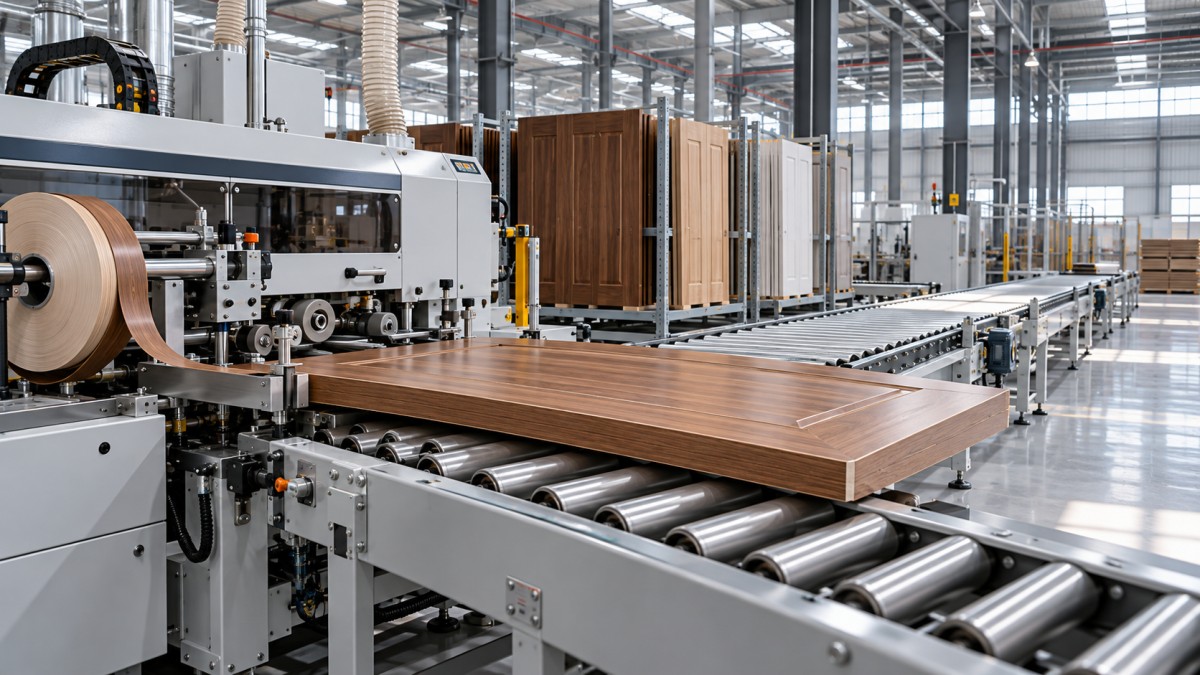
For mixed-batch production, this creates a practical direction for 2026 investment: configuration should follow the cost of transitions as closely as the cost of processing. The strongest automation case is where repeated handling or adjustment work demonstrably limits output, rather than where automation merely adds features.
Finish quality and material compatibility shape equipment value
Edge quality affects more than appearance. Poor adhesion, visible glue lines, damaged decorative surfaces, or inconsistent trimming can create repair work and rejection after substantial value has already been added to a door. Reducing those losses can justify investment even when shipment volumes remain unchanged.
Adhesive selection is part of that calculation. EVA hot-melt systems and reactive PUR systems have different processing, maintenance, and material-handling requirements. PUR can offer performance advantages for suitable applications, but its moisture-reactive chemistry also requires appropriate storage, cleaning, operating discipline, and occupational controls. It is not automatically the most economical choice for every door specification.
Likewise, “zero-joint” is not a single interchangeable technology. Hot-air or laser activation requires compatible functional-layer edging and suitable equipment. A very thin conventional glue line is a different proposition. Equipment comparisons should establish exactly which process and consumables are included rather than treating similar visual descriptions as equivalent capabilities.
The complete material combination matters: door substrate, applied lipping or edge strip, decorative face, adhesive, and subsequent finishing operations. A successful trial on a standard panel cannot establish performance on every lightweight, veneered, or laminated door construction. Trials should reproduce the intended product and relevant process variations.
For fire-rated or other performance-rated doors, changes to edge construction or bonding processes may also affect the approved product specification. Machinery capability alone does not demonstrate that the resulting door retains its required performance.
Global demand is better assessed through production conditions than regional labels
A useful reading of global market trends for door edge banding machinery in 2026 distinguishes between manufacturing locations, end markets, and equipment sourcing countries. These are not necessarily the same. An export-oriented factory may invest because of overseas contracts, while domestic construction conditions remain weak.
Regional comparisons become more meaningful when they examine specific operating conditions:
These conditions can exist within the same country, or even within neighboring industrial clusters. Broad descriptions of a region as “high growth” or “automation driven” are therefore insufficient grounds for a sales forecast or factory investment.
Financing and import conditions can also determine whether technical need becomes an order. Exchange-rate exposure, borrowing costs, duties, freight, and installation expenses affect the delivered investment. A factory may have a credible automation requirement but defer purchasing because financing or commissioning capacity is constrained.
The return depends on recovered losses, not theoretical capacity
The financial case should separate additional sales from operating savings. Extra output has value only if it can be sold and if upstream and downstream processes can support it. Labor savings are cash savings only where staffing, overtime, or outside processing costs actually change; redeployment may create value, but it should be recorded differently.
A practical calculation compares annual incremental contribution and avoidable operating costs with the full installed investment. The latter includes freight, applicable duties, utilities, extraction, handling equipment, commissioning, training, initial spares, and production disruption—not simply the machine invoice.
Material recovery deserves a separate line. Better process control can reduce rejected edge strips, damaged faces, excess trimming, or complete door rejection. Savings should be based on measured losses and realistic acceptance results, not on an assumption that a new machine eliminates scrap.
Consider a purely illustrative investment of $240,000 installed. If it produces $80,000 in annual net operating benefit, simple payback is three years. If lower utilization or a less favorable product mix reduces that benefit to $40,000, payback doubles. Neither figure is a market benchmark; the example shows why utilization assumptions can matter more than a modest purchase-price discount.
The investment should therefore be tested against fewer operating shifts, longer changeovers, slower commissioning, and higher maintenance costs. Where the return disappears under a modest reduction in utilization, a smaller or staged investment may be more defensible than a fully integrated line.
Service capability can determine whether investment delivers
Cross-border machinery sourcing gives buyers access to different equipment configurations and price levels, but it also creates distance between the installation and the people who can restore it after a failure. That exposure belongs in the investment model.
Remote diagnostics can help with control faults and parameter issues. They cannot replace a technician when mechanical alignment, damaged components, or process commissioning requires physical intervention. The value of remote access also depends on connectivity, documentation, language support, and agreed access controls.
Supplier assessment should establish which components are stocked locally, which are proprietary, and how replacement assemblies are identified. Familiar component brands help only if the required specification, software configuration, and technical instructions are available. A nominally standard part may still require integration support.
Acceptance testing should use representative doors and include changeovers, restart behavior, and finish inspection—not just continuous running at a selected speed. Where adhesion develops after processing, the acceptance plan should allow suitable conditioning and testing rather than relying entirely on immediate visual inspection.
These requirements can influence which investments proceed in 2026. A technically ambitious system with uncertain commissioning and parts support may offer a weaker risk-adjusted return than a simpler configuration backed by credible service arrangements.
What would make the 2026 demand outlook more convincing?
The strongest signals are closer to factory operations than to broad construction headlines: funded door-production projects, machinery orders tied to defined products, replacement plans, sustained capacity constraints, and measurable costs from rework or manual handling. Enquiries and exhibition interest are useful indicators of attention, but not equivalent to committed expenditure.
Order composition also matters. Spending on automated handling and changeover control indicates a different requirement from purchases of basic standalone machines. Replacement orders reveal different economics from greenfield installations. Tracking those distinctions provides a clearer picture than combining all woodworking equipment sales into one growth claim.
For 2026, the defensible investment thesis is selective rather than universal. Door edge banding machinery earns capital where it removes a verified constraint, meets a necessary product specification, and remains supportable throughout its operating life. The decisive evidence is not the highest quoted speed or the broadest market forecast, but the cost of the current production problem and the demonstrated ability of the proposed system to reduce it.
Send Your Inquiry
We welcome your cooperation and we will develop with you.