


News & Exhibitions
Latest Factory Updates, Industry Trends & Global Exhibition Information
Six-Side CNC Drilling Machine for Cabinet Panels: Why Simultaneous 6-Axis Processing Eliminates Re-Clamping in Frameless MDF Production
Simultaneous 6-Axis Processing Isn’t Just Faster — It Changes How You Plan Cabinet Panel Production
If you’re evaluating a six side CNC drilling machine for cabinet panels, your primary technical concern isn’t whether it “has six sides.” It’s whether those six sides are processed *in one clamping cycle* — and whether that capability actually holds up under real frameless MDF production conditions. Many machines advertise “six-side” capability, but only a subset deliver true simultaneous 6-axis motion with coordinated tool paths, rigid kinematic architecture, and zero re-fixturing tolerance. That distinction isn’t marketing nuance — it’s the difference between eliminating handling steps and merely rearranging them.
Frameless MDF cabinets demand precision across all surfaces: hinge holes on front edges, cam lock dowel pockets on back faces, shelf pin holes on interior sides, and edge-banding prep on top/bottom. Traditional workflows require at least three setups: front/edge drilling, back-face drilling, and secondary side processing — each introducing cumulative error, operator dependency, and fixture wear. Re-clamping isn’t just slow; it’s where repeatability breaks down. A 0.15 mm misalignment in one setup propagates into misaligned hinges, gaps in carcass assembly, and costly field rework.
Why “Simultaneous” Matters More Than “Six-Side”
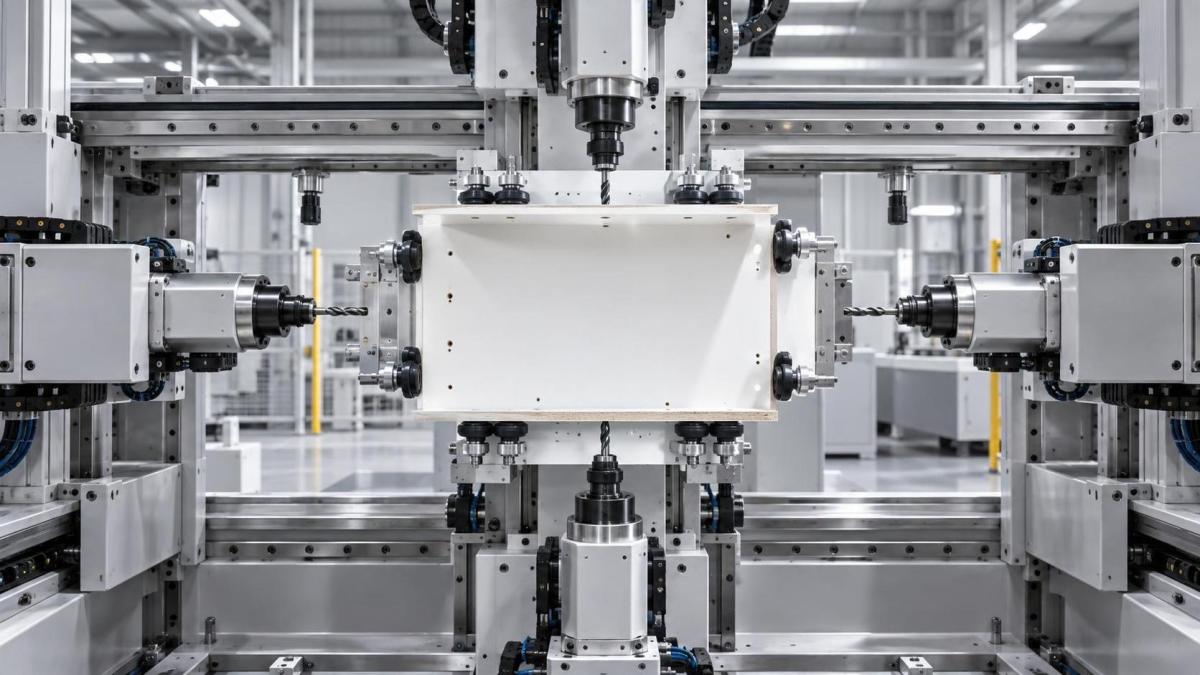
The phrase “six side CNC drilling machine for cabinet panels” often masks a critical engineering divide. Some systems use sequential indexing: the panel rotates or shifts between operations, stopping to reposition before each face is drilled. Others use true simultaneous 6-axis control — where the spindle head, rotary table, and linear axes move in coordinated real-time, keeping the workpiece fixed while tools access all six surfaces without pause.
This isn’t about speed alone. It’s about constraint elimination. In simultaneous systems:
- Positional integrity remains locked: The panel never leaves its original datum reference. No re-homing, no manual alignment, no fixture recalibration.
- Thermal and mechanical drift stay bounded: Continuous motion avoids thermal settling delays and eliminates micro-shifts caused by repeated clamping force application.
- CAM-to-machine translation becomes deterministic: Toolpath instructions map directly to physical axes without interpolation gaps introduced by indexed stops.
For technical evaluators, this means verifying not just axis count, but how axes are synchronized — specifically, whether the controller supports true multi-axis interpolation (not just G-code sequencing), whether the mechanical structure maintains rigidity during compound motion, and whether tool changers operate without interrupting the cycle.
Frameless MDF Adds Specific Demands — Not All Six-Side Machines Meet Them
MDF behaves differently than solid wood or plywood. Its homogeneity allows tight tolerances — but its low density and lack of grain make it prone to tear-out, blowout, and deflection under lateral drilling force. A six side CNC drilling machine for cabinet panels must therefore balance aggressive feed rates with controlled chip removal and minimal workpiece flex.
Key technical requirements emerge:
- Clamping must be distributed, not point-loaded: Vacuum pods or segmented clamping zones prevent localized deformation — especially critical on thin 16–18 mm MDF panels.
- Spindle torque and RPM range must match MDF-specific tooling: Carbide-tipped drills with optimized flute geometry need consistent torque delivery at mid-range RPMs (8,000–15,000 rpm), not just peak horsepower.
- Toolpath strategy must account for material stack-up: Drilling through stacked panels (e.g., 4-ply laminated MDF) requires adaptive depth control — not just fixed Z-depth programming.
Many six-side systems excel at solid wood but struggle with MDF’s consistency demands. If your shop runs high-volume frameless cabinets — especially flat-pack or ready-to-assemble lines — verify that the machine’s default tool libraries, feed/speed presets, and chip evacuation design reflect MDF-specific validation, not generic woodworking defaults.
What “Zero Re-Clamping” Actually Requires — Beyond the Machine Itself
A true single-setup workflow depends on more than hardware. It relies on integrated process discipline:
- Fixture-less part registration: Reliable edge-sensing or camera-based alignment eliminates reliance on physical locating pins — which wear, shift, or require manual verification.
- Robust CAM integration: The machine must accept industry-standard NC formats (like .tap or .cnc) with full support for nested part data, tool offset management, and automatic collision avoidance across all six faces.
- Tool life monitoring tied to material feedback: Not just time-based replacement, but spindle load trending per drill type, adjusted automatically when MDF batch density varies.
Without these, even the most advanced six-axis platform degrades to “single-clamp-but-multiple-program-runs” — defeating the core benefit. Technical evaluation should include live testing with your actual cabinet panel nesting files and tooling, not just demo parts.
Where Qingdao Zhongding’s Approach Aligns With Real Production Needs
With over two decades focused exclusively on woodworking machinery, Qingdao Zhongding has engineered their simultaneous 6-axis CNC drilling solutions around repeatable frameless MDF output — not theoretical axis counts. Their systems integrate:
- A rigid gantry structure designed to resist torsional twist during simultaneous X/Y/Z + A/B/C motion;
- Vacuum clamping zones calibrated for MDF’s surface tension profile, minimizing bowing on large-format panels;
- Pre-configured MDF drilling cycles embedded in the controller — including adaptive peck drilling for deep dowel holes and ramped entry for edge bands;
- Open CAM interface supporting major nesting software (e.g., OptiNest, TopSolid Wood), with verified post-processors for seamless toolpath transfer.
This isn’t about adding features — it’s about removing failure points. Their long-term service model reflects this: global spare parts availability, controller firmware updates tied to material-processing refinements, and technical support trained on MDF-specific troubleshooting — not just general CNC theory.
Before You Specify: Three Non-Negotiable Checks
Don’t evaluate based on brochure claims. Ask for evidence:
- Request a timed cycle test using your standard cabinet panel (e.g., 600 × 450 × 18 mm MDF) with full drilling — front, back, both sides, top, bottom — measured from first clamp to final unclamp. Compare against your current multi-setup time, including manual handling.
- Ask for a repeatability report: drill 10 identical panels consecutively, then measure positional deviation of identical holes (e.g., hinge cup centers) across all six faces — not just XY, but Z-depth consistency on back faces.
- Verify how the system handles panel variation: run a test with ±0.3 mm thickness variance across five panels — does toolpath compensation engage automatically, or does it require manual override?
If any answer relies on “it depends on operator skill” or “you’ll need to adjust manually,” the system isn’t truly built for zero-re-clamp frameless production — regardless of how many sides it claims to drill.
Ultimately, selecting a six side CNC drilling machine for cabinet panels isn’t about acquiring six axes. It’s about confirming that those axes function as a single, coherent system — one that respects the physical realities of MDF, the tolerance budgets of frameless construction, and the operational cost of human intervention. When those conditions align, re-clamping doesn’t just decrease — it disappears from the process map entirely.
Send Your Inquiry
We welcome your cooperation and we will develop with you.