

News & Exhibitions
Latest Factory Updates, Industry Trends & Global Exhibition Information
Can woodworking machine adaptation extend an older line's service life?
Woodworking Machine Adaptation can extend an older line's service life, but only when the machine's structural condition, safety basis, and process capability remain sound. Replacing controls on a line with worn guideways, unstable spindles, cracked frames, or obsolete mechanical safeguards does not create a reliable production asset. In contrast, a mechanically healthy machine with aging electrics, limited automation, or unavailable control parts can often remain productive for years after a properly engineered retrofit.
The evaluation should therefore start with a question that is more useful than “Is the machine old?”: Which parts of the line are limiting output, quality, safety, or maintainability, and can those limits be removed without creating new risks? Age alone is a poor replacement criterion. A robust older panel saw, edge bander, drilling unit, sanding line, or material-handling section may have a sound mechanical foundation even when its control cabinet and operator interface are no longer practical.
Adaptation works when the machine's core remains stable
Most woodworking production lines consist of several layers: the structural frame and machine bed, mechanical transmission components, cutting or processing units, electrical power and control systems, safety devices, and material flow equipment. These layers do not wear or become obsolete at the same rate.
Controls, sensors, drives, operator interfaces, and communication hardware often become difficult to support before the castings, welded frame, pressure beams, or main machine bed reach the end of their useful life. This is where adaptation can make sense. Replacing an unsupported controller, adding variable-frequency drives, updating a servo system, or integrating modern sensors may restore maintainability and improve consistency without discarding a mechanically capable machine.
However, a retrofit cannot compensate for fundamental loss of mechanical accuracy. If a machine cannot repeatedly hold its reference position, if spindle runout affects cut quality, if feeding pressure varies unpredictably, or if vibration is already causing defects, electrical modernization may only make those faults easier to observe. It will not eliminate them.
Begin with a condition assessment, not a retrofit wish list
A useful assessment separates defects that can be corrected through adaptation from defects that indicate replacement or major rebuilding is more appropriate. This prevents a common mistake: specifying a new control package before confirming that the machine can still meet the required process tolerance.
The assessment should include operation under representative load. A line that appears acceptable while idling may show vibration, feed variation, pressure loss, overheating, electrical noise, or control instability only during real cutting, boring, sanding, pressing, or edge-processing cycles.
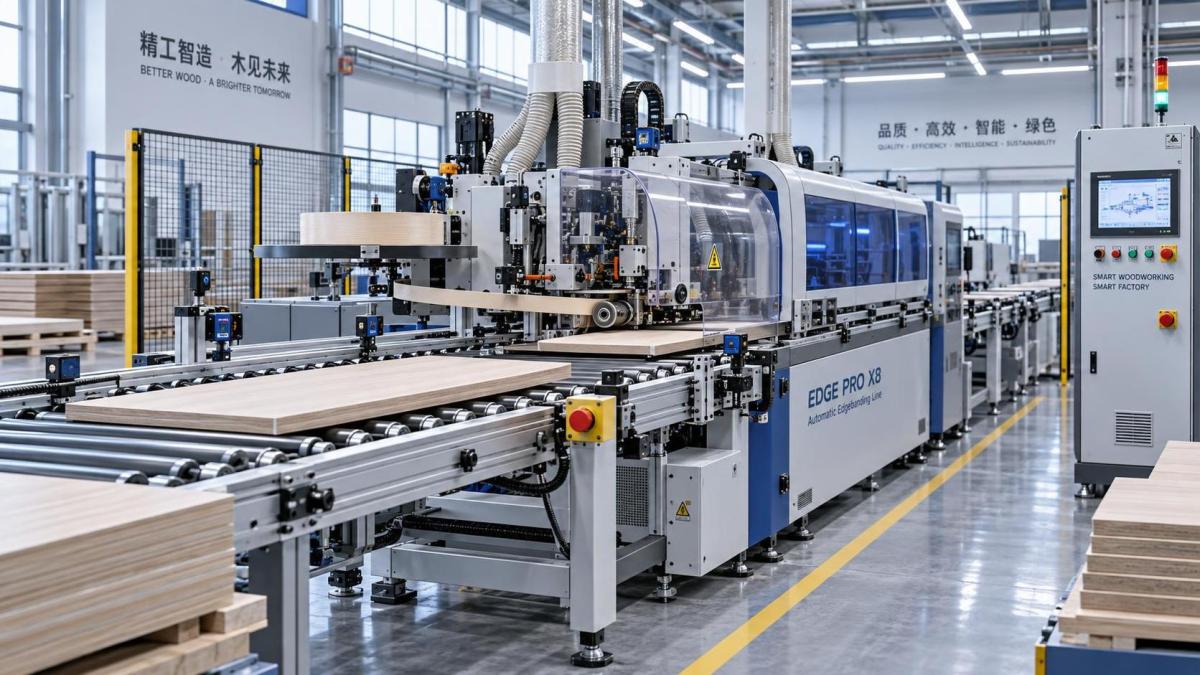
What an older woodworking line can realistically gain
The strongest adaptation projects address a defined operational constraint. An older line may still process material accurately but lose time to manual setup, difficult fault tracing, inconsistent feeding, or unavailable electrical parts. In those cases, modernization can improve the usable life of the equipment in practical ways.
Control modernization is often the first option considered. A current PLC or industrial controller can replace unsupported logic hardware, provide clearer diagnostics, retain machine settings, and simplify integration with upstream or downstream equipment. The value is not simply a newer screen. It is better fault isolation, maintainable programming, and reduced dependence on aging proprietary electronics.
Drive and motion adaptation can improve repeatability when the existing mechanical system is still sound. Variable-frequency drives may provide more controlled feed speed or motor management. Servo upgrades can be justified where positioning, drilling patterns, stop movement, or synchronized transfer operations are limiting quality or changeover time. The mechanical load, inertia, gearbox condition, and stopping behavior must be checked before selecting the drive system. Installing a faster drive on a mechanism that was not designed for it can shorten component life rather than extend it.
Sensor and feedback upgrades are useful where process variation is difficult to detect. Position sensors, workpiece detection, pressure monitoring, motor load monitoring, and temperature feedback can help operators identify deviations before they lead to scrap or unplanned downtime. These additions are most effective when alarm conditions are linked to a clear operator response and maintenance procedure.
Guarding and safety adaptation may be necessary even when productivity is the original motivation. Changes to controls, automated transfer sections, or access points can alter machine hazards. Interlocks, emergency-stop circuits, restart prevention, safe stopping, and protective enclosure arrangements should be reviewed as part of the design. A retrofit that improves output but makes troubleshooting or cleaning less safe has not improved the production line in a meaningful sense.
Service life is not the same as operating life
An older line may continue to run, yet still create high operating cost through downtime, rework, difficult troubleshooting, and dependence on salvaged parts. The purpose of woodworking machinery adaptation is not to keep equipment alive at any cost. It is to create an asset that can be operated predictably, maintained with available components, and kept within the required quality and safety envelope.
This distinction matters when comparing retrofit with replacement. Full replacement is usually more defensible when the existing line has multiple interacting weaknesses: structural fatigue, repeated mechanical failures, inadequate guarding, insufficient capacity, and a process layout that no longer suits the product mix. Adding modern controls to that type of line can result in a mixed system where new electronics are tied to unreliable mechanics.
Adaptation is more favorable when the machine frame, primary working units, and process layout remain appropriate, while obsolescence is concentrated in electrical controls, automation interfaces, or selected wear systems. It is also suitable when the line has unique dimensions, fixtures, or material flow arrangements that would be difficult to reproduce with a standard replacement machine.
Do not judge the project by purchase cost alone
The lower initial cost of a retrofit can be misleading if engineering, commissioning, downtime, training, mechanical repair, and future support are not included in the decision. The same is true in reverse: a full replacement may appear more expensive at purchase but reduce disruption where the old machine requires extensive rebuilding before adaptation can begin.
A technical comparison should look at the complete scope. Include the condition survey, electrical drawings, mechanical modifications, cabinet build, field wiring, control programming, safety redesign, installation time, production validation, spare-part strategy, and documentation. It should also identify what remains old after the project. Retaining a gearbox, spindle assembly, conveyor chain, or pneumatic system is acceptable only when its remaining condition and maintenance plan are understood.
Documentation deserves special attention. Many older woodworking machines have incomplete wiring diagrams, undocumented modifications, or control logic that exists only in the knowledge of one maintenance technician. Before replacing controls, record existing inputs, outputs, interlocks, operating sequences, manual modes, fault behavior, and abnormal recovery procedures. A control retrofit based only on the normal cycle is likely to create problems during setup, jam clearing, maintenance, and restart.
Common adaptation errors that shorten the expected benefit
One error is treating the electrical cabinet as an isolated component. The controller, drives, motor protection, sensors, safety circuits, pneumatic functions, and operator controls must work as one system. Replacing only the PLC without addressing degraded wiring, unreliable sensors, or poorly labeled field devices often leaves the root causes of downtime untouched.
Another error is copying old logic exactly. Legacy sequences may include unsafe bypasses, inefficient timing, or workarounds created to compensate for mechanical defects. The original machine behavior should be documented, but it should not automatically become the design standard for the adapted line.
It is also risky to add automation without defining recovery behavior. Automatic feeding, transfer, positioning, or clamping can raise output, but operators need clear procedures for a missing workpiece, a misaligned panel, a sensor fault, a jam, a power interruption, and a guarded-area access event. Recovery should return the system to a known safe state without requiring improvised intervention.
A practical decision sequence
- Define the current production requirement: material range, required quality, throughput, shift pattern, and expected changeovers.
- Measure the line’s actual limitations under load, separating mechanical defects from control and workflow problems.
- Classify each major component as retain, repair, replace, or remove from the process.
- Review safety functions before finalizing automation or control changes.
- Specify acceptance criteria for the adapted line, including repeatability, fault recovery, operator access, and maintainability.
- Plan commissioning around real workpieces and normal production variations, not only a demonstration cycle.
For manufacturers evaluating this route, a supplier should be able to discuss the condition of the existing equipment, the boundaries of the retrofit scope, spare-parts availability, and the production target in the same conversation. Qingdao Zhongding Machinery Co., Ltd., a woodworking machinery manufacturer and exporter with more than 20 years in the industry, supports this type of evaluation through machinery knowledge, technical support, and parts-oriented service planning. The useful outcome is not a predetermined retrofit recommendation, but a clear basis for deciding whether adaptation, rebuilding, or replacement best supports the line.
When replacement is the more responsible decision
Replacement should be considered when the line cannot be brought to a stable mechanical condition, when essential safety functions would require disproportionate redesign, or when its underlying process no longer matches the factory’s needs. A machine designed for simple repeated work may not be a suitable platform for frequent product changes, complex nesting, higher-speed transfer, or tightly linked digital production control.
The same applies when adaptation would preserve a bottleneck. If the old machine’s working width, feed architecture, tool arrangement, dust-extraction compatibility, or handling configuration permanently limits the required production flow, a new controller will not solve the capacity problem. In that situation, keeping the old line may delay a necessary process redesign.
Woodworking Machine Adaptation extends service life when it restores control, reliability, safety, and maintainability on top of a mechanically credible platform. The first action is therefore not selecting new hardware. It is establishing whether the old line still deserves to be the foundation of the next production cycle.
Send Your Inquiry
We welcome your cooperation and we will develop with you.