


News & Exhibitions
Latest Factory Updates, Industry Trends & Global Exhibition Information
Preparing woodworking machine deliveries for UAE site installation
A woodworking machine delivery to UAE can fail at the last few meters even when the machine itself is correctly specified and safely shipped. A container may arrive on schedule, yet installation is delayed because the unloading route is too narrow, the machine room is unfinished, the lifting equipment is unavailable, or the electrical connection has not been confirmed. For a project manager, these are not minor site details: they affect storage costs, commissioning dates, contractor coordination, and the planned start of production.
The practical rule is to treat delivery, site access, and installation readiness as one connected work package. Before the machine leaves the factory, confirm its transport dimensions, lifting points, package sequence, utility requirements, and installation footprint against actual conditions at the UAE site. A well-prepared woodworking machine delivery to UAE is not simply a shipping task; it is an installation sequence that begins before packing.
Start with the machine layout, not the shipping booking
Shipping arrangements are often made as soon as the purchase order is confirmed. That can be too early if the final site layout is still changing. The first useful document is a coordinated installation drawing showing the machine position, operator space, material flow, maintenance clearance, foundation requirements, electrical route, extraction connection, and the path from the unloading point to the final location.
Do not rely only on the overall machine dimensions shown in a quotation. The installation team needs to know the dimensions of every transportable section, including extension tables, control cabinets, guards, conveyors, dust hoods, tool packages, and separately packed accessories. A panel saw, edge bander, CNC router, four-side moulder, sanding line, or press may be divided into several crates, but one long or heavy component can determine the required door width and lifting method.
Questions that should be answered before packing
- What is the largest, longest, and heaviest individual package?
- Will the container be unloaded at the project site, a warehouse, or a port-side handling area?
- Can the delivery vehicle reach the building entrance without restrictions from gates, turning radii, overhead structures, or road access?
- Is there a level route from the unloading point to the machine foundation?
- Which machine sections need a forklift, crane, pallet truck, skates, or lifting beams?
- Are lifting points marked on the crates and on the machinery itself?
- Will any package need to pass through a door, service corridor, freight lift, or mezzanine opening?
These details prevent a familiar disruption: a machine reaches the site, but its main frame cannot pass an internal doorway or cannot be positioned because the planned crane cannot work close enough to the building. Resolving such a problem after arrival may require temporary dismantling, alternative rigging, or a revised access route. Each option adds risk to alignment-sensitive equipment.
Match export packing to UAE transport and storage conditions
Woodworking machinery usually combines machined steel surfaces, electrical components, pneumatic parts, hydraulic assemblies, precision guides, and electronic controls. The equipment may encounter marine humidity during transit, heat during local transport or storage, and dust if unpacking takes place before the building envelope is fully complete. Packing therefore needs to protect both the machine and the order in which it will be installed.
Ask for a packing list that identifies each crate, its gross and net weight, external dimensions, and the machine components inside. The crate numbering should match the installation documentation. It is much easier to stage equipment in the correct sequence when the site team can identify the main base, electrical cabinet, auxiliary equipment, spare-parts box, tool kit, and manuals without opening multiple crates.
Moisture protection deserves close attention. Corrosion protection on exposed metal parts, sealed wrapping where appropriate, desiccant use, and protected electrical enclosures reduce the risk of damage from condensation. Once the shipment arrives, do not leave opened crates exposed while the installation area still has active civil work, water ingress, or heavy dust. If final placement is not immediately possible, keep the machinery elevated from the floor, dry, covered without trapping moisture, and protected from impact by other site activities.
Wooden packaging may also require treatment and marking accepted for international shipment. Confirm this with the freight provider and customs support team before cargo collection, rather than discovering a packaging-document mismatch when the goods are already in transit.
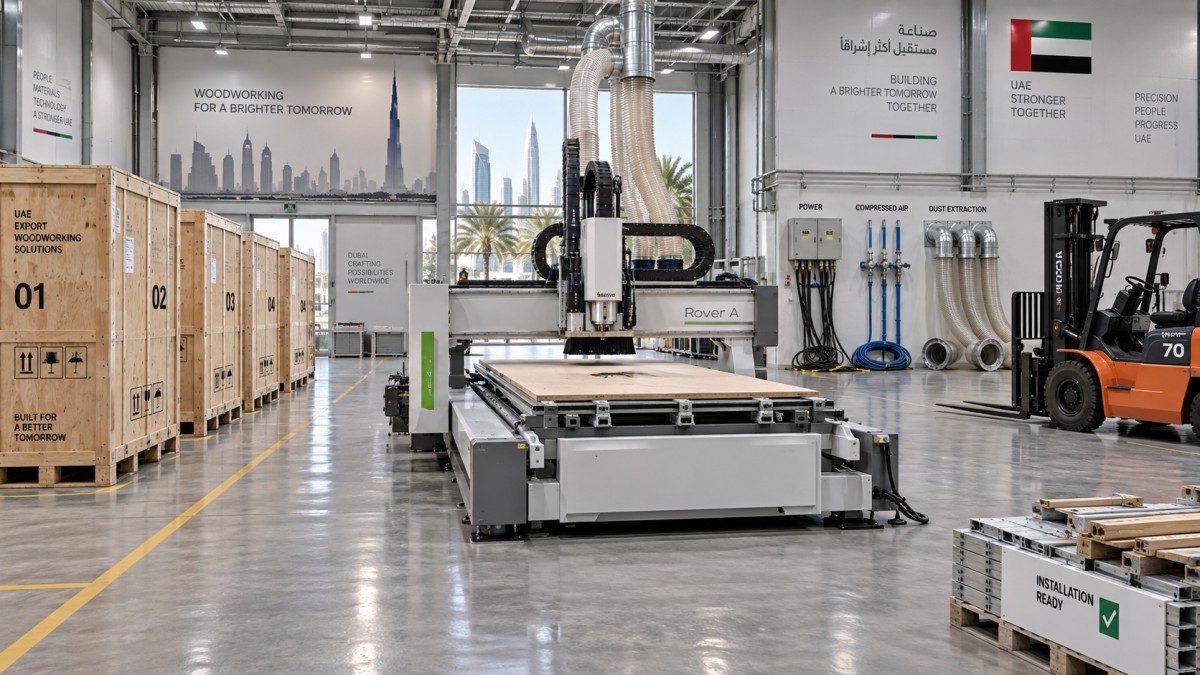
Build the document pack around clearance and installation
Customs clearance is smoother when the commercial and technical documents describe the shipment consistently. Differences between the invoice, packing list, bill of lading, machine description, quantity, weight, or country-of-origin information can create questions that delay release. The project team should review the paperwork before dispatch, not after the shipping documents have been issued.
A workable document review normally includes the commercial invoice, detailed packing list, transport document, machine description, origin-related documents where required, and any supporting information requested by the importer or clearance agent. The importing party should confirm in advance which entity will clear the cargo, where it will be delivered, and whether site access or local delivery appointments need to be booked.
Technical documents should travel with the project in both digital and printed form. At minimum, keep copies of the foundation drawing, electrical diagram, pneumatic requirements, installation manual, lubrication instructions, spare-parts list, and packing layout. A digital folder shared with the project manager, installer, site supervisor, and logistics coordinator avoids a common delay: the machine is on the floor, but nobody can confirm a cable size, air connection, anchoring detail, or the intended location of a control panel.
Verify the building is ready for machinery, not just construction complete
A finished floor and closed walls do not automatically mean that a woodworking line can be installed. Site readiness should be checked against the supplier’s requirements for each machine. Focus on the final operating environment rather than general building completion.
Electrical compatibility should be confirmed in writing from the approved machine data rather than assumed from the site’s general utility description. Voltage and frequency, in particular, must match the supplied equipment or be addressed through an agreed technical solution before energization. Do the same for compressed air and extraction. A machine can be physically installed while still being unable to perform its intended cycle because supporting utilities are incomplete.
Plan unloading as a controlled lifting operation
Container unloading is frequently underestimated. Forklifts must be sized for the heaviest package at the actual load center, not merely for an approximate crate weight. Long machinery crates can shift the center of gravity outward, reducing usable forklift capacity. The chosen equipment also needs enough mast height and maneuvering room for the unloading position.
Before delivery day, agree who is responsible for the forklift or crane, certified operator, rigging tools, traffic control, unloading supervisor, and inspection of packaging condition. Confirm whether the container can remain at the unloading point long enough for safe handling. Rushed unloading increases the chance of fork damage to crate bases, dropped accessories, and crates being placed in the wrong order.
Inspect external packaging before unloading and record visible impact, punctures, water marks, broken seals, or signs that a crate has shifted. If damage is suspected, photograph the condition before opening or moving the contents. This creates a clear record for the logistics and insurance process while allowing the technical team to decide whether internal inspection is needed before installation.
Sequence matters more than emptying the container quickly
Where space is limited, unload according to the installation order. The main machine base may need to go directly to its final area, while electrical cabinets and delicate accessories should be moved to a protected staging location. Avoid placing heavy crates in front of machine positions or blocking the route needed for later components. A container that is unloaded quickly but staged poorly can create an extra day of internal material handling.
Use a handover point between logistics and installation
Delivery is not complete when the cargo reaches the gate. It becomes an installation handover when the correct packages are accounted for, their condition is checked, the equipment is stored safely, and the installer can begin work without searching for missing parts or waiting for utilities. Assign one person to reconcile package numbers with the packing list and another to confirm that the site-readiness items have been signed off.
The installation team should then verify machine placement before removing protective transit supports. Machine bases need to be positioned according to the approved layout, with enough room for alignment, access panels, loading tables, and future maintenance. Transit brackets, shipping locks, and protective covers should only be removed according to the machine documentation. Removing them too early during internal movement can expose sensitive parts to damage.
Commissioning should follow a staged process: mechanical placement and leveling, utility connection, safety-device inspection, rotation and direction checks where applicable, lubrication confirmation, dry functional movement, and then controlled test operation. Do not treat the first powered movement as proof that the machine is ready for production. Feed systems, sensors, safety circuits, extraction connections, pneumatic functions, and operating adjustments all need verification within the intended production layout.
When the project includes more than woodworking equipment
Some UAE facilities combine woodworking operations with material-recovery, panel-making, or composite-product areas. In that situation, separate utility and installation plans are essential because a hot press has different requirements from a conventional woodworking machine. For example, a Plastic Waste Recycling Hot Press Machine for Sheet & Board Making uses electric heating with conduction oil, operates with a 120-ton working pressure, and has four layers with 1300 × 2500 mm heating platens. Its maximum working temperature of 240°C and large platen area require a dedicated review of floor loading, electrical provision, thermal clearance, handling route, and operator safety arrangements.
That equipment can process materials such as HDPE, PP, PE, PS, ABS, PVC, plastic flakes, and regrind into dense recycled sheets or boards. It should not be treated as an accessory to a woodworking line simply because the final board may be cut, machined, or assembled in the same facility. Separate installation sequencing prevents the press, its electrical connection work, and its handling needs from interfering with woodworking-machine commissioning.
Control changes before the cargo is committed
Late changes are most manageable before the shipment is packed. A revised machine location, smaller access opening, delayed extraction system, changed utility specification, or unavailable unloading equipment should trigger a review of the delivery plan immediately. Depending on the issue, the practical response may be revised packaging, split shipment, temporary protected storage, delayed dispatch, or a modified internal handling method.
The strongest preparation is a short coordination meeting before dispatch involving the machine supplier, freight coordinator, importing party, site manager, installation lead, and utility contractor. Each party should leave with confirmed responsibilities, dates, documents, access details, unloading equipment, and escalation contacts. This does not remove every delivery risk, but it prevents the avoidable situation where a precision machine arrives at a site that is technically or physically unable to receive it.
Send Your Inquiry
We welcome your cooperation and we will develop with you.