


News & Exhibitions
Latest Factory Updates, Industry Trends & Global Exhibition Information
Inside an Edge Banding Machine Factory: How Production Controls Affect Reliability
A reliable edge banding line is not defined by its brochure specifications alone. Two machines with similar feed speed, motor power, and listed functions can behave very differently after months of processing cabinet parts or furniture panels. The difference often begins inside the edge banding machine factory: how parts are controlled, how assemblies are aligned, and whether the finished machine is tested as a complete process rather than as a collection of individual stations.
For a technical evaluation, the useful question is not simply, “Does the machine include pre-milling, gluing, trimming, and polishing?” It is, “Can the factory repeatedly build those stations so they remain synchronized under normal production conditions?” Edge banding is a chained operation. A small variation in panel transport, glue application, pressure, or cutter position can appear later as glue lines, chipped corners, exposed substrate, or inconsistent edge radii.
Reliability Starts with Controlled Reference Surfaces
The machine bed, beam, tracks, and mounting faces establish the reference geometry for every processing unit. If these surfaces are not machined and inspected consistently, technicians can adjust one station correctly while another station remains slightly out of position. The machine may still produce an acceptable sample at low speed, but repeatability becomes harder to maintain when panel sizes, edge materials, or shifts change.
A technically capable factory controls more than the appearance of a welded frame. It checks whether the frame is stable before final assembly, whether guide rails are mounted on accurate reference faces, and whether the locations of the glue, pressure, trimming, scraping, and polishing units are repeatable from machine to machine. These controls affect how well settings survive transport, routine adjustment, and vibration in service.
For evaluators, this is one reason to look beyond a catalog image of a heavy machine body. Ask how the conveyor beam is aligned, how station mounting positions are verified, and how the factory prevents accumulated tolerances across a long machine. A long automatic edgebander is not one alignment point; it is a sequence of alignment relationships.
Component Selection Must Match the Function, Not Just the Price Point
Not every component carries the same reliability risk. Parts that control motion, heat, pressure, and cutting have a direct effect on edge quality and downtime. A factory should have a clear approach to sourcing and checking these items, especially where a failure cannot be corrected by a simple cosmetic adjustment.
Component brand names can be useful information, but they are not a complete quality judgment. The integration work matters just as much: cable routing, pneumatic connections, protection from dust, access to service points, and the factory’s method for preventing loose fittings or inconsistent settings. A well-known component installed poorly does not produce a reliable machine.
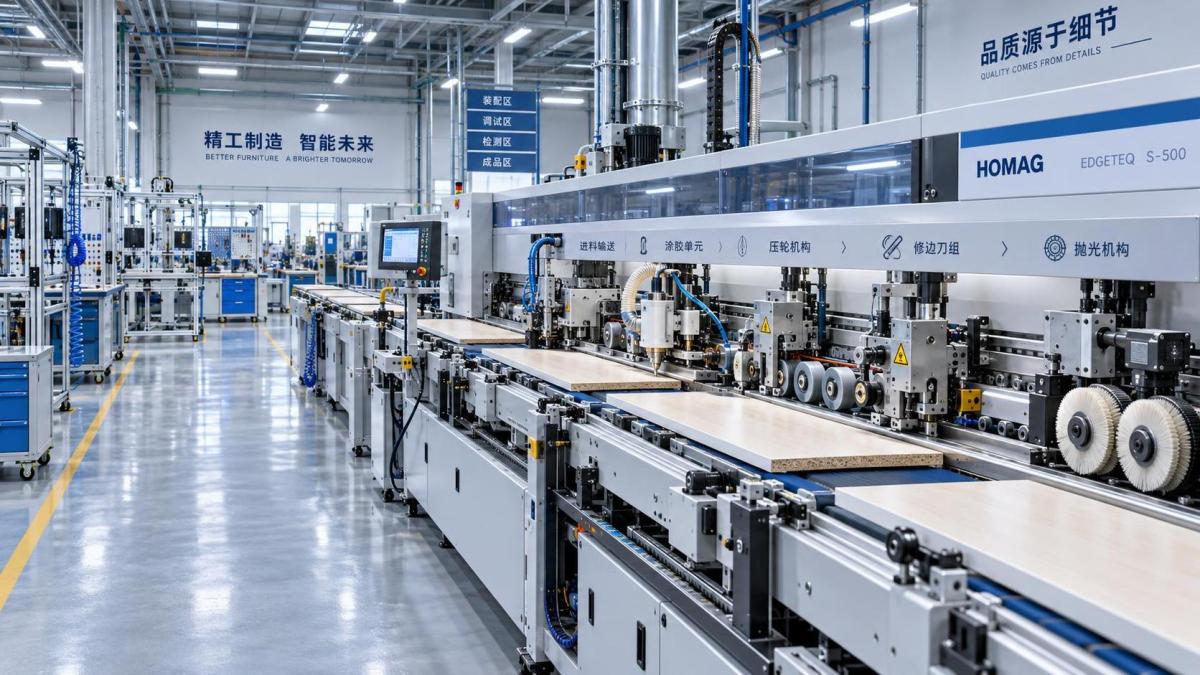
Assembly Accuracy Is a Process, Not a Final Adjustment
A common purchasing mistake is to assume that final commissioning can compensate for weak assembly control. Commissioning can fine-tune a properly built machine. It cannot permanently solve a structural misalignment, a conveyor system with inconsistent tracking, or mounting surfaces that change position under load.
During assembly, each station should be set from a common panel path and reference position. This is especially important for the relationship between the pressure rollers and trimming tools. If the edge tape is pressed inconsistently, a fine trimmer may be adjusted to hide the problem on one board thickness, only to reveal it again when production moves to another panel or tape.
Factories that treat assembly as a controlled sequence generally separate mechanical alignment from electrical commissioning. The mechanical path is established first: panel transport, station position, cutter clearance, and pressure contact. Electrical and pneumatic functions are then checked through normal operating cycles. This sequence reduces the risk of using software settings or operator adjustments to compensate for a mechanical issue.
Why adjustment accessibility deserves attention
Technicians should also inspect how adjustments are made. Handwheels, scales, locking devices, digital indicators, and accessible service panels do not replace precision manufacturing, but they influence whether the machine can be returned to its intended setting after a material change or maintenance task.
For mixed furniture production, frequent setup changes are normal. A machine that requires difficult, poorly referenced manual adjustments may be suitable for a stable, repetitive product range but less suitable for work involving different board thicknesses, edge materials, and finished panel styles. The best configuration depends on the production mix, not on the maximum number of stations.
Testing Should Recreate the Process the Buyer Will Run
A no-load test confirms that motors turn and cylinders move. It does not demonstrate reliable edge banding. A meaningful factory acceptance test runs representative panels through the entire sequence and evaluates the result at operating conditions relevant to the intended application.
The test panel should be selected with purpose. Melamine-faced board, MDF, particleboard, plywood, and solid-wood-derived panels can react differently at the edge. PVC, ABS, veneer, and thicker tape also create different trimming and bonding demands. A clean result on one sample does not establish that the setup will remain stable across all materials.
Technical evaluators should inspect the completed panel rather than relying only on the machine display. Look at the glue line under normal viewing light, the corner finish after end trimming, flushness along the top and bottom edges, tape damage near changes in grain or board density, and the polish after scraping. Then repeat the test after changing panel thickness, feed speed, or edge material within the expected production range. Consistency across those changes is more informative than one perfect demonstration piece.
It is also sensible to observe warm-up, glue application, and shutdown procedures. Glue-related problems are often linked to temperature stability, contamination, unsuitable cleaning routines, or inconsistent operating discipline. A factory that can explain its testing sequence clearly is usually easier to work with during installation and later troubleshooting.
Read Specifications as Operating Boundaries
Specifications establish whether a machine fits the job, but they should be read as boundaries rather than proof of output quality. Consider a straight-line automatic machine intended for cabinet and furniture components. Its stated panel thickness, minimum panel dimensions, tape range, feed-speed range, power requirement, and compressed-air requirement determine whether the planned parts can travel through the line safely and consistently.
For example, the Straight Automatic Edge Banding Machine ZD450A is configured with automatic feeding, gluing, trimming, polishing, and electric lifting. Its specified operating range includes 10–60 mm panels, edge tape from 0.4–3 mm, and feed speeds of 12–23 m/min. Those figures are useful for screening cabinet, furniture, and woodworking-factory applications, but the evaluation should continue with the actual part list. Very short, narrow, curved, damaged, or poorly prepared workpieces may require different handling or a different machine type.
The same principle applies to utilities. The stated 0.6–0.8 MPa working air pressure and 16.5 kW total power are installation inputs, not minor administrative details. Air quality, pressure stability, electrical capacity, dust extraction, floor layout, and material flow can all affect whether the machine performs as intended after delivery.
What a Factory Review Should Actually Cover
A factory visit, remote inspection, or pre-shipment review is most useful when it follows the production path instead of becoming a general tour. The aim is to connect manufacturing controls to the risks that matter in the buyer’s workshop.
- Trace the machine from frame preparation to final assembly and identify where dimensional alignment is checked.
- Inspect a machine that is being assembled, not only a completed show unit. Open access panels and examine wiring, tubing, connectors, and service space.
- Ask to see representative edge-banding tests using the buyer’s likely panel and tape categories.
- Check whether settings can be recorded and restored when moving between common production jobs.
- Review the availability of wear parts such as cutters, pressure rollers, glue-system service items, sensors, belts, and pneumatic components.
- Confirm what installation guidance, fault support, and spare-parts process will be available after the machine enters production.
Qingdao Zhongding Machinery Co., Ltd. positions its woodworking machinery offering around precision engineering, complete solutions, technical support, and spare-parts supply. For buyers assessing any supplier on those terms, the meaningful evidence is operational: clear machine documentation, understandable service access, defined commissioning support, and the ability to identify replacement parts without lengthy interpretation.
Reliability Is Also a Serviceability Decision
Even a well-built edgebander uses consumable and wear-prone elements. Cutters dull, glue systems need cleaning, rollers age, sensors require adjustment, and moving mechanisms need inspection. Reliability therefore includes the time required to identify, access, replace, and reset these parts.
A machine can appear technically sophisticated while creating unnecessary maintenance exposure if essential components are hard to reach or part identification is unclear. Conversely, a more straightforward configuration may be the stronger choice for a workshop with limited in-house maintenance capability, provided it covers the required material range and finish standard.
The most defensible factory selection is based on a connected evaluation: controlled construction, appropriate components, repeatable assembly, realistic testing, and usable long-term support. That approach moves the decision away from feature lists and toward the conditions that determine whether edge banding remains clean, consistent, and manageable on the production floor.
Send Your Inquiry
We welcome your cooperation and we will develop with you.