


News & Exhibitions
Latest Factory Updates, Industry Trends & Global Exhibition Information
How humidity affects curing during PUR adhesive bonding
Humidity affects the chemical curing of moisture-reactive PUR adhesives, but it does not control every stage of bond formation. A joint can become firm enough for trimming as the adhesive cools while still requiring substantial chemical curing before it develops its intended heat resistance and durability. Treating this early handling strength as proof of complete cure is a significant process-control mistake.
For woodworking applications, the decisive variable is moisture available at the bondline—not factory relative humidity alone. Substrate moisture, adhesive-layer thickness, material permeability, temperature, and exposure time all influence that availability. Low moisture availability can delay curing; excessive moisture can promote gas formation and bond defects. A reliable process therefore needs a validated moisture window rather than the highest achievable humidity.
Cooling and chemical curing are different processes
The PUR systems considered here are one-component, moisture-reactive polyurethane hot-melt adhesives used in applications such as edge banding and panel lamination. Their behavior should not be confused with that of two-component polyurethane adhesives, whose curing depends primarily on the reaction between separately mixed components.
After a reactive hot melt is applied, cooling increases its viscosity and develops initial strength. This physical setting allows the assembly to resist movement and, where the process permits, undergo immediate trimming or handling. It does not demonstrate that the moisture-driven reaction has finished.
Chemical curing involves the reaction of residual isocyanate groups with water. The reaction forms an intermediate that releases carbon dioxide and produces an amine; that amine can then react with another isocyanate group to form a urea linkage. These reactions build molecular structure and, depending on the formulation, a crosslinked network that contributes to final performance.
This distinction explains why apparently identical parts can leave a machine with similar edge appearance yet behave differently during later heat exposure or mechanical loading. Their cooling histories may be similar while their chemical cure states differ. Increasing cooling capacity or changing feed speed cannot, by itself, correct inadequate moisture availability during post-bond curing.
Why room humidity is only part of the explanation
Relative humidity describes how close air is to water-vapor saturation at its current temperature. It is not a direct measurement of water inside wood or at an adhesive interface. Two production areas with the same relative humidity but different temperatures do not contain the same concentration of water vapor, and their adhesive reaction rates can also differ.
Wood and wood-based panels exchange moisture with their surroundings, but that exchange takes time. Panels moved from a dry warehouse into a humid production room do not immediately reach equilibrium. Their surfaces and interiors may also have different moisture conditions. A room sensor can therefore show acceptable conditions while the material entering the bonding station remains unusually dry.
In an edge-banded panel, moisture can reach the adhesive through the board, through a permeable edging material, or from exposed bondline boundaries. The importance of each pathway depends on the assembly. A relatively impermeable plastic edge strip restricts access from its outer face, making the panel and exposed edges more important moisture sources.
Wide-area lamination presents a different geometry. When both bonded faces have low moisture permeability, the interior of the adhesive layer may cure more slowly than its perimeter. Raising room humidity may have limited effect if water still has no effective route into the center of the joint.
Adhesive thickness also matters. A thicker layer increases the distance moisture must travel and can create a greater difference between surface and interior cure. A simple assumption that doubling humidity halves curing time is therefore unreliable. Reaction kinetics, diffusion, substrate sorption, and bond geometry interact.
What changes when moisture availability is too low or too high?
Low humidity does not automatically produce a weak finished joint. It can instead extend the time required to reach the specified performance. The production risk arises when parts are packed, loaded, machined, or exposed to demanding service conditions before that performance has developed.
Excess moisture creates a different problem. Carbon dioxide is a normal product of the isocyanate–water reaction, but gas generation becomes detrimental when bubbles are trapped in the adhesive layer. Whether visible foaming occurs depends on the formulation, water availability, viscosity, temperature, and joint restraint. High relative humidity alone is not proof that foaming will occur.
Condensation deserves separate attention because it introduces liquid water rather than water vapor. A cold panel brought into warm, humid air can have a surface temperature below the local dew point. Bonding under those conditions can cause defects that would not be predicted from room humidity alone. Surface temperature and dew-point assessment are especially relevant when materials arrive from unheated storage.
Temperature can conceal or amplify a humidity problem
Temperature affects chemical reaction rate, adhesive viscosity, open time, substrate wetting, and cooling. These effects must be separated during diagnosis. A cold panel may cause the molten adhesive to lose heat quickly and form inadequate contact before pressing is complete. That is an interface-formation problem, even if slow moisture curing also occurs afterward.
Conversely, satisfactory wetting at the application station does not establish that later curing conditions are adequate. Parts transferred to a cold, dry storage area may develop strength differently from samples retained beside the machine. Monitoring only the bonding station misses this change in exposure.
Application temperature should remain within the adhesive supplier’s specified range. Raising it to compensate for slow curing can change open time and thermal exposure without solving the moisture limitation. Likewise, spraying water onto substrates is not a general remedy: uncontrolled wetting can create local reaction, gas formation, and variable adhesion. Any deliberate moisture addition requires an adhesive-specific, validated process.
Machine specifications do not establish a curing window
Feed speed, pressure, and profile-following capability determine whether an edge-banding machine can form a consistent joint. They do not establish how quickly that joint will chemically cure. On shaped edges, uneven adhesive distribution or incomplete contact can produce localized defects that resemble a curing problem.
For example, the Soft forming edge banding machine ZD880S is specified for shaped panel-edge processing at a feed speed of 6–8 m/min. That speed helps define the application and pressing sequence, but it provides no evidence of a particular PUR cure time. PUR compatibility, adhesive-system configuration, permitted adhesive grades, and operating procedures need confirmation separately.
Where PUR is used, evaluation should include protection of the adhesive before application. Moisture entering a melter, hose, or applicator can initiate premature reaction, causing deposits, viscosity changes, or restricted flow. This is the opposite of the requirement after bonding: moisture exposure must be controlled before application and adequately available afterward. Shutdown, sealing, and cleaning procedures therefore form part of cure consistency.
How to establish a defensible curing specification
There is no universal relative-humidity target or full-cure time for all PUR adhesive bonding processes. Supplier technical data should identify the reference temperature and humidity, application conditions, and the meaning of any stated cure time. A figure obtained with one substrate combination cannot automatically be transferred to a different panel, edge material, or adhesive thickness.
A useful validation links environmental records to actual joint performance:
- Define the assembly. Record the panel grade, edge or facing material, surface preparation, primer where applicable, and adhesive grade. Changes in permeability or surface treatment can alter results even when machine settings remain unchanged.
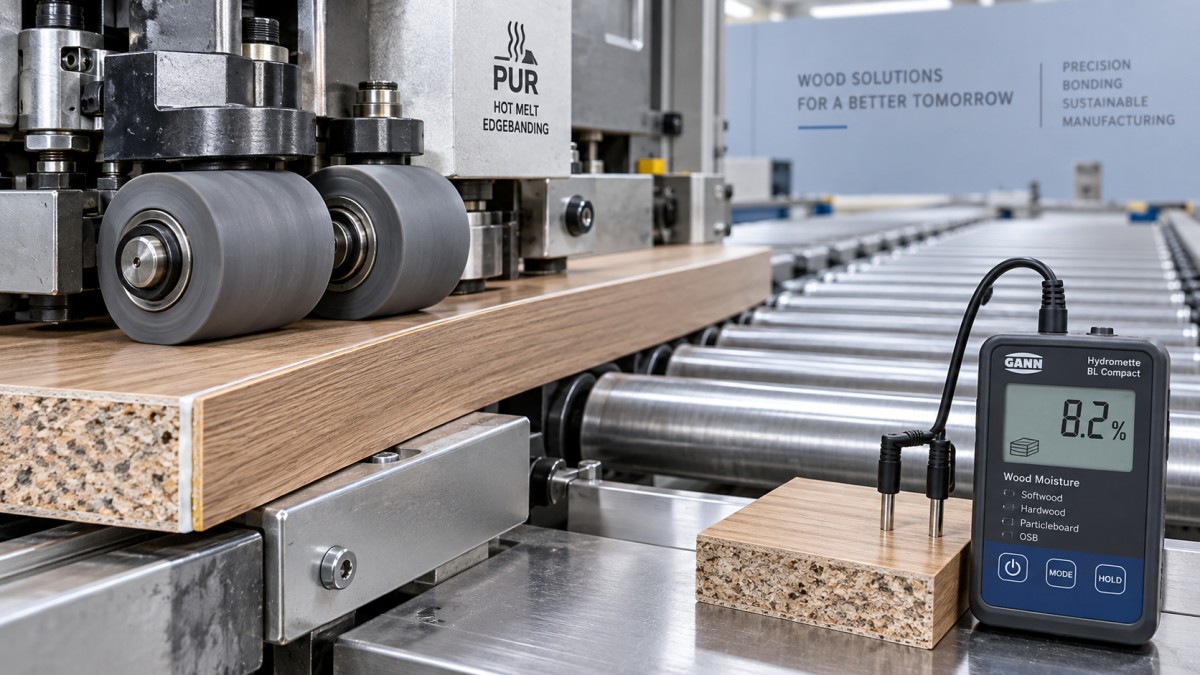
- Characterize incoming materials. Measure substrate moisture using a method suitable for the material. Electrical moisture meters need appropriate calibration or correction; readings from solid wood should not be transferred uncritically to MDF or particleboard.
- Record the complete exposure. Log air temperature and relative humidity during bonding and subsequent storage. Include substrate temperature where condensation or rapid adhesive cooling is a concern.
- Control bond formation. Record application temperature, coat weight or film thickness, line speed, contact pressure, and the delay between adhesive application and pressing.
- Measure performance at defined intervals. Use a repeatable strength or peel method appropriate to the joint and evaluate the failure mode, not just the peak force.
The test schedule should distinguish immediate handling requirements from later machining, packing, transport, and service requirements. Heat-resistance testing may reveal incomplete cure that a room-temperature handling check misses. However, it must use controlled specimen geometry, loading, and exposure conditions to support a meaningful comparison.
Failure location provides additional evidence. Separation at the substrate–adhesive interface can indicate poor wetting, contamination, or incompatible surface treatment. Failure within the adhesive can indicate insufficient strength development, but it is not conclusive proof of low humidity. Porous adhesive sections suggest gas entrapment and warrant investigation of moisture, application conditions, and adhesive handling together.
Reading standards and supplier claims correctly
A statement such as “fully cured after 24 hours” is incomplete unless its test conditions and acceptance criterion are known. It could refer to a particular strength threshold under specified laboratory conditions rather than complete chemical conversion throughout every possible bond geometry.
Similarly, a water-resistance classification, heat-resistance result, or adhesive approval does not establish a universal production cure time. Its relevance depends on the standard’s scope, specimen preparation, conditioning, substrate, and test procedure. A classification for one type of wood joint should not be treated as automatic validation of a shaped edge-band assembly.
Acceptance criteria should therefore connect a named test method—or a documented internal method—to the actual assembly and required performance. Environmental limits should be treated as validated operating boundaries, with defined action when materials or storage conditions fall outside them.
The most reliable humidity specification is not a single factory RH number. It is a relationship between material moisture, temperature, bondline geometry, exposure time, and demonstrated joint performance. Once that relationship is established, humidity records become useful production evidence rather than an indirect assumption that every firm-looking bond is fully cured.
Send Your Inquiry
We welcome your cooperation and we will develop with you.