


News & Exhibitions
Latest Factory Updates, Industry Trends & Global Exhibition Information
How Wood Grain Brushing Machines Create Consistent Texture on Veneer Panels
How Wood Grain Brushing Machines Create Consistent Texture on Veneer Panels
A veneer panel can look flat even when the wood species itself has attractive grain. This is especially common after sanding, pressing, or applying a dense veneer sheet to MDF, plywood, or particleboard. The visual pattern is present, but the tactile contrast between earlywood and latewood has been reduced. A Wood Grain Brushing Machine restores that contrast by selectively removing softer fibres while leaving the denser grain structure more pronounced.
For furniture factories and panel-processing workshops, the aim is not simply to make the surface rougher. The goal is to produce a controlled, repeatable texture that looks natural after staining, painting, oiling, or laminating. A good brushed panel should have visible grain depth without torn fibres, dark streaks, patchy areas, or brush marks that become obvious under side lighting.
That balance is where machine setup matters. Veneer is less forgiving than solid wood. Its face layer may be thin, its density can vary from sheet to sheet, and adhesive or sanding inconsistencies below the veneer can affect the final appearance. Operators need to understand the relationship between brush type, contact pressure, feed speed, panel support, and the condition of the incoming surface. If one of those variables drifts, texture consistency usually drifts with it.
What the Brushing Process Actually Does
Wood grain brushing is sometimes described as “opening the grain,” but that phrase can be misleading. The machine does not create wood grain that was not already present. It follows the natural density difference in the material. Softer earlywood is abraded more readily, while harder latewood remains relatively raised. On species with a clear open structure, this creates a textured surface that can resemble weathered timber, wire-brushed oak, aged ash, or deeply grained decorative boards.
The result depends heavily on the veneer species and cut. Oak, ash, elm, chestnut, and some softwood veneers often show stronger brushing effects because their grain contrast is more obvious. Fine, dense, or closed-grain species may produce a subtler result. That is not a machine problem; it is a material characteristic. A common production mistake is trying to force a dramatic texture onto a veneer that does not naturally respond well to aggressive brushing. The outcome can be fibre tearing rather than a refined grain effect.
In a properly configured line, the panel passes under one or more rotating brush heads. Depending on the desired finish, these may be steel wire brushes, abrasive nylon brushes, sanding brushes, or combinations of different brush materials. The first station may establish the texture, while a later station cleans loose fibres, softens sharp grain edges, or evens out the visual appearance before finishing.
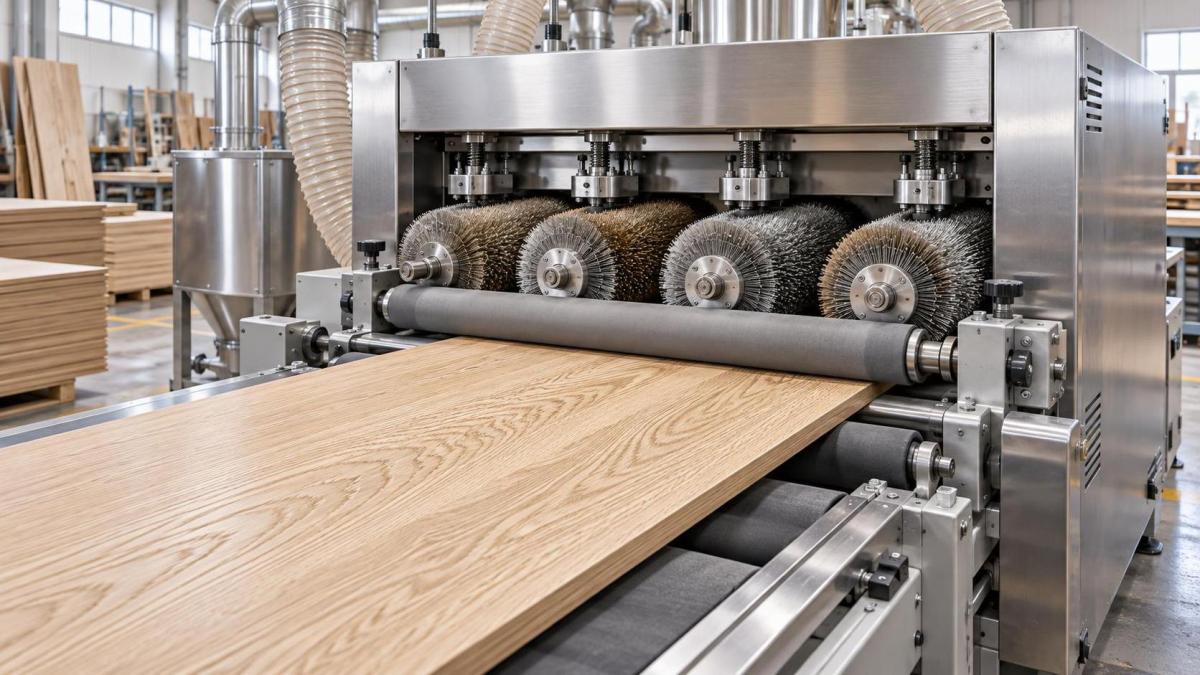
Why Veneer Panels Need More Control Than Solid Wood
Solid wood offers more sanding allowance. Veneer does not. Once an operator brushes through the face layer, the panel may be unusable or require costly rework. This is why a Wood Grain Brushing Machine for veneer processing needs stable workpiece support and predictable brush contact rather than brute-force abrasion.
Panel flatness is one of the first things to check. A slightly bowed board can receive too much brushing at the high points and too little at the edges or centre, depending on the conveyor and hold-down arrangement. Likewise, a panel with poorly bonded veneer may show local lifting when the brush catches loose fibres. Brushing will not correct a weak veneer bond; it often exposes it.
Surface preparation matters just as much. If the incoming panel still has cross-grain sanding scratches, glue contamination, uneven filler, or inconsistent sanding marks, the brushing stage can make those defects more visible. Brushing enhances surface character, including unwanted character. For that reason, production teams should inspect the panel after pre-sanding rather than assuming the brushing machine will hide upstream variation.
This is particularly important for decorative panels intended for transparent stain or dark oil finishes. A heavy pigment can conceal some inconsistency, while a clear or semi-transparent coating tends to reveal every change in grain depth. The finishing department should therefore be involved when brushing standards are set, not only after the first batch has already been processed.
The Settings That Determine Texture Consistency
There is no universal recipe for brushed veneer. The same settings can produce different results on two oak veneer lots because veneer thickness, moisture condition, grain orientation, and density are not identical. Still, several operating variables consistently deserve attention.
The most reliable approach is to change one variable at a time during sampling. If feed speed, brush height, and rotation speed are all adjusted together, it becomes difficult to identify why the panel changed. This sounds basic, but it is where many setup trials lose useful information. Keep a sample board beside the machine, label the settings used, and evaluate it after the intended finish has been applied whenever possible.
Brush Selection Is Not Just About Aggressiveness
Steel wire brushes are commonly used when a more pronounced rustic texture is required. They can remove soft grain efficiently, but they demand careful setup on veneer. Brush wire diameter, wire configuration, and the way the brush contacts the surface all affect the final result. A setup suitable for solid oak may be too severe for a thin oak veneer face.
Abrasive nylon brushes offer a different kind of control. They can combine brushing and light sanding action, making them useful for refining the surface after a more aggressive first pass or for producing a softer texture. In practical production, the best result is often not achieved with one brush alone. A primary brush establishes relief; a secondary brush cleans, blends, or reduces raised fibres that might otherwise absorb stain unevenly.
Brush direction deserves attention too. Most brushing follows the grain direction, especially on long furniture components and decorative wall panels. Working against the grain can make the surface look fuzzy and may pull fibres from vulnerable veneer areas. Cross-grain brushing is sometimes used for special effects, but it should be treated as a deliberate finishing choice, not an accidental consequence of panel orientation on the conveyor.
Feed Stability Often Matters More Than Maximum Output
When a line is running well, operators may be tempted to increase throughput by raising conveyor speed or reducing the number of brush passes. That may work for a relatively forgiving texture, but veneer panels need visual consistency from the first board to the last. A feed system that slips, hesitates, or allows panels to shift can leave visible bands or irregular brushing marks. These defects may not be obvious until stain is applied.
Stable feeding depends on more than the conveyor motor. Roller condition, pressure settings, dust buildup, panel dimensions, and the grip of the transport surface all influence how smoothly the board moves. Very light or narrow components can be more difficult to control than full-size panels. In those situations, supporting fixtures, suitable hold-down systems, or adjusted production methods may be necessary.
The operator should also watch the transition between panels. If the brush head reacts differently at leading and trailing edges, edge texture may not match the centre. This is not always avoidable, particularly on short workpieces, but it should be checked during sample approval. A panel that looks acceptable at a quick glance may still show edge-to-centre variation once it is assembled into a cabinet door or wall system.
A Practical Inspection Routine Before Finishing
Visual inspection should not rely only on overhead factory lighting. A low-angle light is useful because it reveals relief, streaking, and directional marks that are difficult to see from directly above. Operators should inspect both the centre and edges of the panel, then compare panels from the beginning and end of a run. Consistency across a batch is more valuable than making one sample panel look dramatic.
A practical check includes the following:
- Texture depth appears even across the usable face area.
- No loose fibres, splinters, torn veneer, or exposed substrate are visible.
- Brush marks follow the intended grain direction.
- Panel edges are not noticeably more or less textured than the middle.
- The surface is clean enough for the next finishing stage, with dust properly extracted.
- Approved reference samples remain available at the machine for comparison.
Dust extraction is not an optional housekeeping detail. Fine dust can settle into recessed grain, interfere with stain absorption, and make it harder to judge the true surface. It also accelerates wear in moving components when machine cleaning is neglected. A brushing line should be maintained as part of the finishing process, not treated as a separate rough-processing station.
Where Operators Usually Lose Consistency
One frequent issue is continuing to use a brush after its cutting behaviour has changed. Brushes do not fail only when they break. They gradually lose uniformity, load up with residue, or wear unevenly across their width. The machine may still run, but the surface no longer matches the approved standard. A routine brush inspection and replacement plan is less expensive than discovering a finish mismatch after coating.
Another issue is treating every veneer lot as identical. Even when the species name is the same, the grain pattern and density can vary. A new veneer batch should be trial-brushed before full production. It may require a small adjustment in brush contact or feed rate, especially when the final coating is transparent. The adjustment should be documented so that operators do not have to rediscover it during the next production run.
Machine suppliers can help establish those working conditions, but the final texture standard belongs to the factory’s process. Qingdao Zhongding Machinery Co., Ltd., with more than two decades in woodworking machinery manufacturing and export, approaches this type of equipment as part of a broader processing line rather than as an isolated machine. For users, that perspective matters: brushing performance is connected to pre-sanding, panel handling, dust extraction, finishing requirements, spare-parts availability, and the ability to obtain technical support when production conditions change.
Consistency Comes From a Controlled Process, Not a Single Setting
A Wood Grain Brushing Machine can make veneer panels more tactile, more visually distinctive, and easier to position within premium furniture or decorative panel ranges. But the machine alone does not guarantee a good result. Stable panel quality, appropriate brush selection, measured adjustments, clean feeding, and inspection under realistic lighting all contribute to the final surface.
For operators, the most useful habit is to protect the approved texture standard. Keep physical samples, record changes, inspect brush wear before quality complaints appear, and test new veneer lots before committing a full batch. On veneer, subtle process discipline is usually what separates a convincing natural grain effect from a surface that looks overworked.
Send Your Inquiry
We welcome your cooperation and we will develop with you.