

News & Exhibitions
Latest Factory Updates, Industry Trends & Global Exhibition Information
Can a Woodworking Belt Sander Safely Sand Metal Furniture Parts?
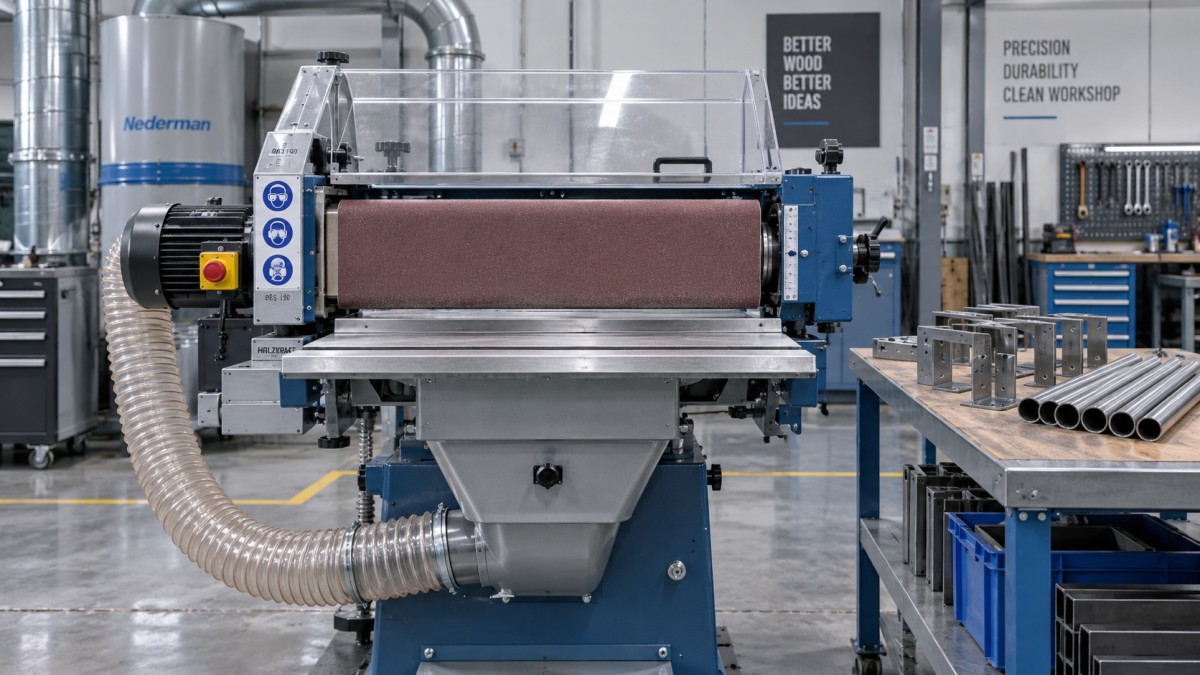
A woodworking belt sander should not be used on metal furniture parts unless the manufacturer explicitly approves the exact machine configuration for that work. A belt that cuts steel does not make a wood-only machine safe for metal. The decisive issues are spark containment, dust extraction, workpiece support, operating speed, and protection of the machine’s internal components.
For a sander connected to a wood-dust collection system, the immediate answer is no: do not introduce metal-grinding sparks into that system. Even a brief deburring job can send hot particles into accumulated sawdust. Approved mixed-material equipment can be an exception, but only when its extraction arrangement, cleaning procedures, and operating limits are followed.
Start with the machine’s approved use—not the abrasive belt
“Belt sander” describes several machines with very different capabilities. A small bench-mounted belt-and-disc sander, an edge sander, and a wide-belt thickness sander do not present the same handling or extraction risks. Approval for one model cannot be transferred to another simply because both use a similar abrasive.
Check the operating manual for permitted materials and prohibited applications. If metal is not addressed, obtain written confirmation from the manufacturer for the machine model, proposed material, and operation. An abrasive supplier’s statement that a belt is suitable for steel confirms the belt’s application—not the machine’s.
A useful compatibility inquiry should identify:
- The metal or alloy, including any plating, paint, or other coating.
- The part’s dimensions, wall thickness, and shape.
- Whether the task is light deburring, weld blending, stock removal, or cosmetic finishing.
- The proposed belt specification, belt speed, and contact arrangement.
- The extraction system and whether it has previously handled wood dust.
Manufacturer approval is a necessary starting point, not a substitute for assessing the installation. A machine capable of processing metal may still be unsafe when connected to an unsuitable collector or used with unsupported parts.
Why the dust system can rule out the job
Grinding steel can generate incandescent particles. These can travel beyond the visible spark stream and enter the extraction hood, ductwork, filter, or collection container. Wood dust retained in those locations supplies fuel; ignition need not produce an immediate, visible flame at the machine.
Emptying the collection bag does not eliminate this risk. Dust can remain on filters, in duct bends, behind guards, and inside the sander. Nor does disconnecting the extraction hose make a wood-only machine acceptable: residual dust can still ignite, while airborne metal dust becomes an uncontrolled exposure.
A spark trap alone is not proof that a shared collection system is suitable. Spark control, dust characteristics, filtration, collector construction, and fire or explosion protection must be considered together. Use an extraction arrangement designed for the actual process and material, with competent assessment where combustible dust is involved.
Metal dust also cannot be treated as one uniform waste stream. Fine aluminum dust can present a combustible-dust hazard even when the operation produces little visible sparking. Mixing certain metal dusts, including aluminum and iron-bearing residues, can introduce additional hazards. An ordinary shop vacuum is not an acceptable default solution.
Where switching between materials is permitted, the changeover procedure needs to address the whole dust path—not just the belt and collection bin. If the machine or ducting cannot be adequately inspected and cleaned, keeping wood and metal processes separate is the more defensible choice.
Identify the metal and its surface condition
The fact that a component is used in furniture says little about its sanding requirements. A mild-steel bracket, stainless-steel trim strip, and aluminum leg can behave differently under the same belt.
Unknown coatings are a reason to pause. Sanding old paint or plated components can release hazardous substances, and appearance alone does not establish composition. Review available material documentation and arrange further assessment when the coating cannot be identified. Respiratory protection does not replace source control or make an unsuitable machine safe.
For stainless-steel furniture components, contamination is also a quality issue. A belt previously used on carbon steel can transfer iron-bearing particles, leading to surface rust staining. Changing the belt may not be sufficient if contaminated dust remains on the work support or other contact surfaces.
Check whether the machine can control the part
A machine designed to feed broad wooden panels may not safely handle a short bracket, narrow tube, or open frame. Conveyor friction, pressure rollers, hold-down devices, and minimum part dimensions all affect whether a component remains controlled during sanding.
On a wide-belt machine, do not assume that a small metal component can be placed on a board and passed through safely. A carrier changes the feed arrangement and requires manufacturer-approved design. Loss of retention can eject the part, damage the sanding head, or pull the carrier into the machine.
On a bench or edge sander, inspect the work rest, belt travel, exposed contact area, and trapping points. A thin bracket can enter a gap; a tubular leg can rotate unexpectedly; a projecting tab can catch on the belt. Work-rest settings and allowable part sizes must follow the machine instructions.
Internal durability matters as well. Conductive and abrasive debris can enter components that were not designed for metal grinding. Hot particles may damage a conveyor belt, platen covering, extraction hood, or other heat-sensitive parts. These limitations cannot be corrected simply by fitting a tougher abrasive belt.
Match the belt and speed to the approved operation
Once machine and extraction suitability are established, select the abrasive for the alloy, contact pressure, finish requirement, and machine configuration. Aluminum oxide, zirconia alumina, ceramic, and silicon carbide abrasives have different applications; the abrasive family alone is not a complete specification.
The belt backing, joint, dimensions, contact-wheel compatibility, and maximum permitted speed must also match the equipment. Some high-performance abrasives need pressure and operating conditions that a light woodworking sander cannot provide effectively. Conversely, a coarse belt that removes weld metal quickly may be too aggressive for thin decorative tubing.
There is no universal “safe metal speed” for woodworking sanders. Use the machine manufacturer’s approved range together with the abrasive supplier’s recommendations. Variable speed is useful only within an approved application; lowering the speed does not resolve unsuitable dust handling or workholding.
Heat depends on pressure, dwell time, belt condition, and contact area as well as speed. A loaded or worn belt rubs rather than cuts efficiently. Pressing harder to compensate can overheat the part, distort thin sections, and overload the machine. Increasing pressure is not a reliable cure for poor cutting performance.
Do not add oil, wax, grinding aids, or water unless the equipment and process explicitly allow them. These can affect belt tracking, extraction, fire risk, and subsequent coating adhesion. A dry sander does not become a wet-finishing machine by adding coolant.
Set up a controlled trial only after compatibility is confirmed
A trial establishes whether an approved process produces acceptable results; it must not be used to discover whether an unapproved machine is safe. Before starting, isolate the equipment using the applicable energy-control procedure for cleaning, belt changes, and adjustments.
Prepare the machine and work area according to the approved process:
- Remove incompatible residues from accessible machine surfaces and the extraction path using suitable cleaning methods.
- Inspect the belt, joint, tracking, guards, work support, and extraction connections.
- Provide a controlled spark discharge area, separated from combustible materials and nearby work.
- Establish secure handling or an approved fixture for parts that cannot be safely supported by hand.
- Select eye, face, hearing, and any required respiratory protection based on the task and exposure assessment.
Keep loose clothing, jewelry, and unsecured hair away from the moving belt. Follow the manufacturer’s instructions on gloves: sharp edges create a handling hazard, but gloves can also create an entanglement risk near moving machinery. Use appropriate handling protection after the machine has stopped rather than assuming gloves are safe during sanding.
Use a representative sample with the same alloy, wall thickness, geometry, and coating condition as the production parts. Start with the approved settings and light, controlled contact. Keep hands outside trapping zones and never bypass guards to reach a difficult surface.
Stop if the belt loads rapidly, tracking changes, the component becomes difficult to control, or abnormal vibration, smoke, or heat develops. Isolate the machine before investigating. Suspected fire in a collector or combustible-metal dust requires the site’s emergency procedure; extinguishing methods must suit the material, and water is not universally appropriate.
After the pass, check more than surface appearance. Inspect for rounded mounting edges, dimensional loss, distorted thin walls, heat tint, uneven scratch patterns, and remaining burrs. A smooth-looking part can still fail assembly or coating requirements.
When a dedicated metalworking sander is the better decision
A dedicated machine is the stronger option when metal finishing is recurring work, the existing sander is wood-only, or material changeovers require extensive cleaning. It is also preferable when parts need reliable fixturing, controlled weld blending, or repeatable cosmetic finishes that the woodworking machine cannot deliver.
“Metalworking” does not mean suitable for every metal. A machine and collector configured for steel may need different controls for aluminum or other combustible dusts. Selection should cover the complete system: material approval, part support, guarding, belt specification, extraction, and waste handling.
The cost comparison should include cleaning downtime, inspection, abrasive segregation, rejected finishes, maintenance, and the consequences of interrupting wood production—not just the purchase price of another machine. For occasional work, outsourcing the metal-finishing operation may be more practical than maintaining an approved mixed-material setup.
The operating rule is straightforward: no explicit approval, no metal sanding on the woodworking machine. Where approval exists, it applies only within the specified material, handling, extraction, and operating conditions. A different belt is one process component—not permission to convert a wood-only sander.
Send Your Inquiry
We welcome your cooperation and we will develop with you.