


News & Exhibitions
Latest Factory Updates, Industry Trends & Global Exhibition Information
Does a Metal Sander Need a Separate Dust Extraction System?
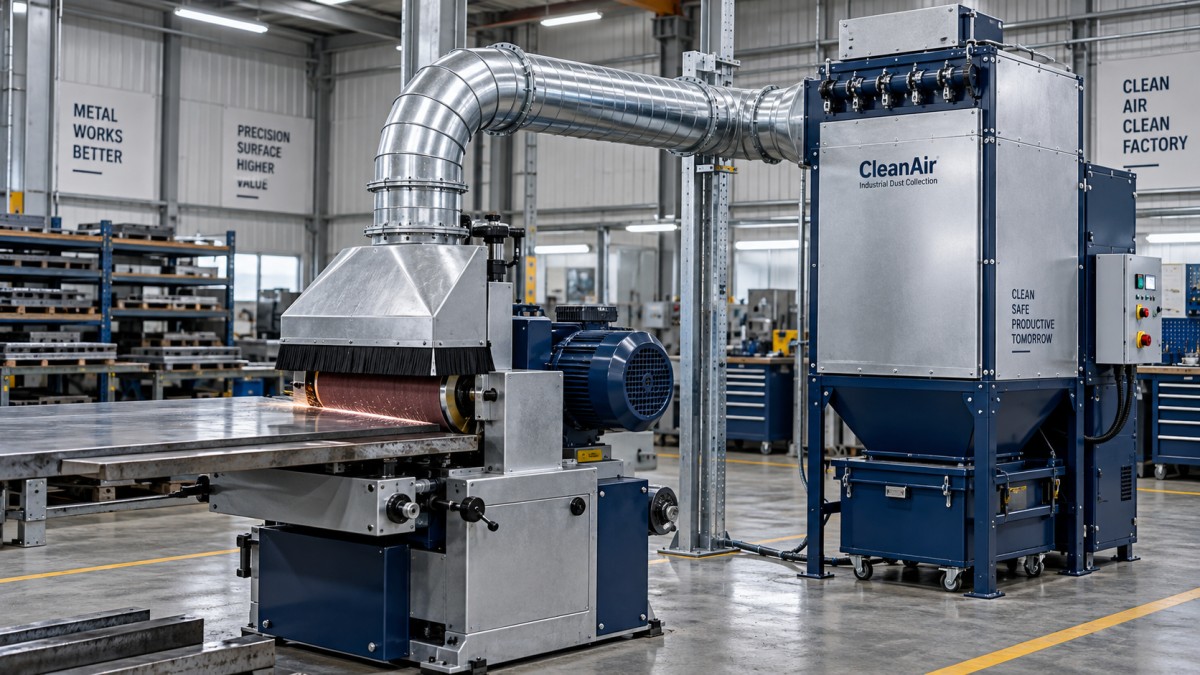
A metal sander generally needs extraction designed specifically for its metal dust and spark hazards, but it does not always need a standalone collector for every machine. Several sanders may share an engineered metal-dust system when their materials, operating conditions, and collection requirements are compatible. An existing woodworking dust collector should not be treated as a suitable connection point simply because its hose fits.
This decision often arises when a workshop adds metal deburring beside woodworking equipment or starts sanding aluminum on a machine previously used for steel. The wrong connection can carry ignition sources into combustible deposits, mix incompatible dusts, or leave fine particles in the breathing zone. Before connecting anything, establish what the sander produces and whether the entire extraction system—not just its filter—is suitable.
“Separate” means more than another extraction hose
A dedicated branch duct does not provide separation if it joins the same main duct, collector, or waste container as wood dust. Likewise, two collection inlets on one machine do not establish material segregation. Dust can remain inside the sander enclosure, duct bends, filters, and collection bins after production stops.
For this decision, distinguish between three arrangements:
- A machine-integrated extractor: potentially sufficient when its documented intended use covers the material, dust loading, and sanding process.
- A standalone metal-dust collector: serves one machine or a defined duty and remains isolated from incompatible collection systems.
- A centralized metal-dust system: serves several approved sources, with engineered controls for airflow, material compatibility, ignition, and explosion hazards where applicable.
The useful question is therefore not just whether a metal sander needs separate dust extraction. It is whether its emissions can safely enter the proposed system under normal operation, maintenance, and foreseeable changes in production.
Start with the material and the actual sanding operation
“Metal dust” is not one substance with one risk profile. Alloy composition, particle size, surface coatings, and process conditions all influence collection requirements. A collector approved for one metalworking operation is not automatically suitable for another.
Record the abrasive type, stock-removal rate, operating time, and whether the work produces fine finishing dust, coarse debris, or both. A brief deburring task and continuous wide-belt sanding can impose very different demands on the same collector. Small production volume does not, by itself, establish low ignition or exposure risk.
Why sharing with wood extraction is the wrong default
In a mixed workshop, the existing woodworking network may appear convenient: it already has ductwork, a fan, and a large collection bin. However, it also contains combustible material across surfaces that are difficult to inspect. Metal sanding can introduce hot particles into those deposits, including dust retained inside filters.
A spark arrestor or pre-separator does not turn a woodworking collector into an approved metal-dust system. Such devices may form part of an engineered design, but they do not eliminate every ignition source or resolve dust incompatibility. A cyclone separates particles; it is not, by itself, complete fire or explosion protection.
Do not connect a metal sander to a wood-dust network without an engineered assessment explicitly approving that arrangement. For routine workshop planning, keep metal sanding extraction separate from woodworking extraction. Merely emptying the wood-dust bin before sanding metal leaves deposits elsewhere and does not establish safe separation.
Using the same sander for wood and metal introduces an additional problem: material can remain behind guards, around rollers, and inside extraction passages. Confirm that the machine manufacturer permits the intended materials. Changing the hose alone does not make a woodworking sander suitable for metal processing.
When several metal sanders can share extraction
A centralized system can be practical where the dust streams are compatible and the collector was designed for those processes. Approval should cover the metals and coatings involved, expected dust characteristics, simultaneous machine operation, duct layout, and protective measures. “For metalworking” on a product description is not enough detail.
Airflow deserves particular attention. Opening a second branch can reduce capture at the first machine unless the system has adequate capacity and appropriate balancing. Closing branches can also alter duct transport conditions. The system must maintain capture at each active hood and convey dust without allowing hazardous accumulation.
Shared extraction also needs an operating boundary that staff can enforce. A system assessed for one specified steel-sanding process should not receive aluminum work merely because a spare connection is available. Identify permitted materials at the machine and inlet, and require review before adding another machine, coating, or alloy.
Separate collectors may simplify segregation, but separation alone does not make equipment safe. Each collector still needs suitable construction, location, filtration, waste handling, and any required fire or explosion protection.
Choose between dry and wet collection by hazard, not convenience
Dry collection
A suitable dry collector may be appropriate for an assessed metal-sanding process. Selection must address combustible-dust characteristics where relevant, ignition sources, filter suitability, electrical hazards, and safe disposal. Depending on the assessment and applicable requirements, engineered explosion protection and isolation may be necessary.
A high-efficiency filter describes particle-removal performance; it does not establish suitability for sparks, combustible dust, or reactive metals. An ordinary shop vacuum should not collect metal-sanding dust unless its manufacturer explicitly approves the specific material and duty. Improvised filters, hoses, or grounding connections are not substitutes for a suitable system.
Wet collection
Purpose-designed wet collectors are used for some metal-dust applications, but water is not universally safe for metal dust. Certain metals and fine particles can react with water and generate hydrogen. The design may therefore need controlled ventilation, water-level monitoring, and defined sludge-removal procedures.
Wet collection also creates a maintenance obligation. Sludge can remain reactive, and drying deposits may introduce additional hazards. Select this approach only with documented material compatibility and operating instructions covering collection, shutdown, cleaning, and waste storage. Do not improvise a wet collector by placing a hose in a water container.
A practical approval sequence before the first connection
- Define the permitted work. List base metals, alloys, coatings, contaminants, abrasive processes, and expected operating patterns. Obtain relevant safety data and machine instructions. Treat unidentified coatings or residues as an unresolved issue rather than assuming the base metal determines every hazard.
- Establish the dust hazards. Review available material information and determine whether representative dust testing is needed. Bulk-metal information may not describe fine sanding dust adequately. A competent combustible-dust assessment should establish whether fire and explosion controls are required.
- Obtain documented equipment suitability. Ask the sander and extraction suppliers to confirm compatibility with the defined duty. Include inlet conditions, spark loading, filtration, discharge, waste handling, and operating restrictions. A nominal airflow figure or motor rating is not sufficient evidence.
- Check the full installation. Review hoods, duct routing, fan duty, collector placement, electrical suitability, and required protective systems. Include bonding and grounding where specified, while recognizing that these control static electricity rather than every ignition mechanism.
- Commission under representative conditions. Measure extraction performance with the intended branches operating. Check hood capture, duct transport, filter pressure drop, and safety interlocks. Establish baseline readings and assess employee exposure where required.
- Define maintenance and change control. Specify inspection, cleaning, filter service, and waste-removal procedures. Require reassessment before changing materials, increasing production, modifying ducts, or adding equipment.
There is no single airflow number that makes every metal sander safe. Required volume and pressure depend on hood geometry, enclosure openings, belt direction, particle behavior, duct losses, and collector condition. Use the machine’s extraction requirements and an engineered duct calculation rather than selecting by hose diameter.
Signs the current arrangement needs attention
Dust escaping around the belt, deposits inside the machine, or visible leakage from the collector indicate that capture or containment needs investigation. A hose that feels as though it has suction can still provide inadequate airflow at the generation point. Conversely, an apparently clean workstation does not prove that fine-particle exposure is controlled.
Compare operating readings with commissioning baselines. Reduced airflow may result from blocked filters, obstructed hoods, duct deposits, leaks, fan problems, or changed branch positions. Do not simply increase fan speed: that can affect other branches, exceed equipment limits, or change protective-system requirements.
Unexpected heat, smoke, glowing material, or unusual collector behavior requires stopping work and following the site emergency procedure. Do not open a suspected burning collector or apply water to unknown metal dust. Fire response must account for the specific metal and the installed equipment.
For routine housekeeping, avoid compressed-air blowdown and dry sweeping that redisperse fine dust. Use cleaning methods and equipment approved for the material. Keep collected waste streams segregated and follow documented disposal procedures rather than combining them in a general workshop bin.
What to request when specifying the system
Send prospective suppliers a process description, not just a request for “a dust collector for a metal sander.” Include machine details, extraction connections, materials and coatings, working schedule, simultaneous operations, proposed location, and discharge arrangements. Ask suppliers to state permitted materials and exclusions explicitly.
The acceptance documentation should identify required airflow and pressure, monitoring points, filter-service limits, protective measures, cleaning procedures, and waste-handling requirements. Where air will return indoors, confirm that recirculation is permitted and adequately controlled for the actual contaminants and hazards.
Until that suitability is established, do not connect the sander to an available wood-dust line or general-purpose vacuum. The practical choice is a documented, compatible metal-dust extraction arrangement—either dedicated to the machine or shared within a properly engineered metalworking system.
Send Your Inquiry
We welcome your cooperation and we will develop with you.