


News & Exhibitions
Latest Factory Updates, Industry Trends & Global Exhibition Information
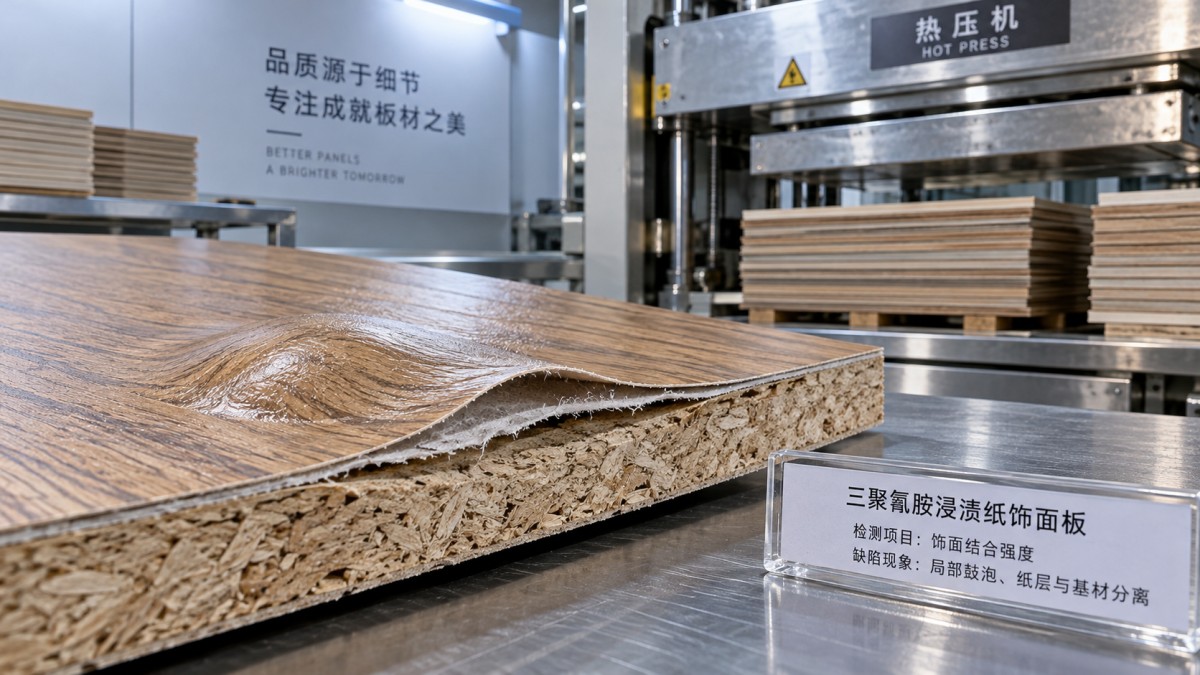
What causes surface blisters during melamine paper lamination?
Surface blisters during melamine paper lamination form when gas pressure beneath the decorative layer exceeds the strength of the developing bond or the panel surface. Excess substrate moisture is one possible source, but the same defect can result from unsuitable resin condition, uneven heating, poor surface contact, or a press cycle that releases pressure before the assembly can withstand it. Increasing temperature or pressure without identifying the failure mechanism can make the problem worse.
The most useful first distinction is where the panel has separated: between the paper and board, within the board’s surface layer, or deeper inside the substrate. Combine that evidence with when the blister appears and whether it follows the material batch or a fixed position in the press. These observations narrow the investigation far more effectively than changing several press settings at once.
Start with the blister’s location and timing
This discussion concerns resin-impregnated decorative paper pressed directly onto a wood-based panel. If a separate adhesive bonds a prefabricated laminate to the board, adhesive spread, open time, and curing requirements introduce additional variables. Establish which construction is being processed before applying a troubleshooting procedure.
Place affected panels on hold and retain examples with their production records. Record the board lot, paper lot, storage conditions, press recipe, loading orientation, and time between pressing and inspection. Mark each defect’s position relative to the press and panel edges. A photograph without this orientation information can hide an otherwise useful pattern.
A raised area alone does not establish the cause. Once the sample has cooled and can be handled safely, examine a section through a representative blister using an approved inspection method. Look at the separation plane and the material remaining on each side.
- Separation at the paper-to-board interface: investigate resin flow and cure, contamination, and insufficient contact. A relatively clean interface supports these possibilities but does not identify one conclusively.
- Board fibers attached to the underside of the paper: investigate failure within the substrate surface, including weak surface layers and moisture-related stress. The bond may have exceeded the local strength of the board.
- Separation deeper within the panel: investigate substrate internal integrity and pressure generated inside the board. Surface preparation alone is unlikely to solve this failure.
Timing adds another clue. Blisters that become visible as the press opens are consistent with internal pressure acting when external restraint is removed, although weak bonding can produce the same timing. Defects that emerge during cooling or later storage warrant examination of residual heat, moisture redistribution, cure condition, and handling. Inspect panels at consistent intervals so that a change in inspection timing is not mistaken for a process improvement.
Check moisture and material condition before changing the recipe
Moisture can vary within an apparently acceptable board lot
During pressing, heat drives moisture movement and can generate vapor inside the substrate. If vapor cannot escape or redistribute sufficiently, it places stress on the decorative layer and the board itself. When pressure is released, a weak interface or weak internal layer can open into a blister.
A single moisture reading from the top of a stack is weak evidence. Compare affected and unaffected boards from different stack positions, and check whether readings vary across the panel. Use an instrument and measurement procedure suitable for the substrate. Meter readings can be influenced by board density, temperature, and calibration; where results are disputed, use the agreed reference method rather than treating every displayed value as directly comparable.
The acceptance range should come from the board and paper suppliers’ processing guidance and the qualified production process. There is no universal moisture percentage that guarantees blister-free lamination across MDF, particleboard, plywood, and different resin systems. Local moisture variation can matter even when a batch average appears acceptable.
Review storage and transfer conditions as well. Cold boards moved into a warm, humid area may develop surface condensation. Uneven exposure within a stack can also create different conditioning histories. Stabilizing materials under controlled conditions may help, but drying or conditioning changes need their own limits: aggressive drying can alter flatness, surface condition, and subsequent processing behavior.
Impregnated paper must retain the right processing behavior
Melamine-impregnated paper depends on a controlled balance between resin flow and cure. During pressing, the resin must make adequate contact with the substrate and develop sufficient strength within the specified cycle. Paper that has absorbed moisture, exceeded its permitted storage period, or advanced in cure during unsuitable storage may behave differently from a previously successful lot.
Review packaging integrity, storage temperature and humidity records, opening dates, and supplier shelf-life requirements. Keep paper identification linked to individual press batches. If blistering starts with a paper-lot change, compare retained material under the same qualified conditions before concluding that the press needs a new recipe.
Residual moisture and other volatiles in the paper can contribute to gas generation. Conversely, resin with insufficient flow may leave poorly bonded areas that become visible under modest internal stress. These mechanisms require different corrections. Supplier testing of flow, volatile content, or cure behavior can be useful when available, particularly if production records show that the defect follows the paper lot.
Determine whether the press is delivering the intended cycle
A recipe displayed on the control screen does not prove that every part of the panel experiences the intended temperature, pressure, and time. Blistering can arise when the nominal settings are suitable but heat transfer or contact varies across the load.
More heat can increase gas generation while shortening resin flow
Insufficient heat or a cycle that is too short can leave the bond inadequately developed. Excessive temperature can drive moisture into vapor more rapidly and may advance resin cure before adequate wetting has occurred. Extending the cycle or raising temperature therefore needs a defined hypothesis; neither adjustment is a universal response to blisters.
Compare actual temperature behavior with the qualified process using approved measurement methods. Check for differences across platen zones, unstable control, and changes after maintenance or extended downtime. Panel thickness, starting temperature, and loading sequence can affect how quickly the interface heats, even when the displayed platen temperature remains constant.
Uneven contact can resemble a resin problem
Pressure must produce consistent contact across the panel. Thickness variation, panel distortion, worn press components, or debris on contact surfaces can leave areas with poor heat transfer and weak bonding. A hydraulic pressure reading alone does not establish uniform pressure over the working area; panel size and loading arrangement affect the relationship between machine pressure and panel loading.
Defects that repeatedly occupy the same press coordinates justify checks of platen condition, heating distribution, parallelism, and the relevant pressure system. Defects that follow a particular board when its orientation changes point more strongly toward material variation. Use approved loading configurations during these comparisons, because changing the occupied press area can itself change processing conditions.
The release stage can expose an existing weakness
When the press opens, external restraint falls while the panel may still contain hot vapor or other gases. If the developing bond or substrate cannot resist that stress, a blister can form immediately. Opening behavior therefore belongs in the investigation, alongside dwell time and temperature.
Any adjustment to decompression or opening must remain within the press manufacturer’s operating limits and the material supplier’s processing requirements. A staged release may be relevant on equipment designed for it, but an improvised opening sequence can introduce hazards and conceal an unresolved material problem. Never bypass guarding, interlocks, or programmed protections to observe a defect more closely.
Inspect the surface, then run a controlled correction
Dust, oil, handling residues, and loose fibers can interrupt resin contact. Uneven sanding can leave ridges or thickness differences that reduce local contact, while excessive material removal may expose a less suitable board layer. A visibly smooth panel is therefore not enough: the surface must also be clean, consistent, and compatible with the qualified lamination process.
Inspect panels immediately before layup rather than relying solely on checks after sanding. Dust may be redeposited during conveying or storage, and compressed-air cleaning can redistribute it if extraction is ineffective. Compare defect locations with handling points, conveyor contact, and recurring surface marks. Keep cleaning products and maintenance lubricants away from bonding surfaces unless their compatibility has been established.
Where thickness variation or surface irregularity is demonstrated, upstream equipment such as a Planer Sanding Machine may support consistent preparation by combining thickness planing and sanding. Its suitability depends on the substrate and required material removal. Planing should not be assumed appropriate for every MDF or plywood surface, and additional sanding cannot correct excessive moisture, unsuitable resin condition, or failure inside the board.
Once the likely mechanism is identified, structure the trial around one question. For example, if the evidence points to substrate moisture, compare appropriately conditioned boards with the suspect material while holding the paper and qualified press settings constant. If the defect follows a fixed press position, prioritize equipment checks before consuming more material in recipe trials.
- Preserve a baseline: retain representative defective and acceptable panels, along with their actual production conditions.
- Change one meaningful variable: define the expected result before running the trial, and remain within approved processing limits.
- Inspect beyond appearance: use applicable bond, surface, or substrate integrity checks from the quality plan to establish whether the failure mechanism has been corrected.
- Check after cooling: apply consistent inspection timing and relevant conditioning requirements before accepting the result.
- Confirm repeatability: verify the correction across representative material variation and operating conditions before releasing held production or revising the standard recipe.
A blister-free face immediately after pressing does not establish that the panel has adequate bond strength. A setting change might suppress visible swelling while leaving incomplete cure or weak internal layers. Release decisions should therefore follow the product’s acceptance requirements, with traceability sufficient to distinguish affected batches from verified production.
For safety personnel, troubleshooting also includes controlling access to hot platens, moving loading equipment, and hydraulic systems. Temperature mapping, cleaning, and mechanical inspection require the appropriate approved procedure and isolation where necessary. Dust extraction must remain effective during surface preparation, and press ventilation should remain in service during trials.
The strongest corrective action matches the observed separation, defect pattern, and process evidence. A problem that follows wet boards needs material control; one that stays in the same press location needs equipment investigation; one tied to paper storage or lot changes needs resin-condition checks. When those relationships are documented, the next adjustment becomes a testable decision, and the resulting production limit has a defensible basis.
Send Your Inquiry
We welcome your cooperation and we will develop with you.