


News & Exhibitions
Latest Factory Updates, Industry Trends & Global Exhibition Information
Planning a Furniture Production Line for Custom Cabinet Orders
A furniture production line for custom cabinets should be planned around the range of orders it must process, not around the output of its fastest machine. A line that cuts panels quickly can still miss delivery dates if parts wait for edge banding, drilling information is incomplete, or finished components cannot be matched to the right order.
Start by defining the expected order mix, the available production time, and the quality customers require. Then map the movement of information and materials through the factory. This sequence makes it easier to decide where automation will help, where manual work remains practical, and how much capacity the entire operation can deliver.
Define the work before specifying machines
Cabinet output is more useful as a planning measure when it is translated into the work behind each order. A simple cabinet with a few rectangular panels places different demands on a line than a unit with multiple drawers, adjustable shelves, special finishes, and nonstandard fittings.
Review representative orders and record the features that affect processing:
- Typical and maximum panel dimensions, including unusually long or narrow parts.
- Board materials, thicknesses, surface finishes, and edge-banding requirements.
- The proportion of standard cabinets versus one-off sizes and designs.
- Common drilling patterns, hardware types, grooves, and other machining operations.
- Required delivery times, order changes, and expectations for finished quality.
Separate cabinet carcasses from doors, drawer components, and any solid-wood or painted elements. These may require different equipment and finishing processes. A panel-processing line can produce many cabinet components, but it does not automatically cover every operation needed for a complete order.
Also decide which work will remain outside the factory. If painted doors or specialist components are purchased, their lead times and identification must be included in the production schedule. Otherwise, an efficient internal line may still produce incomplete orders that occupy valuable floor space while waiting for bought-in parts.
Turn order demand into a practical capacity target
Estimate demand in panels or parts as well as finished cabinets. Use the expected order mix to establish how much cutting, edge banding, drilling, assembly, and packing work must be completed during the available working time. Include setup, material handling, routine maintenance, quality checks, breaks, and normal interruptions. A capacity figure based only on continuous machine operation will be difficult to achieve in a custom shop.
For each main operation, compare the required workload with the time the equipment and operators have available. Pay particular attention to the process with the least spare capacity: it will tend to determine the pace of the line. The constraint may change with the order mix. Complex edging can slow one batch, while hardware-intensive cabinets can put more pressure on drilling and assembly.
Test the plan against a busy period as well as an average week. If demand is uneven, consider whether overtime, a second shift, subcontracting, or a modest buffer of prepared components is preferable to buying equipment sized for a peak that rarely occurs. Any buffer should be traceable to an order and protected from damage; otherwise, it can turn into misplaced work in progress.
Map the physical flow and the information flow together
A typical panel-based cabinet route runs from board storage and cutting through labeling, edge banding, drilling or CNC machining, inspection, assembly, and packing. The exact order depends on the machines and the part design. Some components may need to return for a second operation, while purchased doors and fittings may enter the process close to assembly.
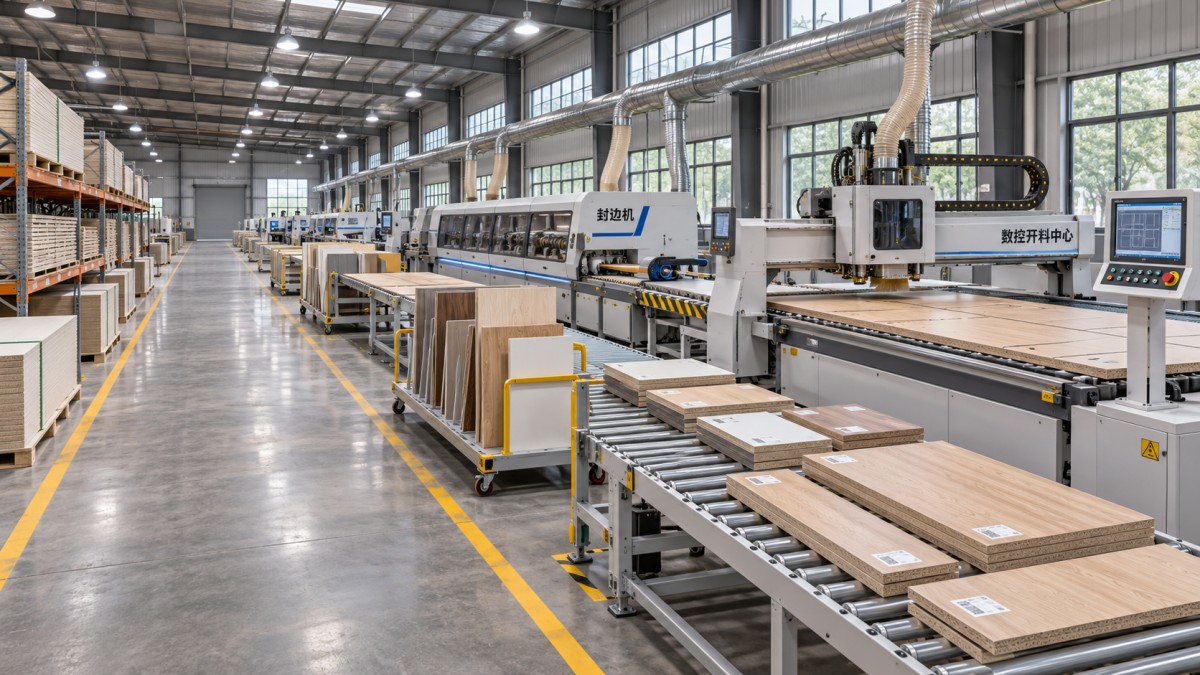
Draw the proposed route on the actual floor plan, including loading and unloading positions, turning space for large boards, access for forklifts or trolleys, and storage for work between stations. Avoid layouts that force finished parts to cross incoming sheet traffic. Allow enough space around machines for safe operation, cleaning, maintenance, and the removal of dust and offcuts.
Then follow the order information along the same route. Each part needs a reliable link to its job, material, dimensions, edge treatment, machining instructions, and final cabinet. Labels or another identification system should remain readable through processing and be placed where they will not damage a visible surface. Agree on how rejected or remade parts are identified so they can rejoin the correct order.
Software matters because an error can travel quickly through an automated line. Establish who releases a design for production, how revisions are controlled, and whether a change can be stopped after parts have been cut. Check that design, nesting or cutting, machine programming, labeling, and production tracking can exchange the required information without repeated manual entry. A demonstration using representative cabinet files is more useful than a general statement that systems are compatible.
Choose equipment around the parts and the order mix
Panel cutting and nesting
A beam saw can suit operations that process substantial quantities of similar panels and can organize cutting efficiently around common board sizes. A CNC nesting router can be attractive when orders contain many differently sized parts and require operations such as cutting and machining features in the same setup. The choice depends on material handling, part geometry, required finish, programming, and how the rest of the line works.
Neither approach removes the need to manage small or awkward parts. Ask how they are held, labeled, unloaded, and transferred without damage. Check whether the planned cutting process leaves an edge quality suitable for the next operation and how offcuts will be identified for reuse.
Edge banding
For many panel-based cabinet lines, edge banding has a major effect on both appearance and throughput. Select a machine for the board and edging materials, thickness ranges, finishes, and daily changeovers it must handle. Consider the processing units needed for the desired result, including how the line will deal with visible edges, corners, and parts that need different treatments.
A high-speed machine offers limited benefit if operators must repeatedly stop to change materials or if parts arrive in the wrong sequence. Conversely, a compact edge bander may be sufficient where volumes are modest and the order schedule leaves time for adjustment. In either case, test representative boards and edge materials, including sensitive finishes, and inspect bond quality and visible surfaces after processing.
Drilling and machining
Cabinet assembly depends on consistent hole positions for hinges, runners, shelves, connectors, and other fittings. A CNC drilling or machining center can reduce manual layout work when programs are generated accurately and the order mix justifies it. For simpler or lower-volume production, dedicated boring equipment and well-controlled fixtures may be a better fit.
Check access to every required face and edge of the part. Some designs may need repositioning or a separate operation, which affects handling time and the risk of orientation errors. Hardware specifications should be reflected in the production data; changing a fitting can change the machining pattern even when the cabinet dimensions stay the same.
Plan the work between machines
Manual handling often determines whether an otherwise well-specified line reaches its target. Large sheets need suitable loading arrangements, while finished panels need support that prevents scratches, chipped edges, and bending. Consider lifting aids, roller tables, carts, and clearly marked staging areas as part of the project scope, rather than accessories to be added after installation.
Decide how parts will be grouped. Processing by material or edge type can reduce machine changes, but assembly may then wait for components scattered across several batches. Processing by order can simplify tracking and delivery, although it may increase changeovers. A practical schedule balances these effects and sets a limit on how much unfinished work can accumulate between stations.
Assembly and packing deserve the same attention as machining. Provide space for hardware, checks, rework, and protection of finished surfaces. If cabinets are shipped flat-packed, define how parts and fittings are grouped and labeled. If they are shipped assembled, include the extra handling and storage space needed for completed units.
Budget for the working system, not just machine prices
The equipment quotation is only one part of the investment. The project budget should also account for installation, electrical supply, compressed air where required, dust extraction, material handling, software, tooling, consumables, training, and the space needed for maintenance and storage. Site conditions can change the cost and layout significantly, so involve the relevant machine and facility suppliers while the plan is still flexible.
Operating costs also vary with the chosen process. Faster cutting may require more capable extraction and handling; a highly automated cell may depend on trained programming and maintenance staff. Compare options using the expected workload, labor needs, consumables, maintenance arrangements, and the consequences of downtime. Buying capacity that cannot be supplied with material or kept in production is unlikely to solve a delivery problem.
Service access and spare parts should be discussed before purchase. Qingdao Zhongding Machinery supplies woodworking machinery and complete solutions, with technical support and spare parts among its stated services. When evaluating any supplier, ask what support is available for the proposed configuration, how operators and maintenance staff will be trained, and how replacement parts will be supplied to the installation site.
Set acceptance criteria before equipment arrives
Use the same representative parts and materials selected during planning to define acceptance checks. Include ordinary orders, mixed dimensions, visible finished panels, and any demanding drilling or edge-banding requirements. Agree on how dimensions, edge quality, hole positions, surface condition, labeling, and output will be assessed, along with the operating conditions for the run.
Include the transitions between machines in the trial. A cutting machine may perform correctly on its own while labels, programs, or part orientation cause errors at drilling or assembly. Run a complete order through to packing, record interruptions and rework, and assign responsibility for resolving open issues before full production begins.
Leave room for growth where it has a clear operational purpose: additional staging space, a future handling device, or a second machine at a likely constraint. Keep the initial configuration aligned with orders the factory expects to process. A phased plan makes expansion easier to justify when actual workload shows where extra capacity is needed.
Send Your Inquiry
We welcome your cooperation and we will develop with you.