

News & Exhibitions
Latest Factory Updates, Industry Trends & Global Exhibition Information
Is a Turnkey Woodworking Production Line Worth the Investment?
A turnkey woodworking production line is worth the investment when the existing process loses time at handoff points, quality varies between stations, or output is limited by manual material movement rather than actual machining capacity. The investment is harder to justify when product designs change constantly, batch sizes remain very small, or upstream and downstream operations have not been defined clearly enough to support connected equipment.
The term turnkey should describe more than a group of machines delivered at the same time. A working line has a defined material flow, matched capacities, compatible control logic, dust collection connections, electrical planning, safety access, installation coordination, and commissioning procedures. Its value comes from reducing interruptions between cutting, edge processing, drilling, assembly preparation, sanding, or other required operations. A line that contains capable individual machines but creates waiting, rehandling, or sorting between them is not yet functioning as an integrated production system.
Where the investment creates measurable value
The strongest case appears when repeatable panel or solid-wood components move through a stable sequence. Cabinet parts, wardrobe panels, doors, drawers, table components, and similar products often require repeated sizing, edge treatment, hole patterns, grooves, or shaping operations. When these activities are separated by manual transfer, several small delays accumulate: panels are stacked, identified, moved, inspected, reoriented, and queued again. None of those delays appears dramatic in isolation, yet they can control the actual daily output.
A connected line reduces the number of uncontrolled handoffs. Feed direction is consistent, part references are maintained, and a downstream machine receives material at a predictable rate. This matters for quality as much as speed. A panel that has been pushed through multiple carts or stacks is more likely to pick up edge damage, face scratches, mixed labels, or orientation errors before machining is complete.
Labor efficiency should be assessed carefully. Automation does not simply remove labor from a workshop. It shifts work away from repetitive loading, unloading, and material searching toward setup verification, tool management, quality inspection, program control, preventive maintenance, and exception handling. The economic benefit is most credible when the same amount of trained labor is currently consumed by repeated non-cutting tasks. It is less convincing when a line is bought mainly to replace a flexible manual operation that already handles varied work with little waiting.
Consistency also has a direct financial effect. If edge banding, drilling positions, or cut dimensions vary, the cost is not limited to the rejected part. Replacement panels consume material, machine time, labels, hardware, packaging attention, and often disrupt the order sequence. A stable line improves repeatability only when the reference surfaces, workpiece dimensions, programs, tooling, and material condition are controlled together.
The starting point is the bottleneck, not the machine list
Before evaluating a turnkey line, map the actual route of a representative order from raw board to the next production stage. Include staging time, inspection, machine setup, rework, part identification, and movement between stations. The map should distinguish machine cycle time from elapsed time. A CNC nesting machine may finish a sheet quickly, while the resulting parts wait because labels are missing, edge banding capacity is lower, or drilled components are not sorted for the next operation.
A line should be designed around its limiting operation. In panel furniture production, that constraint may be edge banding, because parts with several exposed edges require multiple passes and careful feeding. In other work, drilling or routing may limit flow due to complex hardware patterns. For solid wood, conditioning and sanding can become the limiting stages because moisture variation, grain direction, and surface requirements affect acceptable feed rates.
Rated capacity is often misunderstood. A machine's maximum feed speed or theoretical pieces per hour does not equal usable line output. Actual throughput changes with panel dimensions, edge count, machining complexity, tool changes, glue warm-up, part spacing, cleaning cycles, defect removal, and product mix. Very narrow parts or irregular shapes may require different handling than standard rectangular panels. The useful question is whether the line maintains the required flow for the real mix of parts, rather than whether each machine has an impressive standalone specification.
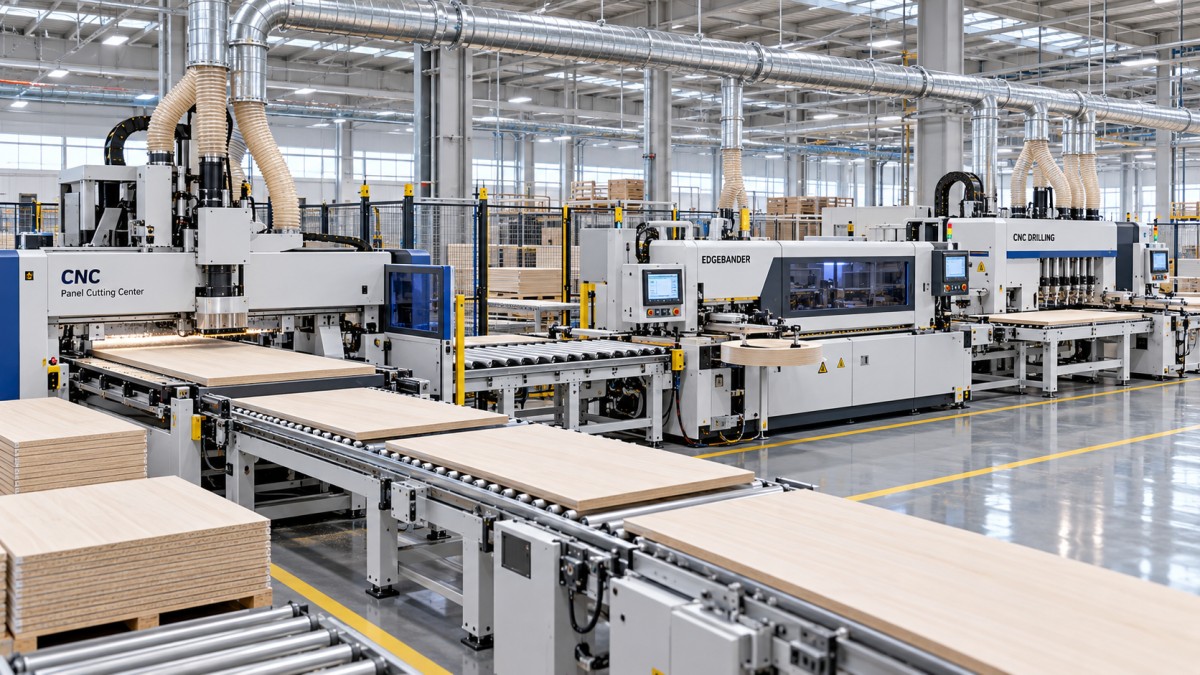
Capacity matching also requires allowance for short stops. If an upstream station produces parts faster than the next process accepts them, an accumulation buffer may be necessary. If there is no buffer, the upstream machine idles; if the buffer is too small, operators begin creating informal stacks that reintroduce sorting errors and surface damage. Buffers are not wasted space by definition. Properly placed, they absorb normal variation without hiding a persistent bottleneck.
How product mix changes the answer
A production line performs best when the work follows a repeatable process family. That does not require every cabinet or door to be identical. It requires enough commonality in board thickness, panel size range, edge material, hole patterns, machining sequence, and handling method for equipment settings and routing logic to remain stable.
High variation changes the calculation. A workshop producing frequent one-off pieces may need rapid setup, flexible programs, manual intervention points, and space for unusual parts. An overly rigid conveyor arrangement can then slow work because every exception has to be removed from the normal route. Flexibility can still be built into a turnkey project through bypass paths, return conveyors, barcode-driven programs, adjustable guides, or independent cells. The design must recognize exceptions rather than assume they do not exist.
Material choice matters as well. Melamine-faced particleboard, MDF, plywood, veneered panels, and solid wood do not behave the same way during cutting and edge processing. Particleboard may expose weak cores at a poor cut edge. MDF demands suitable dust extraction because fine dust can affect both machine reliability and workplace conditions. Veneered panels require attention to tear-out, face protection, and grain matching. Solid wood changes dimension with moisture and may contain natural variation that prevents fully uniform automated handling.
A line intended for a single board category can be configured tightly for speed and repeatability. A line expected to process several material types needs suitable tooling, parameter libraries, glue settings, feed control, and clear procedures for changing from one material condition to another. Treating all boards as interchangeable often leads to chipped edges, weak bonding, poor hole quality, or avoidable setup confusion.
Capital cost is only one part of the investment
The purchase price matters, but it is not the full cost of putting a line into productive use. Site preparation may require changes to electrical supply, compressed air capacity, dust extraction ducting, fire protection arrangements, floor layout, lighting, and access for service. Large machines and conveyors also require a delivery route that accommodates unloading, indoor movement, and final positioning. A line that arrives before these conditions are ready can spend valuable time waiting for infrastructure work.
There is also a transition cost. Existing orders may need to continue while equipment is installed, programs are proved, and production staff become familiar with the new flow. The first operating period should include time for calibration, test cuts, glue adjustments, barcode or labeling checks, and confirmation that finished parts reach the correct downstream location. Assuming immediate full output creates pressure to bypass these checks, which can turn minor setup errors into a larger batch of rework.
Technical details that deserve closer scrutiny
Line layout should follow part flow rather than fit equipment into available empty floor space. Raw panels need adequate storage and a clear route to the first operation. Finished components need an exit point that does not cross the incoming route. Crossing paths create congestion, make labeling harder to follow, and increase the chance that parts are moved before an operation has been completed.
Dust extraction requires an engineering view, not a last-minute connection. Different machines generate different volumes and types of waste. Cutting and routing create fine airborne dust; edge banders produce trim and adhesive-related debris; sanding produces large quantities of fine particles. Insufficient airflow can reduce cut quality, leave debris on reference surfaces, contaminate sensors, and shorten the interval between cleaning tasks. Duct routing, blast gate control, collection capacity, and access for cleaning should be reviewed with the whole line operating, rather than machine by machine.
Tooling is another hidden dependency. Automated production amplifies the effect of dull saw blades, worn routers, incorrect collet assembly, poorly maintained pressure rollers, or unsuitable edge banding glue settings. A manual operator can sometimes notice a declining finish and compensate immediately. In a line, the same defect can continue through many parts before it becomes visible. Tool-life records, first-piece approval after a changeover, and defined inspection points reduce that exposure.
Data handling should be proportionate to the operation. Barcode or label-based tracking is useful when parts have multiple machining stages, variable drilling patterns, or a risk of mixing similar-looking components. It only works when the label remains readable, stays attached through the required processes, and is linked to a reliable program revision. A sophisticated control system cannot correct a wrong drawing revision or a mislabeled panel introduced before the first machine.
Installation and acceptance should prove the process
Acceptance should be based on representative production conditions, not only on a dry run. Test parts should include the thicknesses, dimensions, edge configurations, hole patterns, and materials that create normal difficulty. A simple rectangular panel with one edge does not prove that a system will handle narrow drawer sides, long shelves, panels with multiple edges, or components requiring different hardware patterns.
Inspection criteria need to be visible before commissioning begins. They may include length and width accuracy, squareness, edge-banding appearance and adhesion, hole location, machining cleanliness, surface protection, label readability, and correct part routing. The purpose is not to demand arbitrary perfection; it is to establish what acceptable output means for the intended product and to identify which adjustment controls each result.
Mechanical alignment and software logic must be tested together. A correctly calibrated drilling station will still produce unusable parts when a program calls the wrong face or datum. Conversely, accurate data cannot overcome a warped workpiece, loose guide, contaminated sensor, or panel that is not held securely. When a defect appears, the investigation should separate material condition, setup, program, tooling, machine alignment, and handling. Changing several variables at once makes the real cause harder to find.
When a turnkey line is not the right immediate move
The investment may be premature when demand is uncertain, process routing is still changing every week, or basic quality problems originate before machining. Poorly stored boards, inconsistent incoming material, unclear drawings, and unmanaged engineering changes will remain problems after automation is installed. A line moves those problems faster and makes their effects more visible.
It can also be the wrong scale when one isolated operation is clearly limiting output. Replacing or upgrading that station, improving material staging, or standardizing programs may release capacity at lower cost. A broader line becomes justified when gains from isolated improvements have already been absorbed and the remaining losses come from the connections between operations.
The sound investment decision comes from matching the line to a defined process: real materials, real part dimensions, realistic changeovers, known bottlenecks, available utilities, and a supportable maintenance routine. When those conditions are established, an integrated woodworking line can convert scattered machine time into predictable production flow. When they are unresolved, the equipment may be technically capable while the operation around it remains unprepared to realize its value.
Send Your Inquiry
We welcome your cooperation and we will develop with you.