


News & Exhibitions
Latest Factory Updates, Industry Trends & Global Exhibition Information
How to estimate adhesive cost per panel on a PUR laminating machine
To estimate adhesive cost per panel on a PUR laminating machine, calculate the adhesive applied to every bonded surface, add production losses, and divide the total adhesive cost by the number of acceptable finished panels. The useful purchasing figure is cost per saleable panel, because glue consumed during setup, rejects, and cleaning still has to be paid for.
A quotation based only on panel area and nominal glue spread gives a starting point. A dependable operating budget also needs the production batch size, actual coating weight, adhesive purchase cost, and a clear treatment of material remaining in the machine. Keeping those assumptions visible makes competing equipment proposals easier to compare.
Set the calculation boundary before collecting prices
Define what counts as one panel. Record its dimensions, the surfaces being laminated, and the number of adhesive bond lines. A panel laminated on both faces normally requires separate allowances for each face. If the two sides use different materials or coating weights, calculate them separately.
Use the dimensions at the laminating stage. When an oversized board is laminated and trimmed afterward, adhesive is also applied to material that will become offcut. Calculating from the finished dimensions understates consumption.
The denominator needs equal care. A large laminated board and a finished furniture component are different costing units. If one board produces several components, allocate the board’s adhesive cost across the acceptable components recovered from it. Cutting yield then affects component cost, even though it does not change the glue consumed by the original board.
For comparing adhesive grades or machine settings, cost per bonded square metre is useful. For a production budget, retain cost per saleable panel as well. Using both prevents panel size or product mix from hiding a change in consumption.
Calculate the adhesive that should reach the panels
The basic calculation uses coated area, application weight, and price per kilogram:
Theoretical adhesive mass per panel, kg = sum of [coated area for each bond line, m² × application weight for that bond line, g/m²] ÷ 1,000
Theoretical adhesive cost per panel = theoretical adhesive mass per panel × adhesive price per kg
For rectangular panels, area is length multiplied by width, with both dimensions expressed in metres. Include every adhesive layer required by the construction. Count the adhesive actually deposited: coating both mating surfaces does not automatically mean using the full specified spread on each surface.
For reactive PUR hot melt, use application weight on a clearly defined basis. Do not introduce a solids-content adjustment borrowed from a water-based adhesive calculation unless the adhesive specification calls for it. Likewise, converting a coating thickness into grams requires density; a thickness setting alone does not establish consumption.
Use a consistent purchasing basis for price. Include freight and other directly attributable purchasing charges where applicable, and treat recoverable taxes consistently. Packaging residue can be recorded as a material loss or incorporated into an effective usable-kilogram price. Choose one method so it is not charged twice.
Turn theoretical consumption into cost per saleable panel
A practical batch model separates adhesive deposited on panels from losses associated with running the machine:
Batch adhesive mass = adhesive deposited on all processed panels + setup and operating adhesive losses
Adhesive cost per saleable panel = batch adhesive mass × adhesive price per kg ÷ accepted panel quantity
For a single product with a consistent spread, deposited mass is simply theoretical mass per panel multiplied by the number processed. For mixed production, calculate each product separately and add the results. Include adhesive applied to rejected panels in that deposited total.
This avoids a frequent accounting error: adding a rejection allowance to consumption and then dividing by an output figure that already excludes the same rejects. Each loss should enter the calculation once.
Separate losses into useful categories. Startup coating trials and product changeovers often behave as batch-related costs. Adhesive associated with a recurring shutdown procedure may depend more on the production schedule than on panel area. These distinctions explain why a long production run can have a lower adhesive cost per panel than several short runs with the same combined output.
If using a percentage allowance, state its denominator. A percentage added to theoretical deposited mass differs from a percentage of total adhesive consumption. Suppliers should express allowances on the same basis before their estimates are compared.
Cleaning products belong in a separate consumables line when calculating adhesive cost alone. PUR adhesive discarded during cleaning belongs in the adhesive calculation. Keeping those costs distinct also makes a later total operating-cost comparison easier.
Adhesive remaining in the system is not automatically waste
Material in the melter, hoses, reservoir, or applicator can distort a short trial. If the system starts empty and finishes charged, adhesive loaded during the trial exceeds the amount actually consumed. Charging the entire fill to that batch exaggerates its recurring cost.
The reverse happens when a trial begins with a full system and finishes at a lower level. Measuring only newly loaded adhesive can make consumption appear unusually low.
Use a material balance with the same boundary at the beginning and end:
Adhesive consumed = opening usable adhesive inventory + adhesive added − closing usable adhesive inventory
Inventory here includes usable material within the defined measurement boundary, including the machine where relevant. Material that must be discarded is not usable closing inventory. Count it as consumption and identify the reason for disposal.
PUR reacts with moisture, so whether retained material remains usable depends on the adhesive and the equipment’s storage and shutdown procedures. Ask what happens during routine pauses, overnight stops, and longer shutdowns. Do not assume either that the whole system charge is lost after every stop or that every retained kilogram remains reusable indefinitely.
For investment appraisal, distinguish the initial adhesive charge from recurring consumption. The first charge may tie up working capital; repeated disposal creates an operating expense. Those have different effects on the business case.
Validate coating weight without weakening the bond
The lowest advertised glue spread is useful only if it produces acceptable panels with the intended substrate and surface material. Board porosity, surface condition, flatness, adhesive viscosity, application temperature, and coating uniformity can all influence the required spread.
A smooth, consistent surface may support a different application weight from a more absorbent or uneven one. Pressure cannot reliably compensate for an unsuitable adhesive layer or poor surface preparation. Reducing consumption beyond a workable process window can increase delamination, appearance defects, and scrap costs.
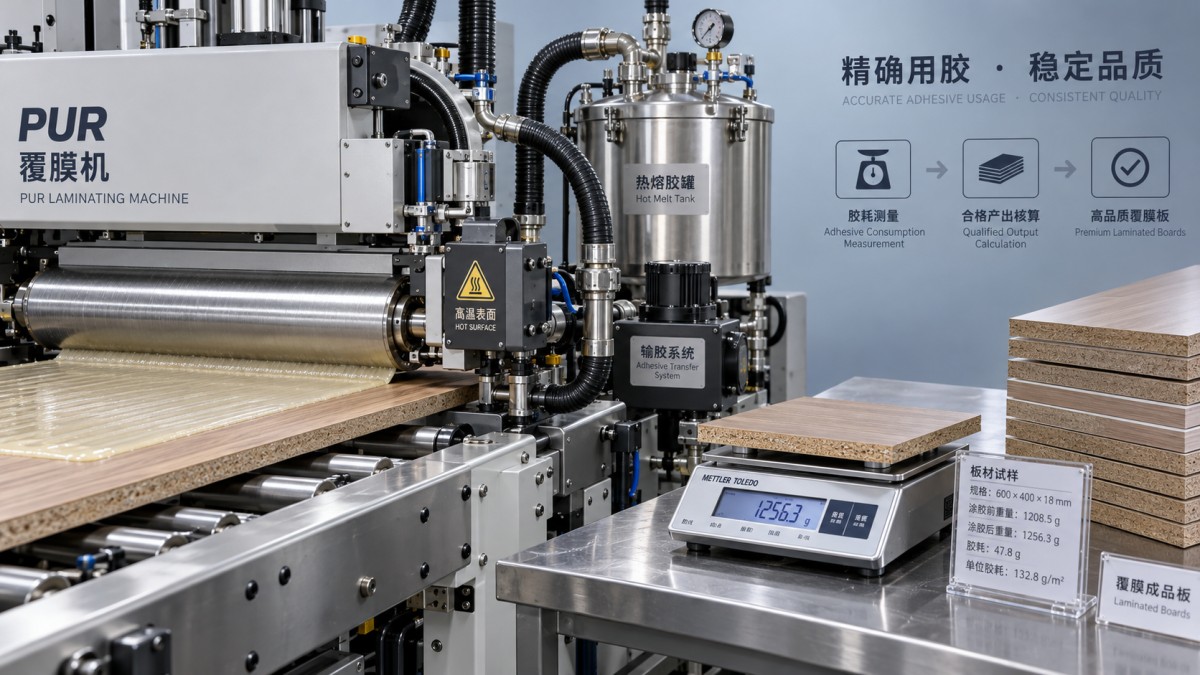
Ask for a controlled coating-weight measurement using a defined area and a suitable weighing method. For example, a representative sample can be weighed before and after adhesive application, provided the procedure safely isolates the deposited adhesive and avoids contamination or other weight changes. Follow the equipment’s handling procedure when working around hot adhesive and moving rollers.
A measured spread verifies deposition; it does not establish bond quality. Assess the laminated samples after the adhesive supplier’s specified cure conditions and against the product’s acceptance criteria. Immediate handling strength alone does not demonstrate final performance.
Machine speed also needs context. Increasing throughput can spread certain fixed losses across more panels, but speed alone does not reduce the adhesive required per square metre. A consumption claim should remain valid at the proposed production speed, with acceptable coating consistency and finished quality.
Compare machine proposals under the same production conditions
A PUR laminating machine proposal should state the conditions behind its adhesive estimate. A demonstration on one easy-to-laminate surface does not establish the budget for a factory processing several substrates, finishes, and batch sizes.
Give each supplier the same production brief and request the following:
- The panel constructions, coated dimensions, and adhesive grades used for the estimate.
- The measured application weight for each bond line and the method used to establish it.
- The processed quantity, accepted quantity, and treatment of trial pieces.
- The adhesive inventory at the start and end of the measurement period.
- The frequency and adhesive consumption of startup, changeover, cleaning, and shutdown routines.
- The quality criteria used to accept the panels after curing.
Where practical, observe a representative production cycle that includes normal interruptions and a changeover. A continuous demonstration can show stable coating performance, while a full cycle reveals the consumption associated with the factory’s actual schedule.
Evaluate equipment features through their effect on this calculation. Accurate application control may reduce excess spread. A system designed for the planned batch pattern may reduce material discarded between runs. Accessible maintenance and available spare parts can help preserve coating consistency over time. Ask suppliers to connect these features to measurable operating conditions.
When discussing a woodworking equipment project with Qingdao Zhongding Machinery Co., Ltd., include adhesive measurement and operating procedures in the technical conversation alongside capacity and support requirements. Its woodworking machinery and after-sales support offering provides context for that discussion; the cost estimate should still rest on the proposed laminating process and documented consumption assumptions.
Test the investment case against changes in production
Build a working spreadsheet with separate inputs for adhesive price, spread weight, product mix, accepted yield, batch size, and losses per production event. Keep the formulas visible so that a revised quotation or production schedule can be evaluated without rebuilding the model.
Use a base case reflecting planned production, a favourable case supported by demonstrated stable operation, and a conservative case reflecting plausible interruptions or a more demanding product mix. Vary the inputs that are uncertain rather than applying one unexplained contingency to everything.
The relationships help identify where further evidence has value. A price change affects the cost of every kilogram consumed. A spread reduction changes the adhesive deposited on panels. Fewer changeovers reduce event-related losses. Better accepted yield spreads the batch’s adhesive cost across more saleable output. Each improvement requires different evidence.
For annual savings, multiply the difference in adhesive cost per saleable panel by a realistic annual accepted output. Where products vary substantially, calculate savings by product group. Keep energy, labour, cleaning consumables, maintenance, and financing in their own lines before combining them into a broader investment assessment.
Before committing to a machine, agree on a representative trial and its measurement boundary. A record showing adhesive added, usable material retained, panels processed, and panels accepted gives the purchasing decision a practical foundation. It also becomes the benchmark for checking operating costs once production begins.
Send Your Inquiry
We welcome your cooperation and we will develop with you.