


News & Exhibitions
Latest Factory Updates, Industry Trends & Global Exhibition Information
How panel furniture process consultation addresses edge banding queues
An edge banding queue becomes a delivery problem when panels needed for assembly sit behind work that is easier to run or was released earlier. Adding another edgebander may help if processing capacity is genuinely insufficient. It will do much less when the queue is driven by oversized cutting batches, missing edge tape, repeated setup changes, or poor visibility of which panels complete an order.
Panel furniture process consultation addresses the queue by connecting production demand with the work the edge banding operation must actually perform. It examines panel arrivals, required edge passes, setup conditions, handling, and downstream priorities. For a project manager, the useful outcome is a practical decision: change how work is released and sequenced, improve the existing operation, or invest in additional capacity supported by a clear workload calculation.
Find out what is waiting—and why
A floor full of panels does not establish that an edgebander is undersized. Some stacks may be ready to process; others may lack tape, identification, approved specifications, or matching components. A queue can also grow while the machine alternates between periods of overload and periods without suitable work.
The first consultation task is to follow representative orders from cutting through edge banding to the next operation. Include the product variations that affect production: different panel sizes, edge materials, adhesive requirements, and finishing expectations. A review limited to long runs of identical panels can give an optimistic picture of available capacity.
For each batch, separate its waiting time from its processing time. Record when it becomes ready, when processing starts, what interrupts the run, and when the complete batch leaves. The purpose is to locate the cause of delay closely enough that someone can act on it.
These patterns can overlap. A genuine capacity shortage may be made worse by poor sequencing, while a handling restriction can hide otherwise usable machine capacity. The diagnosis should explain both the queue and the interruptions before an equipment recommendation is made.
Measure the workload in edge passes, not just panel counts
Panel counts are convenient for reporting, but they can misrepresent edge banding demand. On a single-sided machine, a panel requiring four finished edges needs multiple passes and repeated handling. A panel requiring only one finished edge creates a different workload, even when its dimensions are similar. A double-sided configuration changes that calculation again, depending on the panel and machine arrangement.
A useful workload model groups panels by processing route. It identifies the edges to be finished, relevant dimensions, edge material, setup requirements, and any restrictions that affect how parts can be fed. It also allows for inspection, turning, stacking, and returning panels for further passes.
Nominal feed speed provides only part of the answer. Actual output depends on panel spacing, permitted operating conditions, manual handling, setup time, and interruptions. Small parts may create a high handling burden, while large panels may require support or additional labor. A return conveyor can assist circulation, but its suitability depends on the panel range and the way operators load and unload the system.
For planning, compare the processing and handling time required by the scheduled mix with the time the operation can reliably provide. Treat setup and recurring losses consistently: either include them in required time or deduct them from available time, without counting them twice. Rework also consumes capacity and should remain visible.
Planning every available minute leaves little room for variable arrivals, quality checks, or disruption. The appropriate allowance depends on the production mix and delivery commitments. A consultation should make that allowance explicit so that a schedule does not appear feasible only because normal variation has been ignored.
Queue size is more informative when expressed as estimated processing hours alongside order urgency. Two stacks of equal height can represent very different workloads. This distinction helps a project leader judge whether a delay can be recovered within the shift or requires a change to the delivery plan.
Change the release and sequence before the queue becomes urgent
Cutting optimization and edge banding flow can pull production in different directions. A cutting plan may group panels to improve sheet utilization, while edge banding benefits from compatible processing conditions and assembly needs complete sets. Maximizing the output of each operation separately can leave unfinished orders spread across the factory.
Consultation should therefore examine the rule used to release work from cutting. If cutting releases large batches whenever capacity is available, the edge banding area becomes the buffer for the entire upstream operation. A controlled release rule links new work to available space, expected processing time, and downstream requirements.
This does not require every order to move as a tiny batch. Very small batches can increase transport, identification work, and changeovers. The aim is to choose transfer quantities that keep edge banding supplied while allowing urgent sets to move through without being buried beneath unrelated work.
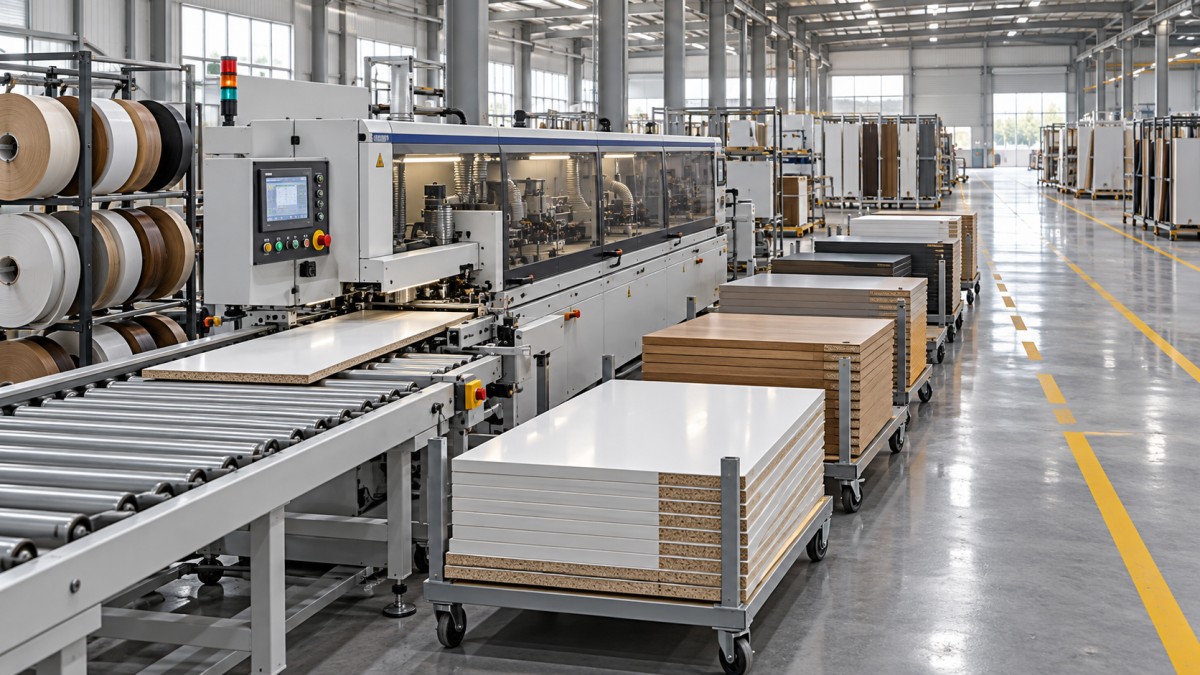
Sequencing then has to balance setup efficiency with delivery priority. Grouping compatible edge materials and processing conditions can reduce interruptions. However, extending a convenient run while a nearly complete assembly order waits for its final panels may increase overall lead time. The sequence needs a defined point at which order completion takes priority over another setup saving.
A workable dispatch rule might prioritize panels needed to complete the next assembly window, then group compatible work within that window. Exceptions should be visible and assigned to someone with authority to approve them. Otherwise, operators receive competing requests from cutting, assembly, and project management, each presented as urgent.
Material readiness belongs in the same decision. Before a batch enters the ready queue, its identity, edge specification, required tape, and processing instructions should be available. Panels awaiting clarification need a separate status so that the visible queue reflects work that can actually run.
For mixed-order production, tracking completion by furniture set or assembly kit adds a useful perspective. High daily panel output offers limited reassurance if every scheduled order is missing a few components. Set completion shows whether edge banding is helping projects advance to their next stage.
Recover capacity without creating a quality problem
Once release and sequencing are understood, the review can examine losses around the machine. Repeated searches for tape, awkward access to waiting panels, insufficient discharge space, and delayed inspection can consume productive time. These issues call for specific changes to material preparation, layout, responsibilities, or handling arrangements.
Setup preparation deserves particular attention. Compatible materials can be staged before a planned change, instructions can be checked in advance, and inspection requirements can be made clear. Any preparation performed while equipment is running must remain within the machine’s operating and safety requirements. Internal adjustments still require the appropriate stopping and isolation procedures.
Quality losses need their own cause analysis. Poor bonding, trimming defects, surface damage, or dimensional problems can send work back through edge banding or require replacement panels. The review should consider incoming cut quality, panel condition, edge material compatibility, adhesive application, tooling, and equipment settings as applicable to the process.
Increasing feed speed without validating the finished edge can simply exchange visible waiting time for rework. Acceptable settings depend on the equipment, materials, adhesive system, and required finish. Capacity improvements should be judged using conforming output that can proceed to the next operation.
Handling changes also need to be tested against the full panel range. An arrangement that works well for standard cabinet sides may be awkward for narrow strips or large tops. Operator access, turning space, panel support, and stack stability determine whether a proposed layout will work throughout the scheduled mix.
Make equipment investment answer a measured gap
Additional equipment becomes easier to justify when a capacity shortfall remains after realistic operating improvements have been assessed. The investment case should identify which work exceeds capacity, when that shortfall occurs, and why the proposed configuration can absorb it.
The appropriate response may be a second machine, an upgrade to an existing line, improved return handling, or a separate route for work that repeatedly interrupts the main flow. These options solve different problems. A second edgebander needs labor, floor space, material supply, extraction, and coordination with upstream and downstream operations. Its nameplate capacity alone does not establish the increase in factory output.
Supplier discussions should use a representative production mix, including difficult parts and frequent setup changes. Ask how the proposed arrangement handles those requirements and what assumptions support the capacity estimate. Where a demonstration is available, assess complete processing cycles, handling, setup, and finished quality alongside running speed.
Moving the bottleneck also matters. Faster edge banding can increase pressure on drilling, sorting, or assembly. The project evaluation should follow the additional output far enough downstream to establish whether it improves completed furniture deliveries. Otherwise, capital may relocate the queue while leaving the delivery constraint unresolved.
Turn the consultation into an operating decision
A useful consultation ends with a workload model, a clear explanation of the main queue causes, and actions that production can implement. Each action needs an owner, a dependency, and a way to assess its effect. “Improve scheduling” is too vague; defining a release limit and an assembly-based dispatch rule gives the team something concrete to apply.
Trial the proposed operating changes across a representative mix before treating the result as a permanent capacity gain. Track waiting time, queue workload, setup losses, conforming output, and completion of scheduled sets. Record changes in staffing or working hours so that their contribution remains clear.
For the project manager, the final decision should connect the intervention to a delivery requirement: which orders can move sooner, what operating conditions must hold, and where the remaining constraint sits. If the queue falls only when operators work extra hours or postpone necessary maintenance, the underlying capacity question remains open. If controlled release and better sequencing restore reliable flow, the equipment specification can be reconsidered around the remaining, measurable need.
Send Your Inquiry
We welcome your cooperation and we will develop with you.