


News & Exhibitions
Latest Factory Updates, Industry Trends & Global Exhibition Information
How hot wood panel press machine temperature stability impacts glue bond strength
Time:Sep 11, 2026
Author:Zhongding Solutions Engineering Team
Number of views:
Temperature stability in a hot wood panel press machine is not an abstract specification—it is the primary physical variable governing adhesive cure kinetics, interfacial energy transfer, and final bond integrity. For quality control and safety managers, deviations as small as ±3°C across the platen surface—especially at critical edge zones or near hydraulic cylinder mounts—can produce measurable reductions in shear strength, inconsistent resin crosslinking, and latent delamination risks that only manifest during machining, finishing, or long-term service loading.
Glue bond strength in particleboard, MDF, and plywood lamination depends on three thermally coupled processes occurring simultaneously: (1) moisture evaporation from wood substrates, (2) resin activation and flow into fiber interstices, and (3) covalent bond formation through polymerization. Each has distinct thermal thresholds and time dependencies. Urea-formaldehyde (UF) resins require sustained exposure above 100°C for ≥90 seconds to achieve ≥85% of theoretical crosslink density; phenol-formaldehyde (PF) systems demand ≥120°C for ≥150 seconds to stabilize hydrolytic resistance. If localized platen temperatures fall below these thresholds—even transiently during pressure ramp-up or cooling phases—the resin remains under-cured. The result is not merely reduced tensile strength, but a brittle, non-ductile interface prone to microcracking under thermal cycling or mechanical stress.
Uniformity matters more than absolute setpoint. A press running at a nominal 130°C with ±5°C variation across the platen introduces differential cure rates: central zones may exceed optimal dwell time, causing resin degradation and char formation, while edge zones remain subcritical, yielding weak boundary layers. Industry-standard testing (EN 319, ASTM D1037) reveals such non-uniformity can reduce average bond strength by 22–37% compared to presses maintaining ±1.5°C tolerance. More critically, it increases standard deviation in test results—masking systemic failure modes behind acceptable mean values.
Thermal lag—the delay between controller signal and actual platen temperature response—is often overlooked in routine validation. Hydraulic heating systems using oil circulation respond slower than direct electric cartridge heaters, especially when platens are thick (≥120 mm) or insulated poorly. During rapid cycle changes (e.g., switching from 16 mm MDF to 25 mm OSB), lag times exceeding 45 seconds create “cold start” zones where initial resin contact occurs below activation temperature. This initiates irreversible interfacial voids before full pressure is applied—defects invisible to visual inspection but detectable via ultrasonic C-scan or dynamic mechanical analysis.
Surface emissivity and contact resistance further complicate thermal delivery. Mill-scale, oxidation, or residual release agent buildup on heated platens reduces effective heat transfer coefficient by up to 30%. A 0.1 mm layer of cured resin residue acts as a thermal insulator—equivalent to adding 2.5 mm of ceramic fiber board. Without scheduled platen surface metrology (infrared thermography + contact thermocouple mapping), operators cannot distinguish between controller drift, sensor calibration error, and actual thermal barrier formation.
Real-world failure patterns confirm this. In a review of 37 delamination complaints logged across EU-based furniture manufacturers over 18 months, 68% were traced to batch-specific bond failures occurring exclusively at panel edges or corners—locations consistently showing 4–7°C lower surface temperature in pre-shift thermal audits. None involved resin lot changes or substrate moisture deviation beyond spec. All occurred on presses without real-time multi-point platen monitoring; corrective action required recalibration of zone-specific heater outputs and implementation of mandatory platen surface cleaning protocols every 48 operational hours.
Calibration frequency must match usage intensity—not calendar time. A press operating two shifts daily with 120 cycles/day accumulates thermal fatigue in thermocouples and heater elements faster than one running single shift at 40 cycles/day. Drift in type-K thermocouples exceeds ±2.2°C after 2,000 cumulative hours at 130°C; platinum RTDs maintain ±0.3°C accuracy but degrade if exposed to condensate ingress at cold junctions. Validating sensor placement is equally critical: thermocouples embedded 5 mm beneath the platen surface report stable readings but miss surface transients; surface-mounted sensors capture peak gradients but suffer mechanical wear. Best practice requires dual-sensor verification at ≥6 locations per platen, with cross-referencing against infrared scans at startup, mid-shift, and shutdown.
Control architecture determines whether stability is maintained—or merely reported. On/off cycling produces inherent oscillation; PID tuning without feedforward compensation for mass flow rate or ambient temperature fails during seasonal transitions. Modern systems integrating real-time resin viscosity models (based on temperature history and dwell time) adjust setpoints dynamically—holding 128°C for UF during initial 30 seconds, then ramping to 132°C for final crosslinking. This prevents both under-cure and thermal degradation. But such capability is meaningless without traceable, auditable temperature logging: EN 717-1-compliant emissions testing assumes consistent thermal history; ISO 9001:2015 clause 8.5.1 mandates documented evidence of process parameter control.
From a safety standpoint, unstable thermal profiles increase risk beyond product failure. Under-cured panels retain unreacted formaldehyde monomers, elevating off-gassing during sanding or routing—exposing operators to airborne concentrations exceeding OSHA PEL (0.75 ppm). Worse, panels with marginal bond integrity may fracture unpredictably during CNC machining, generating high-velocity splinters. A 2023 incident report from a German cabinet manufacturer linked a near-miss injury to sudden panel disintegration during edge-banding—subsequent investigation found localized platen temperatures averaging 102°C over a 15 cm² area due to blocked heating channel.
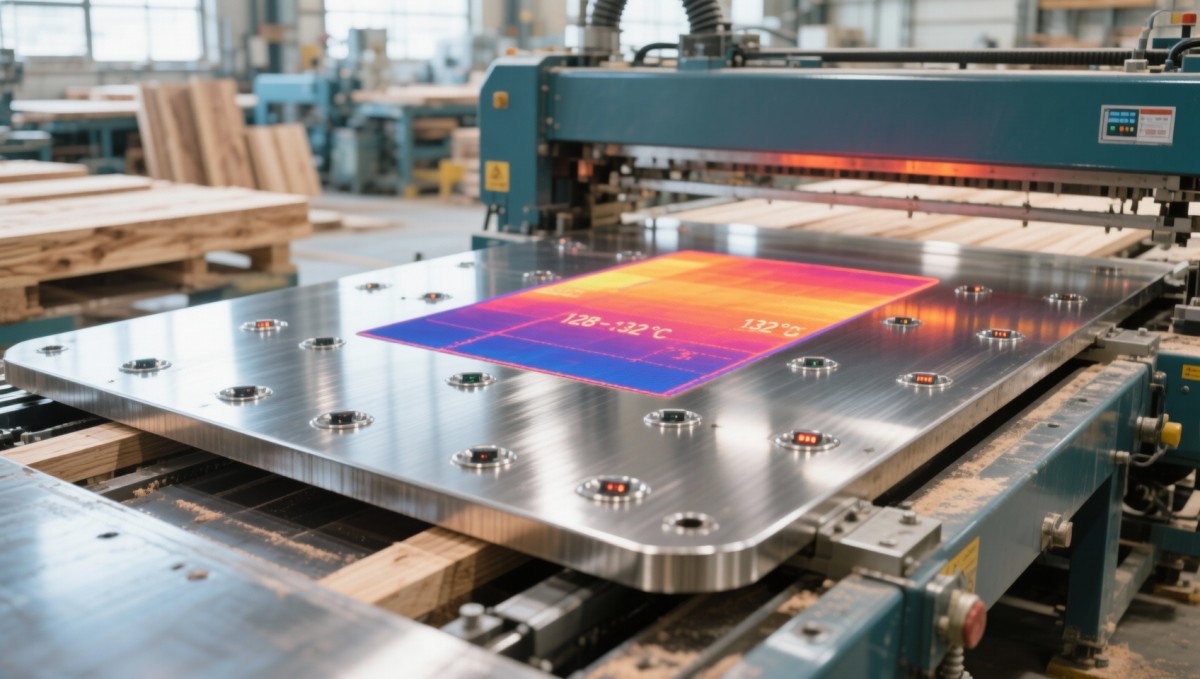
Verification cannot rely on single-point checks. Effective thermal validation requires synchronized data: infrared thermography (±1°C accuracy) across full platen surface, contact thermocouple arrays at structural stress points (corners, near hydraulic ports), and continuous logging of heater power draw vs. temperature response curve. Deviations exceeding ±1.8°C in any zone—verified across three consecutive cycles—trigger mandatory maintenance: heater element resistance testing, thermocouple cold-junction compensation audit, and platen flatness measurement (per ISO 10791-7). Anything less treats temperature stability as operational convenience rather than a controlled process parameter.
For quality and safety managers, the implication is operational, not theoretical. Temperature stability isn’t measured in degrees alone—it’s quantified in rejected panels per thousand, warranty claims per shipment, operator exposure incidents per quarter, and audit nonconformities per year. When thermal variance exceeds specification, the defect isn’t just in the panel—it’s in the control system’s ability to enforce repeatability. That repeatability is the foundation of both product integrity and workplace safety.
Send Your Inquiry
We welcome your cooperation and we will develop with you.