


News & Exhibitions
Latest Factory Updates, Industry Trends & Global Exhibition Information
Can an automatic wood panel press machine handle both MDF and plywood without reconfiguration?
Can an automatic wood panel press machine handle both MDF and plywood without reconfiguration?
Short answer: Yes—but only if the machine is engineered for adaptive material handling, not just rated for “both materials.” Most operators discover this distinction too late—after commissioning a press that demands manual recalibration every time they switch from MDF to plywood. That downtime adds up: 8–15 minutes per changeover, repeated dozens of times per shift. Worse, inconsistent pressure profiles across material types lead to delamination in plywood edges or surface blistering in MDF—defects that escape visual inspection until downstream sanding or edgebanding.
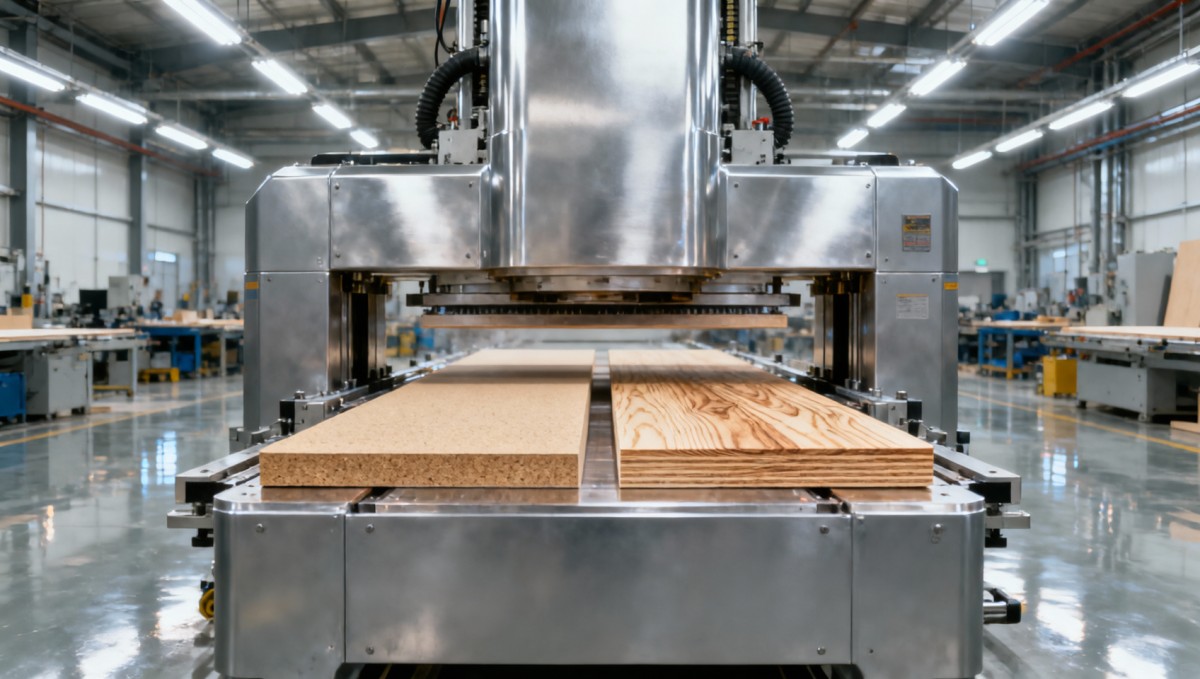
The real question isn’t whether a press *can* process both materials—it’s whether it maintains target bond integrity, dimensional stability, and surface quality *without operator intervention* between runs. That depends less on marketing specs (“supports MDF and plywood”) and more on three functional design layers: thermal response, pressure distribution logic, and material profile memory.
Why “rated for both” doesn’t mean “ready for both”
Many automatic wood panel press machines list MDF and plywood in their technical documentation—but those listings often reflect static lab testing under ideal conditions: single-material batches, ambient shop temperature, pre-conditioned panels, and fixed dwell time. In practice, MDF and plywood behave fundamentally differently under heat and pressure:
- MDF is homogeneous, moisture-rich (8–12% MC), and thermally conductive. It absorbs heat rapidly but compresses easily—excess pressure causes irreversible density loss at the surface layer, leading to poor veneer adhesion or post-press springback.
- Plywood is anisotropic: glue lines expand/contract at different rates than veneer layers, core plies vary in density and moisture content, and voids or patches create localized thermal resistance. Applying uniform pressure risks crushing softwood cores while under-compressing hardwood crossbands.
A press that applies identical heating curves and pressure ramps to both will inevitably compromise one—or both. The issue isn’t capability; it’s control fidelity. True seamless switching requires the machine to recognize material type *before* closing, then adjust its entire pressing sequence—not just pressure setpoints, but ramp timing, hold duration, cooling rate, and even hydraulic cylinder synchronization.
What actually enables true no-reconfig operation
Three interdependent features separate presses that *tolerate* both materials from those that *optimize* for each without setup:
1. Material-aware heating zones
Not just “multi-zone heating,” but independently controllable zones with feedback-driven thermal modulation. Plywood needs slower, lower-peak surface temperatures (105–115°C) to avoid glue line degradation in outer plies, while MDF benefits from faster ramp-up to 125–135°C to drive off moisture before resin cure. A press with fixed zone profiles forces trade-offs; one with adaptive thermal mapping adjusts zone output in real time based on material thickness, density, and surface emissivity readings.
2. Dynamic pressure profiling
Static pressure (e.g., “12 MPa constant”) fails both materials. MDF requires high initial pressure (to close gaps and initiate resin flow), then gradual reduction during dwell to prevent surface collapse. Plywood needs staged pressure: low initial force to align plies without shifting, then progressive increase to consolidate glue lines without crushing cores. Machines with programmable pressure ramps—tied to temperature and time—not only enable dual-material use but also reduce cycle time by 12–18% versus fixed-pressure cycles.
3. Preset, field-verified material profiles
“Preset profiles” aren’t just stored settings—they’re empirically calibrated sequences validated across multiple board suppliers, glue chemistries, and environmental conditions. A reliable profile for 18mm birch plywood includes compensation for seasonal humidity swings; an MDF profile accounts for variations in urea-formaldehyde vs. phenol-formaldehyde resin systems. Without this depth, operators end up manually tweaking parameters daily—defeating the purpose of automation.
Where the gap shows up—in production, not spec sheets
Two common failure points expose whether a press truly handles both materials without reconfiguration:
- Edge quality inconsistency: If plywood edges show glue-starved zones or micro-cracks after pressing, while MDF edges exhibit raised grain or slight bulging, the machine is likely applying uniform pressure regardless of material anisotropy. This isn’t a “setting error”—it’s a control architecture limitation.
- Post-press dimensional drift: MDF panels shrinking 0.15–0.25 mm across width within 24 hours, while plywood panels warp slightly along grain direction, indicate mismatched cooling protocols. Uniform cooling rates ignore how MDF releases internal stress isotropically, while plywood relieves tension directionally. Adaptive cooldown sequencing prevents this.
These aren’t defects you fix with training or maintenance—they’re symptoms of insufficient material-specific control logic. Retrofitting them into older-generation presses rarely works; the hardware (sensors, valve response speed, PLC processing latency) must support millisecond-level adjustments.
What to verify before committing
If your workflow regularly alternates between MDF and plywood—and especially if you run mixed batches (e.g., cabinet carcasses in MDF, doors in plywood)—don’t rely on brochure claims. Ask for evidence of these three things:
- A documented test report showing consecutive MDF and plywood runs (same day, same operator, same glue system) with bond strength data (ASTM D1037 shear tests) and surface flatness measurements (±0.08 mm tolerance maintained across both).
- Proof of adaptive profile switching: video or log files showing automatic parameter adjustment when scanning a material barcode or selecting a preset—no manual input required beyond confirming the job type.
- Service logs from at least two existing customers running >60% mixed-material schedules, with average unplanned downtime attributed to material-changeover issues (should be near zero, not “less than before”).
Manufacturers who’ve solved this well embed the logic at the firmware level—not as an add-on software module, but as integrated control architecture. That’s why experience matters: it takes years of field feedback across furniture plants, door manufacturers, and industrial laminators to refine thermal and pressure models that survive real-world variability.
For shops where flexibility isn’t optional—where today’s order might be 300 sheets of 16mm MDF, tomorrow’s 200 sheets of 19mm marine-grade plywood—the right automatic wood panel press machine doesn’t just accept both materials. It treats them as distinct physical systems—and responds accordingly, every time the platen closes.
Send Your Inquiry
We welcome your cooperation and we will develop with you.