


News & Exhibitions
Latest Factory Updates, Industry Trends & Global Exhibition Information
Why edge banding machine quote accuracy depends on your panel material and thickness
Why Your Panel Material and Thickness Directly Shape Edge Banding Machine Quotation Accuracy
If you’re finalizing a capital equipment budget for a new furniture line—or scaling up an existing cabinetry production cell—you’ve likely received several edge banding machine quotes. And you’ve probably noticed something: the same model, from the same supplier, carries different specifications, options, and prices across proposals. That variation isn’t arbitrary. It’s not about sales tactics or regional pricing tiers. It’s almost always rooted in how precisely the supplier understands—and accounts for—your actual panel material and thickness range.
This isn’t a minor technical footnote. For project managers overseeing production readiness, quoting inaccuracies tied to substrate assumptions are among the top causes of delayed commissioning, unplanned retrofitting, and first-year throughput shortfalls. A quote built on generic “16–19 mm particleboard” assumptions will misalign with reality if your shop runs 3 mm MDF drawer fronts, 25 mm plywood carcasses, and solid wood edging on tabletops—all in one shift.
Material Isn’t Just About Surface Appearance—It Dictates Thermal & Mechanical Behavior
Edge banding is a thermomechanical process: heat softens adhesive, pressure bonds it, and mechanical trimming finishes the joint. But materials respond differently to each stage—not just in appearance, but in density, thermal conductivity, moisture content, and edge stability.
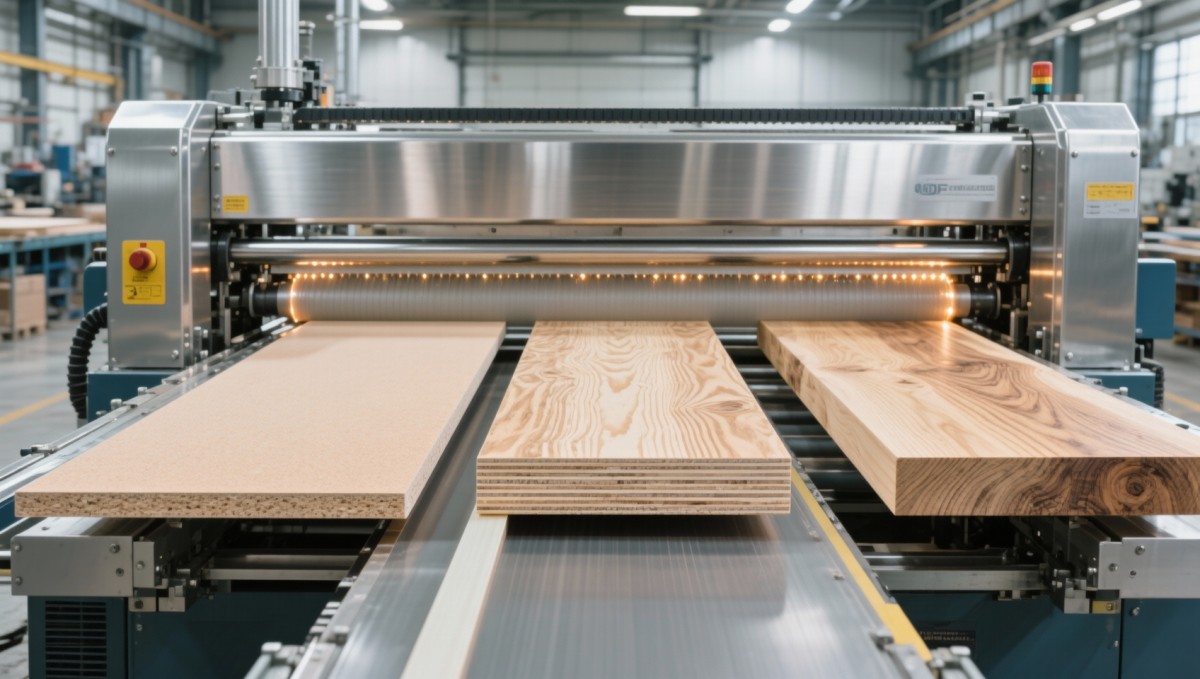
- MDF: Uniform density allows consistent glue penetration, but its low thermal mass means it heats and cools rapidly. Machines must deliver precise, responsive temperature control—especially during high-speed runs. Overheating risks surface blistering; underheating leads to poor adhesion at the core.
- Particleboard: Heterogeneous structure creates variable glue absorption. Its higher thermal inertia demands longer pre-heat dwell time and more stable roller pressure profiles. Inconsistent density also increases risk of edge chipping during trimming—so cutting tool geometry and feed synchronization become critical.
- Plywood: Cross-laminated layers expand and contract at different rates under heat. This introduces micro-movement at the bonding interface. Successful bonding requires slower, more controlled glue application and adaptive pressure zones that compensate for layer-specific compression resistance.
- Solid wood: Natural grain direction, moisture gradients, and seasonal movement mean no two panels behave identically. Machines must support manual or semi-auto calibration per batch—and include real-time edge detection to adjust glue volume and trim depth dynamically.
A quote that treats all four substrates as interchangeable will omit these functional requirements: specialized heating modules, multi-zone pressure rollers, adaptive trimming sensors, or even basic calibration workflows. Those omissions don’t appear as line items—they surface later as performance gaps.
Thickness Is a System Constraint—Not Just a Dimension
Panel thickness determines mechanical load paths, feed stability, and alignment tolerances—not just whether the panel fits into the machine. A 12 mm panel flexes under roller pressure; a 38 mm panel resists bending but demands higher torque and stiffer frame rigidity.
Consider this: most edge banders specify a “standard thickness range” (e.g., 12–30 mm). But that number hides three operational realities:
- Minimum thickness: Below ~8 mm, standard feed belts lose grip. Thin panels deflect between rollers, causing glue smear, inconsistent pressure, and premature trimming blade wear. Solutions include vacuum-assisted lower belts or segmented roller systems—neither standard on base models.
- Maximum thickness: Above 30 mm, standard machines often exceed their structural deflection limits. The result? Glue line thickness variation across the panel height, especially near the top edge where roller force drops off. Reinforced frames, dual-drive systems, or hydraulic pressure compensation are required—but rarely included unless explicitly scoped.
- Thickness variability: If your production includes both 16 mm cabinet sides and 28 mm island countertops, the machine must maintain glue uniformity across that 12 mm delta. That requires either manual recalibration between batches—or closed-loop thickness sensing with real-time glue metering adjustment. The latter adds cost, but eliminates a major source of bond failure in mixed-thickness lines.
Quoting without knowing your thickness spread forces suppliers to default to worst-case assumptions—or worse, to underspecify. Neither protects your schedule or yield.
Where Generic Quotes Break Down—And What to Watch For
Here’s what typically goes wrong when material and thickness aren’t validated early:
- The “glue-only” upgrade trap: A supplier offers a “basic” machine plus optional glue system. But if your MDF runs at 3 mm, that glue unit may lack the fine-flow control needed—leading to excess glue bleed and costly post-trim cleanup. The fix? A different pump, different nozzle, different heating zone—none of which were in the original quote.
- Trimming accuracy surprises: You’re quoted for “±0.1 mm trimming tolerance.” But that spec assumes stable, flat 18 mm particleboard. On warped 25 mm plywood, the same machine delivers ±0.4 mm—because the trim head lacks dynamic edge-following capability. That deviation doesn’t show up in brochures.
- After-sales cost creep: A machine delivered for “MDF and particleboard” may run reliably on those materials—but fail within months on your occasional solid wood runs. Replacement parts (e.g., hardened trim blades, reinforced feed chains) weren’t factored into the initial service plan.
None of these issues reflect poor machine design. They reflect incomplete quoting discipline—where technical assumptions replace material-specific validation.
How to Anchor Your Next Quote in Reality
You don’t need to become a materials engineer—but you do need to shift how you engage suppliers during quotation. Focus your due diligence on three concrete inputs:
- Provide actual panel samples—not just specs. Send 3–5 representative panels (including worst-case warpage, edge quality, and moisture content readings if available). Let the supplier test glue flow, pressure response, and trim behavior on their demo unit. This reveals compatibility faster than any datasheet.
- Define thickness *distribution*, not just min/max. Share your production mix: e.g., “70% at 16–19 mm, 20% at 25–28 mm, 10% below 10 mm.” That tells the supplier where to prioritize adaptive features—and where fixed settings will suffice.
- Require machine configuration maps—not just model numbers. Ask for a table showing which hardware modules (heating zones, pressure rollers, trim heads, feed systems) activate at each material/thickness combination in your range. If they can’t produce it, the quote is still theoretical.
At Qingdao Zhongding Machinery, we build every edge banding machine quote around this principle: no default assumptions, no generic configurations. We ask for your substrate list before we select a base model—and we validate thickness transitions on our test line before finalizing options. Because for a project manager, the real cost of an inaccurate quote isn’t the price difference. It’s the rework, the downtime, and the delay in hitting your first revenue target.
Send Your Inquiry
We welcome your cooperation and we will develop with you.