


News & Exhibitions
Latest Factory Updates, Industry Trends & Global Exhibition Information
Vacuum Membrane Press for Cabinet Doors: How to Match Clamping Force, Cycle Time & Surface Finish Requirements
Clamping Force Isn’t Just a Number—It’s a System Constraint
When evaluating a vacuum membrane press for cabinet doors, technical evaluators often start by comparing clamping force specs—0.8 MPa, 1.0 MPa, 1.2 MPa—and assume higher is always better. That’s a dangerous shortcut. Clamping force isn’t an isolated metric; it’s the output of a tightly coupled system: vacuum pump capacity, membrane integrity, platen flatness, heating uniformity, and substrate stability. A press rated at 1.2 MPa won’t deliver that pressure consistently across a full 2400 × 900 mm door panel unless the vacuum chamber seals perfectly, the membrane has no micro-tears, and the platen maintains ±1.5°C thermal uniformity over its entire surface.
In practice, most MDF and HDF cabinet doors require only 0.8–1.0 MPa to achieve full thermofoil adhesion—but only if the substrate is dimensionally stable and pre-conditioned to ≤8% moisture content. Over-specifying clamping force without addressing these upstream conditions leads to diminishing returns: increased energy use, accelerated membrane wear, and higher risk of edge lifting or blistering on contoured profiles. What matters isn’t peak pressure—it’s *sustained, uniform pressure* across the entire work area during the critical bonding window (typically 45–75 seconds).
Cycle Time Is a Line-Balancing Equation—Not a Standalone Spec
Manufacturers often quote “cycle time” as a single number: “65 seconds.” But that figure is meaningless without context. Is it measured from door loading to unloading? Does it include membrane cooling? Is it achievable with 3-mm-thick PVC foil on a 12-mm HDF panel with 3D profiled edges?
Real-world cycle time depends on three interdependent variables: heat transfer rate (driven by platen material, heating element density, and thermal mass), vacuum response speed (influenced by pump CFM, piping diameter, and valve actuation time), and operator workflow integration (e.g., whether foil cutting, panel loading, and membrane positioning happen in parallel or sequence). A press that achieves 70-second cycles in lab conditions may run at 110 seconds on your line if your foil handling station adds 25 seconds of manual prep—or if ambient workshop temperature drops below 18°C, slowing thermal recovery between cycles.
For high-volume cabinet production (≥300 doors/day), aim for a system where the *repeatable, fully loaded cycle*—including foil placement, vacuum draw, heating, cooling, and safe unloading—is ≤90 seconds. Anything longer creates bottlenecks downstream, especially when paired with CNC routers or edgebanders running at 85–95% uptime.
Surface Finish Starts Long Before the Membrane Closes
“Class-A finish” is the goal—but it’s not guaranteed by the press alone. It’s the result of process discipline upstream. Vacuum membrane presses don’t correct substrate flaws; they replicate them. A 0.15-mm sanding ripple on an MDF panel becomes a visible wave under glossy PVC foil. A 0.3-mm height variation across a raised-panel door will show as inconsistent gloss intensity—even if clamping force and temperature are perfect.
This is where surface preparation becomes non-negotiable. Before any panel enters the vacuum membrane press, it must have a flat, smooth, dimensionally consistent reference surface. That’s why many Tier-1 furniture producers integrate precision planing directly into their door prep line—not as a one-off step, but as a calibrated process control point. For solid wood doors or laminated panels requiring stock removal and flattening, a professional-grade Surface Planer Jointer ensures repeatable thickness and a true reference face, eliminating the “hidden variable” that undermines finish consistency downstream.
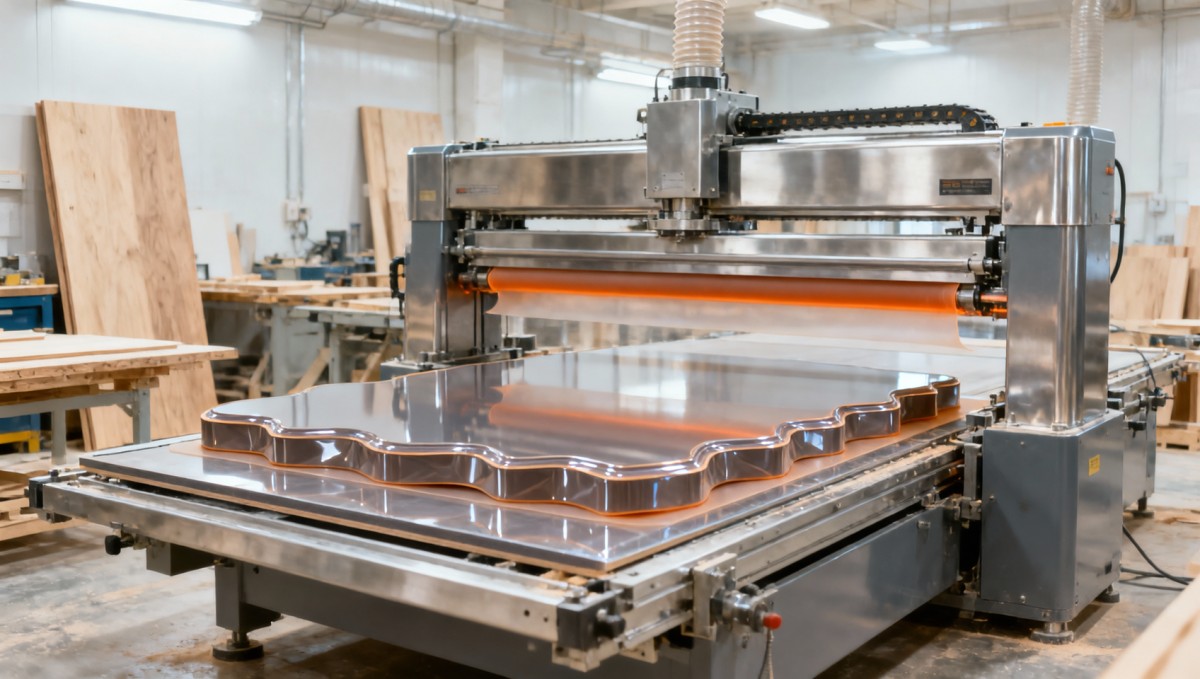
How to Match Specifications to Your Real Production Conditions
Forget generic spec sheets. Build your evaluation around three concrete checks:
- Test substrate fidelity: Run your actual door panels—same grade, thickness, and profile—through the press using your standard foil and adhesive. Measure pressure distribution with embedded sensors (or at minimum, check for consistent edge seal breakage across multiple zones). If pressure varies more than ±8% across the panel, investigate platen flatness and membrane tensioning—not just pump rating.
- Time the full operational cycle: Use a stopwatch during live trials. Start timing when the operator begins foil placement and stop when the next panel is ready for loading. Repeat for 10 consecutive cycles. Discard the first two (warm-up) and average the rest. If the average exceeds 95 seconds, examine workflow—not just machine specs.
- Validate finish under real lighting: Inspect bonded doors under 5000K LED lighting at 45° and 90° angles, at 1-meter distance. Look for orange peel, localized haze, or subtle contour exaggeration. These aren’t defects of the press—they’re signals of inconsistent substrate preparation or thermal gradients.
At Qingdao Zhongding Machinery, our approach reflects this reality: we engineer vacuum membrane press for cabinet doors systems not around theoretical maxima, but around repeatable performance on real shop-floor substrates. Our intelligent vacuum control adjusts draw-down rate based on panel porosity; rapid-heating platens recover temperature within 45 seconds after unloading; and modular tooling allows quick changeovers between flat, shaker, and contoured door families—without recalibration. This isn’t about hitting a headline number. It’s about delivering predictable, auditable results, shift after shift.
When to Question the “Standard” Configuration
If your production includes mixed materials—solid wood doors alongside MDF, or thermofoil over particleboard with varying densities—a single press configuration rarely fits all. Don’t default to the largest available chamber or highest-rated pump. Instead, map your product mix by volume and complexity:
- Do ≥70% of your doors exceed 2100 mm in height? Then platen length and vertical vacuum zoning matter more than raw pressure.
- Do you run frequent small-batch custom profiles? Then modular, quick-change tooling and intuitive HMI controls reduce setup time more than +0.2 MPa clamping force.
- Is foil waste >6.5% per panel? Then membrane tension control and precise edge-seal programming may yield faster ROI than upgrading pump capacity.
The right vacuum membrane press for cabinet doors isn’t the one with the strongest spec sheet. It’s the one whose engineering assumptions match your substrate realities, whose cycle time aligns with your line’s rhythm, and whose finish consistency eliminates rework—not just in the lab, but across three shifts, four seasons, and 12,000 annual production hours.
Send Your Inquiry
We welcome your cooperation and we will develop with you.