


News & Exhibitions
Latest Factory Updates, Industry Trends & Global Exhibition Information
How honeycomb panel processing machinery reduces core crushing
How Honeycomb Panel Processing Machinery Reduces Core Crushing
Core crushing is one of the most frustrating defects in honeycomb panel production because it is often discovered after material, labor, adhesive, and machine time have already been invested. A panel may look acceptable at a glance, yet show weak areas, telegraphed cells beneath the surface, uneven thickness, poor bonding, or edge damage during later machining. For operators, the immediate problem may appear to be a cutting issue or a press setting. In practice, crushing usually begins earlier, through a combination of unsuitable handling, unstable feeding, incorrect pressure distribution, dull tooling, or poor coordination between process stages.
Honeycomb Panel Processing Machinery is designed to manage these risks more consistently than improvised workflows or general-purpose equipment. The objective is not simply to run panels faster. It is to move, cut, bond, press, trim, and stack lightweight sandwich materials without allowing concentrated force to collapse the delicate cellular core. When machinery, material setup, and daily operating practice are aligned, operators can achieve cleaner edges, more stable dimensions, and fewer rejected panels.
Why honeycomb cores crush so easily
A honeycomb panel behaves very differently from solid board. Its face sheets may be rigid, but the internal structure contains thin walls arranged to provide strength at low weight. That structure is effective when loads are distributed properly. It is far less forgiving when a roller, clamp, cutter, pressure beam, or operator applies force to a small area. A localized load can buckle cell walls before the problem becomes visible on the outer surface.
The risk rises when the panel is not fully supported. An overhanging workpiece can flex under its own weight. A panel that enters a machine at an angle may contact one side first and receive uneven pressure. During cutting, vibration can cause the tool to pull at the face material instead of shearing it cleanly. If the core has inconsistent bonding or if the face sheet is not properly seated, even a normally acceptable process setting may create damage.
This is why operators should avoid treating crushed cores as a single-machine fault. The defect can originate in loading, surface preparation, gluing, pressing, sawing, routing, edge finishing, unloading, or storage. A reliable production line controls the panel from one stage to the next rather than optimizing each machine in isolation.
Support and feeding are the first line of protection
Many crushing problems begin before the tool touches the panel. Lightweight panels can drift, sag, or twist as they travel across a table or conveyor. If the machine supports only the edges while the center remains unsupported, the face sheet may deflect and transfer load into the core. This is especially relevant for large-format panels and for workpieces with a low-density core.
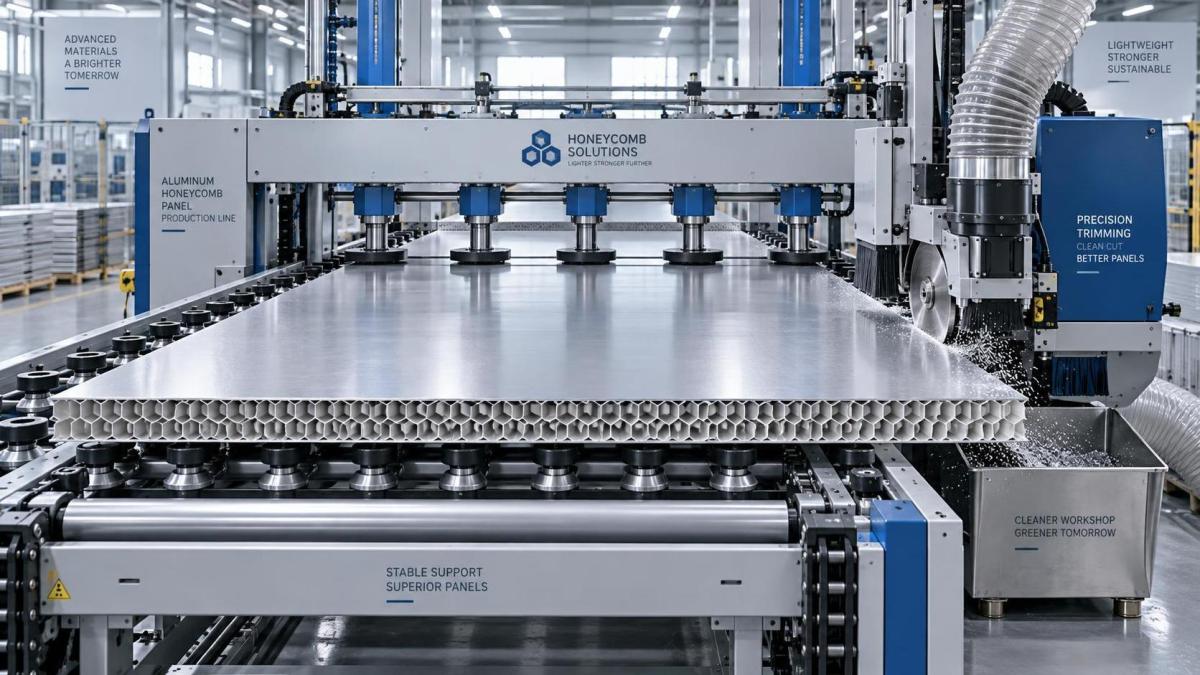
Well-designed Honeycomb Panel Processing Machinery uses stable reference surfaces, appropriately positioned support points, and controlled feed systems to keep the workpiece flat. Conveyor speed should match the operation being performed. Excessive feed can create sudden contact at pinch points or guides; feed that is too slow may increase friction, adhesive pickup, or heat in some cutting processes. The best setting depends on panel construction, face material, thickness, tool condition, and the specific operation.
Operators should watch the panel’s path rather than focusing only on the control screen. A slight lateral movement, repeated bump at a guide, or momentary lifting at the leading edge can signal a setup issue. These small events often predict larger defects later in the run.
For manual loading, consistent handling matters just as much. Panels should be lifted with adequate support across their area instead of being dragged from one corner. Stacking too high, placing a heavy object on an unsupported panel, or allowing sheets to lean for long periods can create deformation before processing starts.
Controlled pressure matters more than maximum pressure
Pressing is necessary in many honeycomb panel processes, particularly where face sheets, inserts, frames, or edge components must bond to the core assembly. Yet pressing is also the stage where an otherwise good panel can be permanently damaged. More pressure is not automatically safer, and it is not automatically a better answer to bonding concerns.
The important question is whether pressure is distributed evenly across the panel. A press surface that is not parallel, a contaminated platen, an uneven caul plate, or an incorrectly placed spacer can create high-pressure zones. Those zones compress cells locally while leaving other areas insufficiently bonded. The result may be a panel with both crushed sections and bond inconsistencies.
Pressure, dwell time, adhesive behavior, panel temperature, and surface flatness must be considered together. The suitable combination should be determined from the adhesive supplier’s process guidance and the panel design, then confirmed through production trials. If a bond problem appears, increasing press force without checking glue spread, open time, moisture condition, or platen alignment can simply conceal one problem by creating another.
A practical habit is to inspect pressed panels at several locations, not just at the corners. Operators can look for surface irregularities, thickness variation, soft spots, or visible print-through. When defects follow a repeated pattern, such as occurring at the same location on every panel, the cause is often mechanical alignment or a damaged support surface rather than random material variation.
Cutting and trimming without tearing into the core
Panel edges are vulnerable because the core is exposed or only partly supported near the cut line. Sawing, routing, drilling, and trimming can crush cells when the workpiece is poorly clamped, the cutting edge is dull, or the cutting direction pulls the face sheet upward. Operators sometimes respond by increasing hold-down force. That may stabilize the panel, but excessive clamping can create the very compression marks they are trying to avoid.
The better approach is balanced restraint. The panel needs enough support to prevent vibration and lifting, while contact surfaces should spread the load across a broad area. A sharp, suitable tool is equally important. Tool selection depends on whether the face sheet is wood-based, decorative laminate, aluminum, composite material, or another substrate. There is no universal cutter geometry that suits every sandwich construction.
Clean extraction also helps. Dust accumulation around a guide, cutter, or table can alter the panel’s reference position and introduce small impacts. In production, this may show up as inconsistent edge quality rather than obvious crushing. Regular cleaning is therefore part of quality control, not merely housekeeping.
What to check when crushed edges appear
Machine settings cannot compensate for inconsistent materials
Even sophisticated machinery has limits. Honeycomb cores vary by material, cell geometry, thickness, density, expansion condition, and bonding method. Face sheets may differ in stiffness and surface condition. Framing components, inserts, and edge reinforcements can create transitions where pressure and cutting behavior change abruptly. A production setup that performs well on one construction may need adjustment for another.
This is why changeovers deserve more attention than they often receive. Before a new panel type enters a routine batch, the operator should verify the workpiece dimensions, support arrangement, feed path, pressure contact points, tooling, and inspection criteria. A short controlled trial is usually more useful than discovering the mismatch after a large quantity has been processed.
The same principle applies when changing adhesives or face materials. If the panel design changes, the process window may change with it. Keeping a clear internal record of proven settings, observed defects, and corrective actions gives the team a more reliable starting point for future jobs.
Daily maintenance protects panel quality
Core crushing is sometimes blamed on operator technique when the underlying cause is gradual machine wear. Loose guides, worn conveyor surfaces, uneven rollers, damaged pressure pads, contaminated platens, and deteriorating bearings can all introduce vibration or uneven loading. These conditions may not stop a machine, but they can steadily increase reject rates.
A useful daily routine includes checking that guides are secure, support surfaces are clean, rollers turn smoothly, safety devices function correctly, and cutting tools are free from visible damage or buildup. Maintenance staff should also investigate changes in noise, vibration, tracking, or panel travel. These are often early warnings, especially when processing lightweight composite structures.
Spare parts availability matters here. A worn pressure strip or guide component may seem minor, but delaying replacement can turn a manageable maintenance item into recurring material loss. For manufacturers operating mixed woodworking and panel-processing lines, responsive technical support and access to service parts can be as relevant as the original machine specification.
Choosing equipment around the actual panel workflow
When evaluating Honeycomb Panel Processing Machinery, the central question is not simply which machine has the longest feature list. It is whether the equipment can support the panel construction and the real sequence of work on the factory floor. Consider panel dimensions, face materials, core type, required edge operations, expected batch variation, loading method, available floor space, and the skill level needed for setup and maintenance.
It is also worth discussing the interfaces between machines. A stable press followed by a poor transfer table can still damage panels. A precise cutting station will not deliver consistent results if the upstream process leaves panels bowed or incompletely bonded. For this reason, suppliers should be able to discuss the line as a process, including infeed and outfeed handling, rather than treating each unit as a separate purchase.
Qingdao Zhongding Machinery Co., Ltd. has developed its woodworking machinery experience over more than 20 years, growing from a small workshop into a modern manufacturing enterprise serving furniture production, woodworking workshops, and industrial lines in global markets. In honeycomb-related applications, that practical background is most useful when it is applied to the details that affect daily operation: stable machine construction, precision adjustment, accessible maintenance, technical communication, and ongoing spare-parts support. The appropriate configuration still needs to be matched to the customer’s panel structure and process requirements.
A lower-crushing process is built step by step
Reducing core crushing does not depend on one dramatic adjustment. It comes from maintaining support during transfer, applying pressure evenly, using suitable and well-maintained tooling, controlling feed behavior, and inspecting defects early enough to trace their cause. Machinery provides the repeatability, but operators remain essential because they see the first signs of panel movement, surface marking, edge deterioration, or inconsistent thickness.
Before selecting or modifying a line, document the panels that create the most difficulty, where defects occur, and at which stage they first become visible. Then review the required support, force distribution, tool access, and handling path around those real conditions. That approach makes it easier to specify machinery that protects the core instead of merely processing the panel.
Send Your Inquiry
We welcome your cooperation and we will develop with you.