


News & Exhibitions
Latest Factory Updates, Industry Trends & Global Exhibition Information
Does an ATC CNC router for cabinet making need a drilling bank?
An ATC CNC router for cabinet making does not automatically need a drilling bank. A machine with suitable spindle-mounted drills can produce cabinet components effectively when drilling demand is modest, hole patterns vary, and the available production time allows sequential drilling. A dedicated drilling bank becomes more attractive when repetitive cabinet holes consume a substantial share of the machining cycle or when compatible horizontal drilling capability removes a separate handling operation.
The decision depends on the cabinet parts you produce and how they move through the workshop. Before paying for additional drilling hardware, establish which holes the router must make, how the proposed bank will machine them, and whether faster drilling will increase finished output. A higher drill count alone does not answer those questions.
Start with the holes your cabinet construction requires
“Cabinet drilling” covers several different operations. Shelf-pin holes, hinge mounting holes, drawer-slide fixing holes, connector bores, and edge holes impose different requirements. Their diameter, depth, orientation, spacing, and position on the panel determine whether a particular drilling bank offers a useful advantage.
For face drilling, an ATC router can load a suitable drill into its main spindle and machine holes individually. Where supported by the tooling and CAM strategy, circular interpolation with a router bit can produce some larger bores. However, a routed bore and a drilled hole are not interchangeable for every fitting. Hole geometry, bottom shape, depth control, and the hardware manufacturer’s requirements still govern the method.
A drilling bank provides dedicated drilling spindles, often with several tools available without a main-spindle tool change. Depending on its design, it may also drill compatible holes simultaneously. Those are separate benefits: a bank can reduce tool changes even when a particular pattern must be drilled one hole at a time.
Map the operations on representative cabinet parts before comparing machines:
- Cabinet sides: shelf-pin rows, hinge mounting holes, slide fixing holes, and construction fittings.
- Tops, bottoms, and shelves: connector holes, dowel bores, or other assembly details required by the chosen construction method.
- Doors and fronts: hinge cup bores and fixing holes where these operations belong in the router workflow.
- Panel edges: horizontal holes for dowels or connectors that face drilling cannot produce from the same direction.
Record which face or edge each operation uses. A nest-based router normally reaches the exposed panel face during the initial setup. Holes on the underside require another setup or another machine, regardless of how many vertical drills the bank contains. That distinction can determine the production route before cycle-time comparisons begin.
Where a drilling bank earns its place
The strongest case is repeated drilling across a stable family of cabinet parts. Long shelf-pin rows and recurring hardware patterns can create many individual positioning and drilling movements. When a bank’s spindle arrangement matches those patterns, it can reduce the number of drilling positions as well as avoid some tool changes.
That benefit depends on the actual spindle layout. A specification listing a certain number of vertical drills does not establish how many holes can be drilled together. Check the spacing between spindles, their arrangement along each axis, which spindles can be selected independently, and which combinations can operate simultaneously. Compare that layout directly with the hole coordinates in your cabinet library.
Even when simultaneous drilling is unavailable for a pattern, dedicated drills may still help. A sheet containing several hole diameters can otherwise require the main spindle to visit the tool changer repeatedly. Keeping the required drills in the bank can shorten those transitions and leave magazine positions available for routing tools.
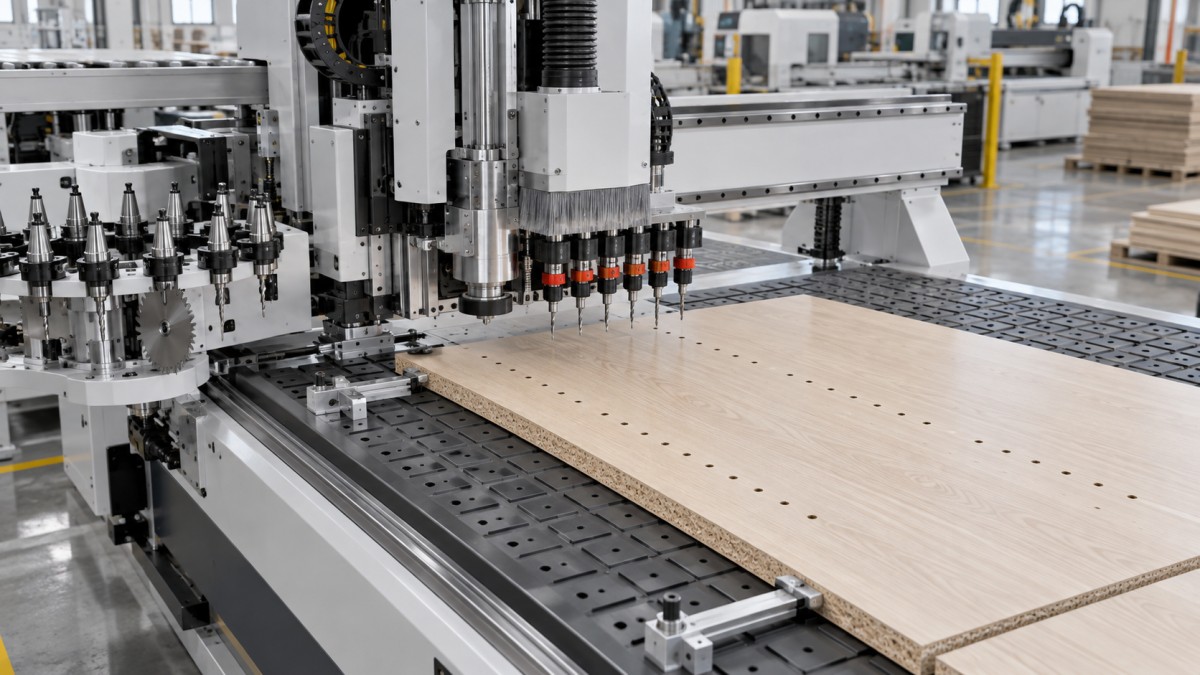
The size of the gain depends on program organization. A well-posted spindle-only program may group holes by tool across the sheet, limiting tool changes. Comparing that program with a poorly organized sequence would exaggerate the value of a drilling bank. Both configurations should be evaluated using practical, optimized machining strategies.
Spindle-only drilling remains a credible choice for custom work with relatively few holes, irregular patterns, or a broad range of parts that seldom use the same drill arrangement. It may also suit a workshop that already sends assembly drilling to another machine. In that setting, adding a bank to the router could duplicate capacity without removing an operation.
Check drilling speed as well as tool availability. The main spindle must support the selected drill’s operating requirements, including an appropriate speed range and toolholding arrangement. The drilling bank has its own limits for tool diameter, length, drilling depth, and operating speed. Neither configuration should be accepted solely because the tool can physically fit.
Horizontal drilling needs its own evaluation
A vertical drilling bank does not provide horizontal boring. If your cabinet construction requires edge holes, the proposed configuration needs suitable horizontal spindles, a compatible aggregate arrangement, or a separate drilling process. These options have different access and setup requirements.
Horizontal spindles mounted on a router head also do not guarantee that every panel edge can be reached within a nested sheet. Adjacent parts, the spoilboard, clamps, and the body of the drilling head can obstruct access. The machine needs sufficient clearance and a safe way to hold the component while the horizontal tool enters its edge.
Ask for the intended edge-drilling operation to be demonstrated on your part geometry and nesting arrangement. If parts must first be separated, repositioned, and secured, include that handling in the comparison. A separate boring machine may provide a more workable route when it lets the router continue processing sheets while edge drilling proceeds elsewhere.
Judge the whole production route, not the drilling cycle alone
A drilling bank can make the router faster without increasing the workshop’s output. If cutting, unloading, edge banding, assembly, or material supply already controls production, the saved drilling time may create spare router capacity while leaving daily cabinet output unchanged. That spare capacity can still be valuable, but its value should be identified clearly.
Start with a representative production mix rather than the most drilling-intensive panel in the catalog. Include common cabinet sides, simpler horizontal parts, and any doors or special components that share the machine. Weight them according to the work the shop expects to run. A configuration that performs well on one demonstration panel may offer a smaller advantage across the actual order mix.
For each configuration, compare the complete sheet or batch cycle, including loading, positioning, drilling, tool changes, routing, unloading, and any secondary drilling. If the drilling bank changes machining order or requires additional setup, capture that too.
The useful figure is net time saved per production batch. Drilling time alone excludes handling and work transferred to another station. Conversely, a bank that removes a separate drilling setup may deliver benefits beyond its faster movements, including fewer part transfers and fewer opportunities to select the wrong program or orientation.
Machining sequence also affects quality. Small nested parts can lose holding stability after their perimeter is cut, so drilling before final separation may be preferable. The correct sequence depends on vacuum holding, part size, material, and cutting strategy. A time estimate that assumes aggressive movement while ignoring part movement is a weak basis for purchasing.
The financial comparison should include the incremental machine price, tooling, software support, maintenance, and operator setup effort. Compare these costs with the value of released machine capacity, handling time saved, and any secondary process that can actually be removed. Avoid counting labor savings when the operator must remain at the machine throughout the cycle.
There is also a workload threshold. A bank that saves useful time on every sheet may justify itself in sustained cabinet production but contribute little when the router runs only intermittently. Equally, a relatively small saving can matter when the router is consistently the constraint preventing orders from moving forward.
Verify the configuration in software and on real parts
The drilling bank, controller, postprocessor, and cabinet software must work together. A machine can have suitable hardware while its software workflow fails to use it efficiently. Establish whether drilling operations from the cabinet design system arrive as recognized hole features, how tools are assigned, and whether compatible holes are grouped automatically.
A generic statement that the router “supports” a particular CAM package leaves important details unanswered. The postprocessor must support the exact bank arrangement and controller functions being supplied. It also needs to manage tool offsets, permitted spindle combinations, clearance movements, and horizontal drilling instructions where applicable.
Automatic grouping deserves particular attention. Holes that appear aligned in a drawing may differ in depth, tool requirement, or machining direction. They cannot necessarily be processed together. Conversely, a capable bank can lose much of its advantage if the postprocessor outputs every hole as an isolated operation.
A useful acceptance exercise follows the production route from design file to finished component:
- Use representative files. Include repeated hole rows, mixed diameters, blind holes, and the edge operations relevant to your construction method.
- Inspect the generated program. Confirm which drills operate, where simultaneous drilling occurs, and how many main-spindle tool changes remain.
- Machine the intended materials. Assess hole position, depth, breakout, and part stability using the panel types and thicknesses you expect to process.
- Fit the actual hardware. Check assembly alignment and fitting behavior, especially where several holes jointly locate a connector or hinge.
- Measure the complete cycle. Include handling and any work needed after the panel leaves the router.
Ask how bank alignment and tool-length settings are established and maintained. Multiple drilling spindles introduce additional positions and offsets that need to remain consistent. Different drill lengths, wear, or an incorrectly seated tool can affect blind-hole depth even when the programmed value is correct.
Service access matters for the same reason. Establish what routine lubrication, inspection, and adjustment the assembly requires, how replacement parts are supplied, and whether the machine can continue useful spindle-based work if the drilling unit is unavailable. That capability is configuration-dependent and should be demonstrated or documented.
Future expansion should be treated just as carefully. A machine sold without a drilling bank may not accept one economically later. Mounting provisions, head capacity, electrical and pneumatic services, controller functions, and postprocessor support can all affect a retrofit. If later installation is part of the investment plan, obtain a defined upgrade scope and cost basis before purchase.
Choose spindle-only drilling when it meets the required output and quality with an acceptable production route. Specify a drilling bank when representative programs show a worthwhile reduction in total processing time, or when its verified capabilities remove a troublesome secondary operation. The most convincing purchase evidence is a set of your cabinet parts, made through the proposed workflow, with the finished holes checked and the full cycle measured.
Send Your Inquiry
We welcome your cooperation and we will develop with you.