


News & Exhibitions
Latest Factory Updates, Industry Trends & Global Exhibition Information
CNC Drilling Machine for Kitchen Cabinets: How to Choose the Right Model for High-Precision Hinge & Shelf Pin Holes
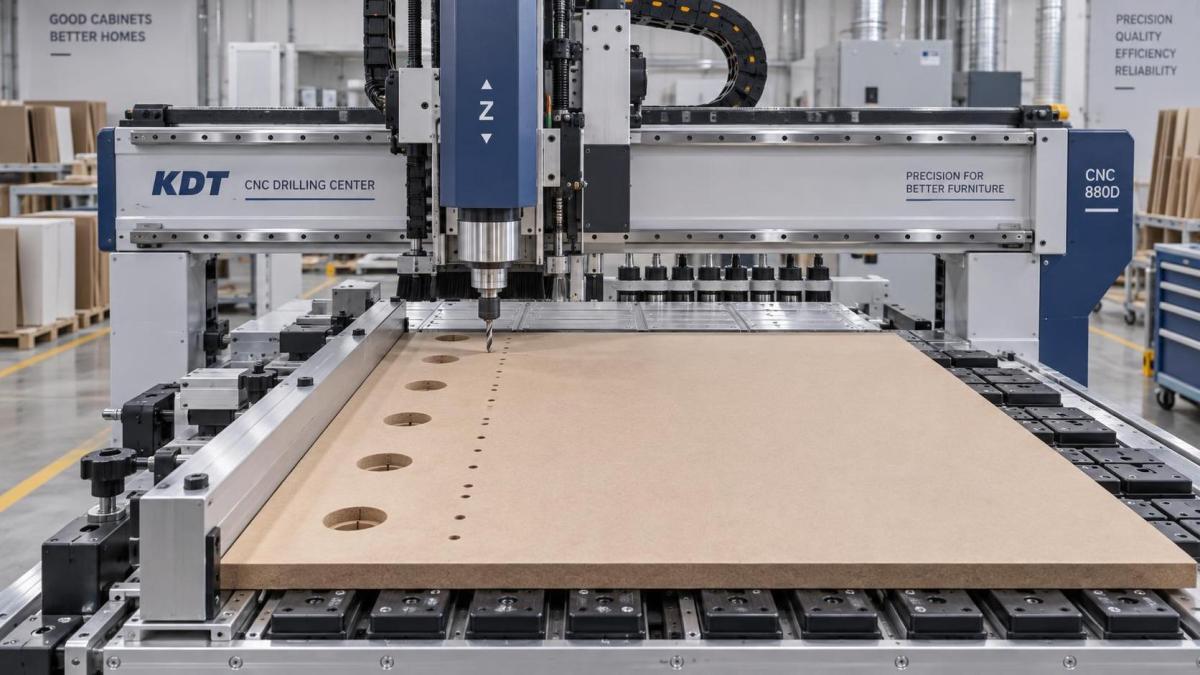
Choosing the right CNC drilling machine for kitchen cabinets isn’t about selecting the most expensive or feature-rich model—it’s about matching machine capabilities to your production reality: hole tolerance requirements, panel throughput, material variability, and operator skill level. For procurement professionals evaluating options, the core question is straightforward: *Which configuration delivers ±0.1mm repeatability on hinge cup holes (35 mm) and shelf pin holes (5 mm), while minimizing setup time between job changes and sustaining accuracy across 8–12 hour shifts?*
Many cabinet shops face the same bottleneck: inconsistent hole positioning leads to misaligned doors, wobbling shelves, and costly rework—especially when switching between frameless and face-frame designs or handling mixed-material batches (MDF, plywood, particleboard). If you’re seeing >0.2mm deviation in hinge cup depth or angular drift in shelf pin rows after 50 panels, the issue likely lies not in tool wear alone, but in how the machine handles workholding rigidity, spindle alignment consistency, and coordinate referencing across long runs.
Start with the Non-Negotiables—Not the Features
Before comparing brands or automation levels, confirm three foundational criteria. These are not marketing claims—they’re mechanical and operational thresholds that directly determine whether a CNC drilling machine can hold specification in daily use:
- Rigid linear motion system: Look for hardened, ground guide rails (not just profiled aluminum extrusions) with preloaded linear bearings. Machines using low-cost rail systems often show measurable positional drift after 200+ cycles due to thermal expansion and bearing play—especially in unair-conditioned workshops.
- True Z-axis depth control: A servo-driven Z-axis with closed-loop feedback is essential. Pneumatic or stepper-based depth actuators cannot maintain consistent pressure or repeat depth within ±0.05 mm across varying panel densities or drill bit wear stages.
- Fixed reference datum system: The machine must use a physical, machined reference edge—not software offsets—to establish X/Y zero. If every new panel requires manual probing or camera recalibration before drilling begins, cycle time loss compounds quickly, and human error enters the tolerance chain.
These aren’t “nice-to-haves.” They’re the minimum structural and control conditions required to achieve repeatable hinge and shelf pin hole placement—regardless of operator experience or software interface polish.
Where Automation Adds Real Value—and Where It Doesn’t
Automated loading, barcode scanning, or nesting integration sound compelling—but their ROI depends entirely on your workflow. If your shop processes 15–30 unique cabinet orders per day with frequent material changes and small batch sizes (<20 panels/order), full automation may increase complexity without reducing labor hours. Instead, prioritize features that reduce *manual intervention per panel*:
- Quick-change drill head modules: Swapping between 35 mm hinge cups and 5 mm shelf pins should take under 90 seconds—without recalibrating the entire head. Machines with modular, pre-aligned tooling carriers eliminate downtime caused by re-zeroing individual spindles.
- On-machine probe calibration: A built-in touch probe that validates spindle perpendicularity and depth offset at startup—and optionally after every 10th panel—catches drift before it becomes scrap. This is more valuable than a “high-speed” spindle if your current scrap rate stems from undetected Z-axis drift.
- Tool life monitoring tied to actual feed load: Not just rotation count. Real-time torque sensing allows the system to adjust feed rate or flag dull bits *before* hole wall finish degrades—critical for clean hinge cup edges in melamine-faced panels.
Automation only pays off when it removes a step that currently requires skilled labor, introduces variation, or creates a bottleneck. If your operators spend more time aligning panels manually than loading them, invest in better clamping and reference systems—not robotic arms.
Material Behavior Matters More Than Spec Sheets
Drilling accuracy isn’t defined solely by machine specs—it’s co-determined by how your materials respond. MDF drills cleanly but compresses under clamping force; plywood layers delaminate if feed rate isn’t matched to grain direction; particleboard sheds dust that clogs vacuum channels and reduces suction stability. A machine that holds ±0.1mm on test steel plates may deliver ±0.25mm on 18 mm particleboard if its vacuum table lacks segmented zones or fails to compensate for uneven panel flatness.
Ask suppliers for validation data—not on ideal lab samples, but on real production panels: What’s the measured standard deviation in hole position across 100 consecutive 2440 × 1220 mm MDF panels, using standard 35 mm hinge cup bits at typical feed rates? If they can’t provide that number—or cite it as “machine-dependent”—the tolerance guarantee is theoretical, not operational.
Integration Isn’t Just About Software Compatibility
“Works with your ERP” or “exports DXF” is meaningless unless the data pipeline preserves dimensional intent. Shelf pin spacing errors often originate upstream: if your design software outputs shelf pin rows as grouped objects rather than discrete coordinate points, some CAM interfaces interpret row spacing as center-to-center distance, while others treat it as edge-to-edge—introducing a 2–3 mm cumulative offset over six pins. Verify how the machine’s controller interprets coordinate origin, unit scaling (mm vs. inch), and layer naming conventions from your existing CAD/CAM environment.
Also consider physical integration: Does the machine accept standard 32 mm system templates? Can it drill both hinge cups and shelf pin rows in one pass without rotating the panel? If your current workflow relies on manual jigging for shelf pin rows, a machine that requires separate fixturing for each operation adds setup time and introduces alignment risk—even if its standalone accuracy is excellent.
Service Access Is Part of the Machine Specification
A CNC drilling machine for kitchen cabinets isn’t purchased—it’s deployed into a production line where uptime directly impacts order fulfillment. A 48-hour spare part lead time on a failed Z-axis encoder means two days of halted hinge drilling. Procurement decisions must include service infrastructure: Is there an authorized technician within 200 km who stocks critical motion components? Are firmware updates delivered remotely, or do they require on-site visits? Do replacement drill chucks ship with pre-calibrated runout values documented per unit?
At Qingdao Zhongding Machinery, this is built into the design philosophy—not added as an afterthought. Every CNC drilling machine for kitchen cabinets ships with factory-verified spindle runout reports, includes onboard diagnostic logs accessible via USB export, and supports remote parameter adjustment by trained support engineers—reducing troubleshooting time without compromising data security.
Ultimately, the right model isn’t the one with the longest list of features. It’s the one whose mechanical integrity, control logic, and service architecture align precisely with how your shop actually operates—not how a brochure imagines it should.
Send Your Inquiry
We welcome your cooperation and we will develop with you.