


News & Exhibitions
Latest Factory Updates, Industry Trends & Global Exhibition Information
Automatic 1300mm Wide Belt Sander vs Manual Calibration: How Real-Time Thickness Feedback Cuts Plywood Sanding Rejects by 37%
Time:Sep 14, 2026
Author:Zhongding Solutions Engineering Team
Number of views:
For project managers overseeing high-volume plywood production, inconsistent sanding thickness isn’t just a quality issue—it’s a systemic constraint that compounds across the value chain. Rework cycles delay shipments, excess material removal increases abrasive consumption by up to 28%, and manual calibration drifts between shifts erode repeatability before the first board is even processed. The root cause lies not in operator skill, but in the absence of closed-loop control: traditional wide belt sanders rely on pre-set roller positions, with no way to detect or compensate for real-time variations in panel density, moisture content, or belt wear. That gap—between static setup and dynamic process conditions—is where 37% of sanding rejects originate.
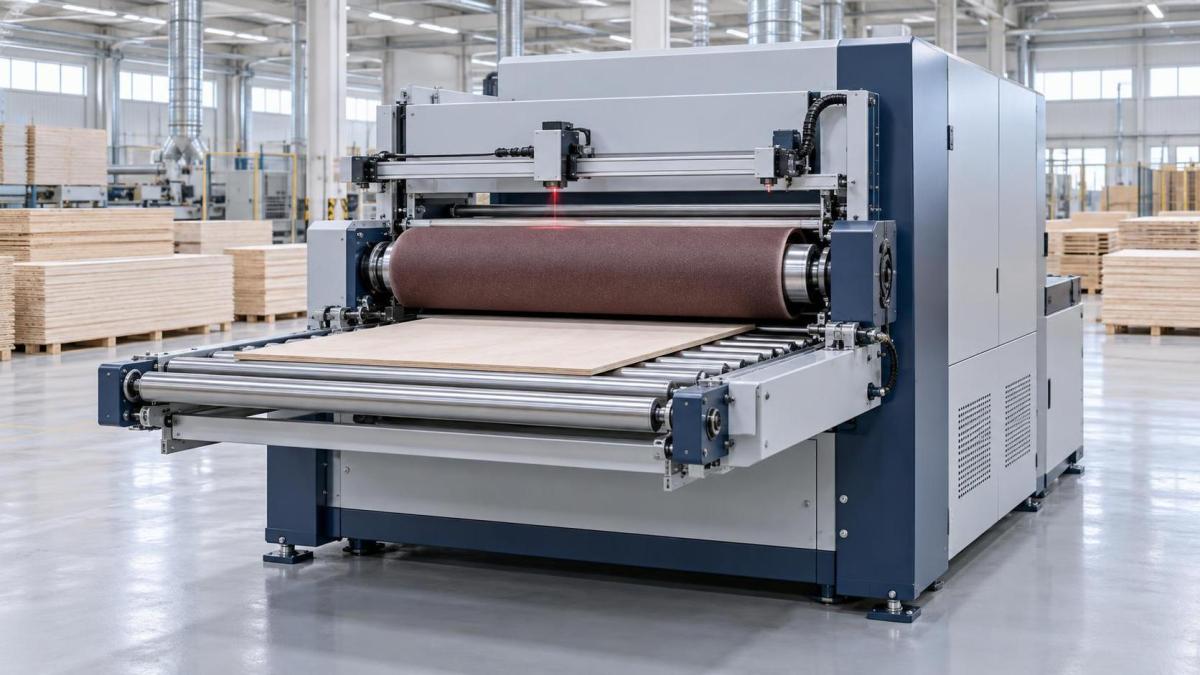
The automatic 1300mm wide belt sander addresses this by embedding thickness feedback directly into the sanding loop. Unlike systems that measure only post-process or require offline sampling, it integrates non-contact laser displacement sensors upstream of the final sanding head, capturing thickness data at 120 Hz per board edge. This isn’t just measurement—it’s actionable input. The machine’s control logic compares each reading against the target profile (e.g., ±0.08 mm for furniture-grade plywood), then adjusts pneumatic pressure on the contact rollers in <150 ms. No human intervention. No recalibration window. No assumption that yesterday’s settings apply today.
This responsiveness matters most where variability is highest: cross-laminated panels with alternating softwood/hardwood layers, veneer-core composites with glue-line swell, or MDF blends with inconsistent resin distribution. In these cases, manual calibration assumes uniformity—yet actual thickness deviation across a single 2440 × 1220 mm sheet can exceed 0.3 mm due to press release behavior, ambient humidity shifts during storage, or minor core layer misalignment. A fixed roller gap either under-sands the thinnest zones (leaving glue residue) or over-sands the thickest (exposing core fibers). Real-time feedback eliminates that trade-off. It treats each board as a unique profile—not a statistical average—and adapts within the time it takes to traverse 300 mm of belt travel.
Implementation isn’t about swapping machines—it’s about redefining process ownership. Project managers often underestimate the labor overhead tied to calibration discipline. On a three-shift line, manual verification typically occurs every 90 minutes, requiring two operators to stop feed, measure five points per board, log deviations, adjust rollers, and validate with test runs. That’s 22 minutes per shift—66 minutes daily—just to maintain baseline consistency. Worse, those checks occur *after* the fact. By the time a drift is caught, 12–17 boards may already be out of spec. The automatic system removes that latency. Calibration becomes continuous, invisible, and auditable: every thickness reading is timestamped, logged to local storage, and exportable as CSV for SPC analysis. There’s no “calibration event”—only ongoing process validation.
Maintenance implications shift accordingly. With manual systems, roller wear is masked until surface finish degrades or reject rates climb. Technicians then perform reactive diagnostics: checking belt tension, verifying pneumatic regulator function, inspecting roller concentricity—all after yield has already dropped. The automatic sander surfaces wear patterns earlier. Consistent upward drift in required pressure to maintain target thickness—tracked across 10,000 board-hours—signals belt glazing or roller coating fatigue long before visible finish defects appear. That turns maintenance from failure-driven to predictive. Spare parts planning improves because consumable life is measured in actual usage metrics, not calendar time or estimated cycles.
Integration into existing lines requires attention to interface constraints—not mechanical fit. The system expects stable 400 V/50 Hz power with ≤3% voltage fluctuation; transient spikes above 10% trigger protective shutdown, halting calibration updates until stabilization. PLC communication uses Modbus TCP, not proprietary protocols, enabling direct linkage to MES systems for real-time yield tracking—but only if the host system polls at ≥500 ms intervals. Faster polling floods the buffer and drops readings. Feed rate must remain within 8–18 m/min: below 8 m/min, sensor dwell time exceeds optimal capture window; above 18 m/min, lateral vibration reduces measurement confidence below ±0.05 mm. These aren’t arbitrary limits—they reflect the physics of laser triangulation on moving wood surfaces and the thermal stability threshold of the embedded signal processor.
ROI crystallizes not in headline speed gains, but in yield stability. A facility producing 85,000 m²/month of 18 mm plywood saw reject reduction from 6.2% to 3.9%—a 37% absolute drop—not by increasing throughput, but by eliminating thickness-related rework. Labor savings came not from headcount reduction, but from redirecting two technicians from calibration tasks to preventive maintenance scheduling and SPC chart review. Abrasive cost fell 19% year-on-year—not because belts lasted longer, but because consistent pressure reduced localized overheating and premature grain fracture. Most critically, delivery reliability improved: late shipments tied to sanding rework dropped from 11% to 3% over six months, directly strengthening contractual SLA compliance.
What doesn’t change—and shouldn’t—is the role of the operator. The system doesn’t replace judgment; it relocates it. Instead of adjusting dials based on tactile feedback or historical averages, operators now monitor trend charts, interpret deviation clusters (e.g., persistent low-thickness readings on left edge indicating misaligned feed conveyor), and initiate diagnostic routines when pressure variance exceeds 12% over rolling 50-board averages. That’s higher-value work: troubleshooting root causes rather than masking symptoms.
The limitation isn’t technical—it’s procedural. Facilities that treat real-time feedback as a “set-and-forget” upgrade, without updating their internal QA protocols to include live thickness logging in audit trails or revising shift handover checklists to cover calibration health metrics, see diminishing returns after 90 days. The tool enables precision; sustaining it requires aligning workflows, accountability, and measurement discipline around the new capability.
 For project managers evaluating upgrades in high-mix plywood environments, the question isn’t whether automation reduces rejects—it’s whether your current calibration protocol can withstand the variability inherent in industrial wood composites. If thickness variation is treated as noise to be averaged away, rather than a signal to be acted upon, the 37% reduction isn’t an outcome—it’s a measure of how much latent process instability you’ve been absorbing. The automatic 1300mm wide belt sander doesn’t eliminate variability. It makes it visible, actionable, and controllable—within the cycle time of the process itself.
Send Your Inquiry
We welcome your cooperation and we will develop with you.