


News & Exhibitions
Latest Factory Updates, Industry Trends & Global Exhibition Information
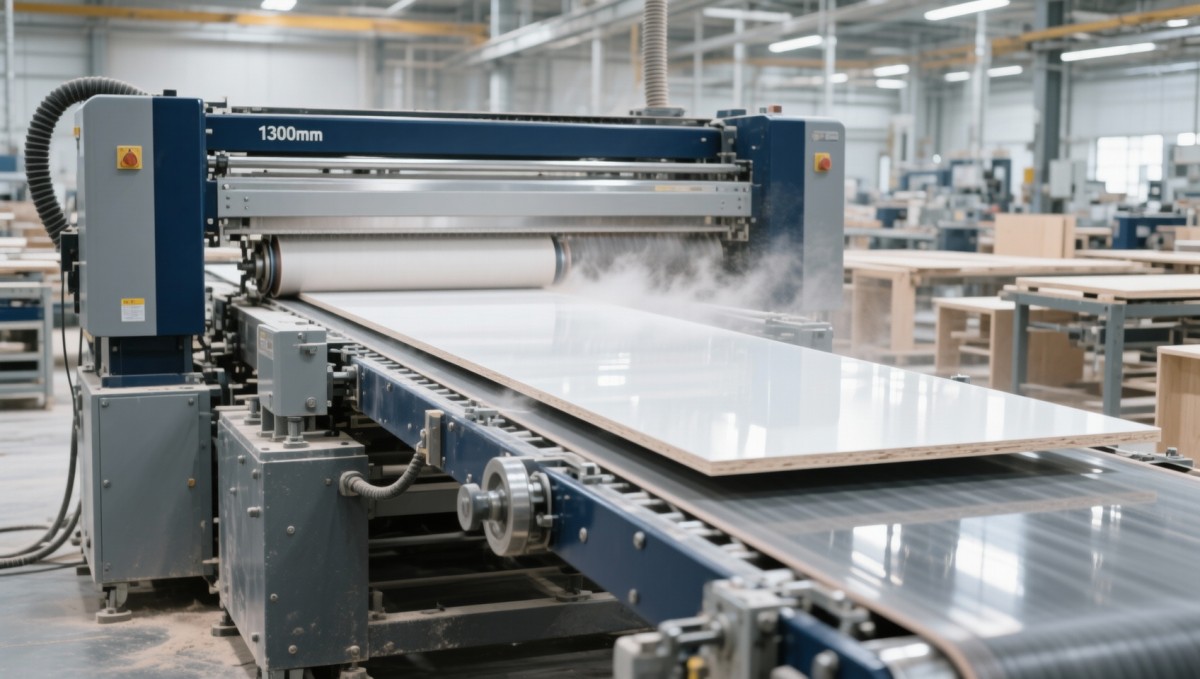
1300mm Wide Belt Sanding Machine: Achieving <0.05mm Tolerance Across 4m Panels in High-Volume Cabinet Production
For project managers running high-volume cabinet production lines, the phrase “<0.05mm tolerance across 4m panels” isn’t a theoretical target—it’s a daily operational threshold. Miss it, and you trigger cascading costs: edge banding misalignment, inconsistent lamination thickness, CNC toolpath errors, and—most critically—rework that halts line flow. The real challenge isn’t just *achieving* that tolerance once; it’s holding it, panel after panel, shift after shift, across humid summer days and dry winter months, on material ranging from MDF to plywood to laminated particleboard.
Why Standard Belt Sanders Fail at This Scale—and Why Width Alone Isn’t the Answer
A 1300mm wide belt sanding machine sounds like the obvious fix for 4m panels. But width is only one variable—and often the most misleading one. Many teams assume: “Bigger belt = more coverage = better consistency.” In practice, that logic backfires without three non-negotiable foundations:
- Frame rigidity under load: A flimsy cast-iron base or undersized cross-beam flexes under the downward pressure of a 1300mm-wide abrasive belt, especially when sanding dense 38mm cabinet sides. That flex translates directly into thickness variation—often peaking near the center of the panel where deflection is greatest.
- Belt tracking and tension stability: On machines with manual tension adjustment or single-point tracking, belt drift accumulates over long runs. A 0.3mm lateral shift across 4 meters compounds into measurable thickness loss on one side—enough to break glue-line integrity in post-lamination bonding.
- Feed system synchronization: If the conveyor doesn’t maintain exact linear velocity—especially during acceleration/deceleration between panels—the sanding dwell time changes. Even a 2% speed fluctuation alters material removal rate enough to push surface flatness beyond ±0.05mm.
These aren’t edge cases. They’re the reasons why some plants report 12–18% rework on tall cabinet components despite using “industrial-grade” wide-belt machines. The failure point is rarely the abrasive itself—it’s how the machine manages mechanical energy across its full working width.
What Actually Holds <0.05mm—And What You Must Verify Before Procurement
True consistency starts before the first panel feeds in. Here’s what separates machines that *claim* precision from those that *deliver* it in real-world production:
1. Dual-Stage Pressure Control (Not Just “Adjustable” Pressure)
Single-knob pressure adjustment is inadequate. At 1300mm width, localized density variations in core material (e.g., resin pockets in MDF) require dynamic response. Machines built for this application use independent pneumatic zones across the platen—typically three: left, center, right. Each zone adjusts in real time based on load sensors, compensating for panel warpage or substrate inconsistency *without operator input*. This is how you avoid the “smile effect”—thinner edges and thicker center—on 4m doors.
2. Precision-Machined Platen Geometry
“Flat” isn’t enough. The platen must be ground to ≤0.015mm deviation over its entire 1300mm width—and maintained under thermal load. Low-cost machines use welded steel platens that warp as motors heat up. High-stability units use stress-relieved, fully machined cast iron with integrated coolant channels. Ask for a certified flatness report—not just a spec sheet.
3. Integrated Thickness Monitoring Loop
The most effective systems don’t rely on pre-set parameters. They embed non-contact laser sensors *immediately before and after* the sanding head. The delta feeds back to the PLC, which auto-adjusts feed speed and pressure within milliseconds. This closed-loop control is what allows sustained ±0.03mm performance—even when switching between 16mm drawer fronts and 36mm carcass panels on the same line.
Integration Is Where Tolerance Gets Real—Not Just in the Machine
A 1300mm wide belt sanding machine doesn’t operate in isolation. Its precision collapses if upstream or downstream processes introduce variation. For example:
- If your panel saw leaves a 0.12mm kerf variation across 4m, no sander can “correct” that baseline error—it can only compound it through uneven stock removal.
- If your edge bander applies inconsistent glue thickness—or fails to register against a non-flat panel edge—the sander may remove critical bond-line material, weakening joint integrity.
- If your CNC nesting software doesn’t account for post-sanding dimensional drift, parts won’t assemble cleanly, forcing manual shimming or re-cutting.
This is why Qingdao Zhongding Machinery designs its 1300mm wide belt sanding machine not as a standalone unit, but as a node in a synchronized workflow. Its control interface communicates directly with common CNC and edge banding systems—so when the PUR&EVA Straight Edge Banding Machine ZD450G1P1 signals a change in material type (e.g., switching from PVC to veneer), the sander auto-recalls optimized pressure and feed profiles. That kind of interoperability eliminates manual setup errors—the #1 cause of first-piece scrap in high-mix cabinet production.
What “20+ Years of Real-World Production Demands” Actually Means
That experience isn’t about surviving two decades—it’s about solving the same problem thousands of times across climates, materials, and shift patterns. It means designing for things manuals never mention:
- Dust management that doesn’t degrade accuracy: Standard cyclones clog fast with fine MDF dust, causing vacuum loss and belt slippage. Zhongding’s system uses multi-stage filtration with automatic pulse cleaning timed to production cycles—not maintenance schedules.
- Service access that doesn’t stop the line: Changing a drive belt shouldn’t require dismantling the frame. Their modular design isolates high-wear components behind quick-release panels—reducing changeover time from 90 minutes to under 12.
- Calibration that survives floor vibration: In facilities with heavy forklift traffic or nearby stamping equipment, standard laser alignment drifts daily. Zhongding’s reference system uses hardened steel datum blocks anchored to the foundation—not just the machine frame—so recalibration holds for weeks, not hours.
None of these are “features.” They’re responses to failures observed across hundreds of installations—from German cabinet makers needing zero-defect export compliance to Vietnamese factories running triple shifts with minimal technical staffing.
Before You Specify: Three Questions That Reveal Readiness
Don’t start with specs. Start with process reality:
- What’s your current average rework rate on panels >3m? If it’s above 5%, your issue likely isn’t sanding—it’s upstream dimensional control. Fix the saw or CNC first.
- How often do you change abrasive grits mid-shift? Frequent changes indicate inconsistent stock removal—pointing to feed speed or pressure instability, not belt quality.
- Can your operators verify thickness *in-line*, without stopping? If not, you’re reacting—not controlling. Demand real-time metrology integration, not just “optional sensor packages.”
When all three align—rigid mechanics, closed-loop control, and integrated workflow—the 1300mm wide belt sanding machine stops being a finishing station and becomes a tolerance anchor. That’s how you turn “<0.05mm across 4m” from a quality target into a repeatable, measurable, and profitable standard.
Send Your Inquiry
We welcome your cooperation and we will develop with you.