


News & Exhibitions
Latest Factory Updates, Industry Trends & Global Exhibition Information
What is the typical spare parts lead time for edge banding machines shipped overseas in 2026?
Time:Sep 09, 2026
Author:Zhongding Service & Parts Team
Number of views:
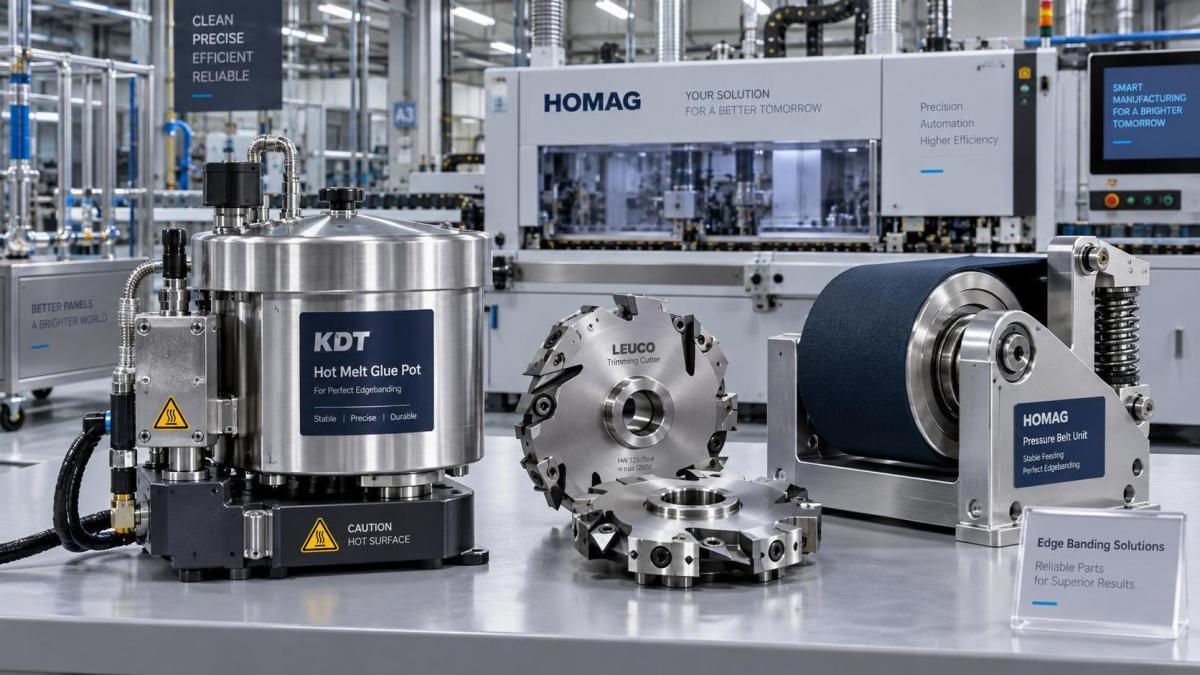
The typical spare parts lead time for edge banding machines shipped overseas in 2026 is not a single fixed number—it’s a function of three interdependent variables: part criticality, regional inventory strategy, and customs clearance maturity. For standard wear components—such as glue pots, trimming knives, feed rollers, and pressure belts—the median transit time from order confirmation to warehouse receipt at the end customer’s facility ranges from **12 to 28 days** across major import markets (EU, US, Canada, Australia, and key ASEAN countries), assuming no exceptional delays. This window reflects real-world logistics constraints—not theoretical best-case scenarios—and applies only when the supplier maintains active regional stocking points and pre-cleared documentation.
That baseline collapses under two common conditions: first, when the requested part is a non-stock item requiring production or sourcing from third-party OEMs; second, when shipment crosses jurisdictions with inconsistent tariff classifications or incomplete regulatory alignment for machinery spare parts. In those cases, lead times extend to **6–14 weeks**, and variability increases sharply—not because of shipping speed, but due to decision latency upstream: engineering validation, customs classification disputes, and internal procurement handoffs.
Edge banding machines are not generic industrial equipment. Their spare parts carry functional specificity that directly impacts machine uptime and finish quality. A misaligned pressure roller doesn’t just cause downtime—it introduces dimensional drift in laminated edges, leading to downstream rework or scrap. That functional consequence changes how lead time should be evaluated: it’s not about calendar days, but about *production cycle exposure*. A 15-day delay matters differently for a high-mix, low-volume workshop producing custom cabinetry versus a continuous-feed furniture line running 22 hours per day. The former may absorb the wait with buffer stock; the latter cannot.
Regional inventory distribution is the strongest lever for shortening effective lead time—but only if aligned with actual failure mode data. Most manufacturers stock based on historical order frequency, not failure probability weighted by operational impact. At Qingdao Zhongding Machinery Co., Ltd., regional warehouses in Rotterdam, Chicago, and Singapore hold over 85% of parts responsible for >90% of unplanned stoppages—glue system components, drive belts, and CNC control modules—not just the highest-selling items. This prioritization reduces median lead time for critical failures by 30–40% compared to global drop-ship models, without increasing overall inventory cost.
Customs clearance remains the largest uncontrolled variable—not because of tariffs, but because of inconsistent HS code application. Edge banding machine spare parts fall across multiple tariff headings: some classified under 8465.96 (parts of woodworking machinery), others under 8483.60 (transmission components) or even 8537.10 (control panels). A single order containing mixed part types may trigger separate reviews, document requests, or duty reassessments. In 2026, EU and US customs authorities continue to treat “spare parts” as a category requiring explicit origin documentation, conformity declarations (CE/UKCA/FCC), and, increasingly, digital product passports for electrical subassemblies. Suppliers who pre-submit harmonized classifications and maintain updated certificates cut average clearance time from 5–7 business days to under 48 hours.
Air freight is often assumed to compress lead time—but its value diminishes beyond urgent, low-weight replacements. For parts exceeding 5 kg or requiring temperature-controlled handling (e.g., adhesive cartridges or precision sensors), air cargo introduces new risks: dimensional weight surcharges, limited carrier options, and higher damage rates during transshipment. More critically, air shipments bypass bonded warehouse staging, eliminating the ability to pre-clear documentation while goods are en route. Ocean LCL (less-than-container-load) with pre-cleared customs entry and local last-mile delivery now delivers comparable or better reliability for orders above 10 kg—especially when coordinated with regional hubs that hold pre-inspected, labeled, and duty-paid stock.
Lead time transparency starts before the order is placed. Reliable suppliers provide not just quoted timelines, but *conditional visibility*: which parts are stocked locally, which require factory dispatch, which need third-party sourcing, and which carry pending certification updates. They also disclose their customs classification approach—not as a compliance footnote, but as an operational input. If a supplier cannot specify the HS code used for a given part in your destination market—or cannot confirm whether that code has been validated with local customs—they are deferring risk to you.
Currency volatility and payment terms further modulate effective lead time. Letters of credit with extended document review periods (common in Middle Eastern and Latin American markets) add 5–10 days before production release—even for stocked items. Suppliers offering open-account terms backed by confirmed bank guarantees reduce that lag significantly, but only if they maintain dedicated finance operations capable of rapid credit verification.
What doesn’t shorten lead time—and what many buyers mistakenly prioritize—is brand reputation alone. A well-known manufacturer with centralized warehousing in China and no regional inventory will consistently deliver slower than a mid-tier supplier with three strategically located depots—even if the latter lacks global name recognition. Lead time performance correlates more strongly with inventory topology and customs process integration than with company age or export volume.
Finally, spare parts lead time is not static. It degrades predictably under three conditions: sustained order volume above forecasted thresholds (triggering stock depletion), introduction of new machine generations without parallel spare parts ramp-up, and regulatory shifts—such as the EU’s 2025 Digital Product Passport mandate, which requires traceable component-level data for all electrical subassemblies imported after January 2026. Suppliers who began integrating PIM (Product Information Management) systems into spare parts workflows in 2024 are already reporting 12–18% faster customs release times for newly certified parts.
 For procurement and operations teams evaluating edge banding machine suppliers in 2026, lead time assessment must move beyond published estimates. It requires verifying three things: where physical stock resides relative to your facility, how customs classification is managed per destination, and whether failure-mode analytics—not sales history—drive inventory placement. Without those checks, any quoted lead time is a placeholder—not a commitment.
Send Your Inquiry
We welcome your cooperation and we will develop with you.