


News & Exhibitions
Latest Factory Updates, Industry Trends & Global Exhibition Information
What Spare Parts Cause the Longest Woodworking Machine Downtime?
A woodworking machine can be mechanically sound one day and become a production bottleneck the next because of one unavailable component. A panel saw that cannot start, an edgebander with no pneumatic movement, or a CNC router that loses spindle accuracy may leave operators waiting while unfinished work accumulates. The longest delays usually do not come from low-cost consumables; they come from parts that are machine-specific, require matching technical parameters, or need careful installation and calibration.
What spare parts cause the longest woodworking machine downtime? The highest-risk items are usually spindle motors and their drives, CNC control boards and servo components, precision bearings, gearboxes, cutting assemblies, pneumatic and vacuum-control parts, and model-specific electrical components. Their downtime impact depends not only on failure frequency, but also on whether a correct replacement is available, whether the part must be programmed or aligned, and whether the machine can safely run with reduced functionality.
Downtime is often determined by replacement difficulty, not part price
A drive belt may cost far less than a control board, yet both can stop a machine. The difference is that a belt is often available in standard sizes and can be fitted quickly, while a control board may need an exact hardware version, compatible software parameters, and electrical checks before the machine can restart. Maintenance planning should therefore rank parts by recovery time rather than by purchase value alone.
Three conditions tend to turn a normal repair into a long shutdown:
- The component is proprietary or matched to a particular machine model, serial range, motor specification, or controller generation.
- The replacement requires setup work, such as spindle runout adjustment, axis homing, inverter configuration, or pneumatic pressure tuning.
- The failed part has damaged or stressed related components, so replacing one item does not immediately restore operation.
For example, a failed spindle bearing may first appear as noise or heat. If operation continues, spindle taper damage, shaft scoring, cutter vibration, and poor finish quality can follow. At that stage, the repair is no longer a simple bearing change.
Spindle motors, spindle cartridges, and precision bearings
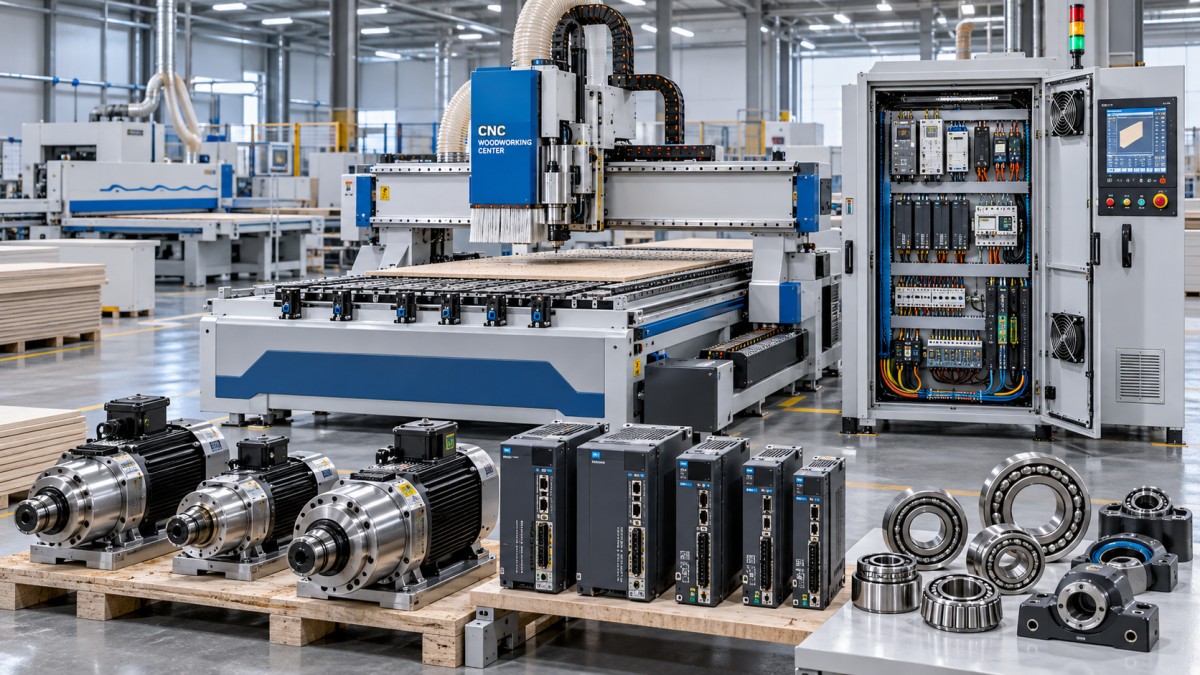
Spindle-related faults are among the most disruptive problems on CNC routers, machining centers, boring machines, and some edge-processing equipment. The spindle determines cutting speed, tool holding accuracy, surface finish, and feed capability. When it fails, production may stop completely because there is no practical way to bypass it.
A complete spindle motor or cartridge can take time to source because the replacement must match power rating, speed range, cooling method, mounting dimensions, taper or collet system, sensor configuration, and drive compatibility. A spindle that appears physically similar may still be unsuitable if its encoder, thermal sensor, lubrication method, or inverter requirements differ.
Bearings can create equally long downtime when the exact bearing arrangement is not identified early. High-speed spindle bearings are not ordinary general-purpose bearings. Their preload, contact angle, precision grade, lubrication requirements, and installation orientation affect performance. Incorrect fitting can lead to excess heat, vibration, premature failure, or cutter marks across the panel.
Watch for increasing spindle noise, abnormal temperature, tool chatter, declining edge quality, or a repeated need to reduce feed speed. These signs do not automatically prove that the spindle is failing, but they justify prompt inspection before the machine reaches an unplanned stop.
Control boards, PLC modules, servo drives, and axis feedback devices
Electrical and electronic parts often create the longest diagnostic delays because the visible symptom may not identify the true failed item. A CNC may show an axis alarm, fail to complete homing, lose communication with a drive, or refuse to start a machining cycle. The problem could be a control board, servo amplifier, encoder cable, power supply, input-output module, relay, parameter corruption, or an intermittent connector.
Control boards and PLC modules are especially downtime-sensitive because replacements are not always interchangeable. Revision numbers, firmware, connector layouts, input-output mapping, and software settings may differ even within a similar product series. Installing an unverified substitute can create more faults than it solves.
Servo drives and motors require the same caution. The motor feedback type, brake arrangement, rated current, encoder resolution, and drive parameters need to correspond. A correct spare drive may still require commissioning steps, including restoring parameters, checking rotation direction, verifying limit switches, and confirming axis travel.
Before declaring a board or drive failed, maintenance personnel should record all alarm codes, inspect supply voltage, examine plugs for loose pins or moisture, and check cables where they bend repeatedly inside drag chains. Replacing a costly controller without confirming these basics can waste time and leave the original fault unresolved.
Keep configuration information with the spare
A control component stored without its associated machine information may not reduce downtime as much as expected. Each critical electronic spare should be labeled with the machine model, controller version, part number, software or firmware details where applicable, and any parameter backup location. Keep current CNC parameters, inverter settings, servo drive settings, and PLC program backups under controlled access. A replacement board that arrives quickly is only useful when the machine can be returned to its correct operating configuration.
Gearboxes, feed drives, and transmission assemblies
Gearboxes and feed transmission parts can immobilize wide-belt sanders, planers, moulders, edgebanders, drilling machines, and material-handling sections. The immediate symptom may be irregular feed speed, slipping, grinding noise, overheating, a stalled conveyor, or inconsistent workpiece movement. Because these machines depend on synchronized mechanical motion, a damaged gearbox can affect both productivity and machining consistency.
Long downtime occurs when the gearbox is integrated with a special motor, flange, brake, encoder, or drive shaft. An apparently minor mismatch in ratio or output shaft geometry can change feed speed and disturb processing results. On equipment with multiple feed zones, restoring only one damaged unit may also require checking synchronization with adjacent rollers or conveyors.
Belts, chains, sprockets, pulleys, and couplings are usually easier to replace, but they should not be treated as low-risk by default. A belt with the wrong profile, width, length, or temperature resistance may fit temporarily yet slip under load. A coupling failure can also indicate misalignment, seized bearings, overload, or abrupt acceleration rather than a worn coupling alone.
Pneumatic valves, cylinders, vacuum components, and air preparation units
Pneumatic faults can stop an edgebander, beam saw, drilling machine, press, or automated loading device even though the failed component is relatively small. Solenoid valves control lifting, clamping, pressing, trimming, tool movement, and material positioning. A sticking valve, leaking cylinder, damaged air tube, or contaminated filter-regulator unit can create inconsistent motion before it creates a complete stop.
The delay becomes longer when a valve manifold uses a specific voltage, port layout, coil connection, or communication interface. Replacing a valve with an incorrect configuration may reverse a function, fail to seal properly, or create unsafe movement. Cylinders must also match stroke length, bore, mounting style, rod thread, cushioning arrangement, and working environment.
Vacuum systems deserve similar attention on CNC nesting and panel-handling equipment. A vacuum pump fault, damaged vacuum valve, clogged filter, leaking gasket, broken hose, or failed pressure switch can reduce holding force. The machine may still run, but a workpiece can shift during cutting, leading to damaged panels, broken tools, or safety risks. Do not treat weak vacuum as merely a quality issue; determine whether the machine can safely continue operation.
Drain water from air preparation units according to the equipment requirements, monitor pressure stability, and investigate repeated valve contamination. Compressed air quality has a direct effect on the life of seals, valves, and pneumatic actuators.
Cutting units and tool-holding components that require setup
Saw arbors, scoring units, cutter heads, collet chucks, tool clamps, boring heads, and pressure assemblies can cause extended downtime when wear or collision damage is discovered late. These parts may not fail electrically, but they can prevent the machine from producing acceptable work. A damaged saw arbor can cause blade wobble; a worn collet can reduce tool grip; a misaligned scoring unit can leave chipped laminate edges.
The critical issue is often not obtaining a replacement alone. Precision cutting assemblies need correct adjustment after installation. Blade projection, scoring alignment, cutter balance, clamping torque, tool length measurement, and runout all influence the finished result. Restarting quickly without verifying these settings can turn a repair into a scrap problem.
Keep an inspection routine for taper surfaces, collets, arbor threads, flange faces, clamping parts, and protective covers. Do not mix damaged or heavily worn holders with new cutting tools and expect stable results. A tool-holding fault may be less obvious than a broken motor, but it can steadily consume production time through rework and repeated setup changes.
Which parts should be held in stock?
Not every expensive component should sit on a shelf. A practical spare-parts plan separates fast-moving maintenance items from critical long-lead parts. Stocking decisions should consider machine importance, failure consequences, local availability, storage life, and whether one part serves multiple machines.
Items commonly worth keeping on site include correctly specified belts, common bearings, fuses, contactors, sensors, relays, pneumatic fittings, filters, seals, valve coils, vacuum gaskets, and selected switches. These are often inexpensive compared with the production time lost while waiting for delivery. Keep them protected from dust, moisture, vibration, and unsuitable temperatures.
For high-value parts such as spindles, servo drives, gearboxes, and control modules, an alternative may be to maintain confirmed supplier lead times, technical records, and a clear approval path for urgent ordering. Where a machine is essential and no backup equipment exists, holding a verified critical spare can be justified. The decision should be based on the cost of a stopped line and the realistic time required to source, install, and commission the part.
Build a parts record before the machine stops
The most useful maintenance document is not a broad inventory list; it is a machine-specific critical-parts record. For each high-impact component, record the manufacturer part number, machine serial reference, photographs of labels and connectors, voltage or power details, dimensions where relevant, compatible alternatives approved by the equipment supplier, and installation notes. A photo of an old label is often more valuable during an urgent repair than a vague description such as “spindle drive” or “air valve.”
Also distinguish between parts that are interchangeable and parts that only look similar. Two proximity sensors may share a mounting thread but differ in sensing distance, output type, connector wiring, or voltage. Two bearings may have the same basic dimensions but different clearance or precision classes. Small specification errors can delay repairs, damage equipment, or cause intermittent faults that are difficult to trace.
Frequently asked questions about woodworking machine spare-part downtime
Are bearings really a major cause of long downtime?
They can be, particularly in spindle, cutter-head, and high-speed feed applications. Standard bearings may be quickly available, but precision bearings require correct specification and controlled installation. If bearing failure has damaged the shaft, housing, or spindle taper, the repair time increases substantially.
Should a workshop keep a spare inverter or servo drive?
That depends on how critical the machine is and whether the drive is a standard, readily available model. Before stocking one, confirm the exact rating, software compatibility, motor feedback requirements, and stored parameters. An incompatible drive on the shelf does not provide meaningful downtime protection.
Can a control board be replaced by matching the visible part number only?
Not always. Check the full part number, revision, firmware or program requirements, connector arrangement, and machine configuration. Back up settings before failure occurs whenever the controller supports it, and verify power supply and wiring conditions before replacing the board.
What is the first action after a critical part fails?
Secure the machine, preserve alarm information, identify the exact component from its label and machine documentation, and inspect related causes before ordering. A failed fuse, drive, bearing, or valve is often a symptom of another issue. Confirming the root condition helps prevent the replacement part from failing immediately after installation.
Send Your Inquiry
We welcome your cooperation and we will develop with you.