


News & Exhibitions
Latest Factory Updates, Industry Trends & Global Exhibition Information
How Can You Prevent Uneven Pressure on a Hot Wood Press?
How Can You Prevent Uneven Pressure on a Hot Wood Press?
How do I prevent uneven pressure on a hot wood press? The short answer is to control the whole pressing system rather than adjusting pressure settings alone. Consistent pressure depends on platen parallelism, hydraulic balance, heat distribution, workpiece preparation, loading practice, and routine inspection. When one of these elements drifts, the press may still appear to run normally while producing weak glue lines, bowed panels, surface impressions, or inconsistent thickness.
For furniture plants and panel-processing workshops, uneven pressure is rarely just a machine problem. It is often a process problem that becomes visible at the press. Veneer moisture, core-board flatness, glue spread, caul condition, and material placement can all change how force reaches the panel. A practical prevention plan therefore needs to begin with diagnosis: identify whether the defect follows a machine location, a specific panel construction, a production shift, or a particular loading method.
This matters most in hot pressing because pressure and temperature work together. Insufficient or inconsistent contact can prevent heat from reaching every area of the glue line at the same rate. Raising the total pressure may not solve the issue; in some cases, it can compress one area excessively while leaving another poorly bonded.
Recognize the Pattern Before Changing the Machine
The defect pattern often provides the first useful clue. If poor bonding repeatedly occurs at the same corner or along the same side of the platen, inspect mechanical alignment, platen condition, and cylinder performance. If the problem moves with certain workpieces, look at substrate thickness, moisture variation, veneer quality, or stacking practice. When the entire panel has inconsistent bonding but no fixed weak area, temperature uniformity, glue application, or press-cycle settings may deserve closer attention.
Operators should avoid judging pressure distribution only by the finished panel surface. A smooth face does not confirm a sound internal bond. Delamination after trimming, sanding, machining, or later storage can indicate that the panel did not receive the required pressure-and-heat combination during the cycle. Recording panel position, material batch, glue type, cycle settings, and defect location makes troubleshooting far more reliable than changing several variables at once.
A simple first check is to press a controlled test stack using flat, consistent material and compare the result across the full platen area. Pressure-sensitive film or other suitable verification methods can help reveal contact variation, provided they are used according to the supplier’s instructions and within the press’s normal operating conditions. The purpose is not merely to produce a colored pressure map; it is to determine whether the pattern is repeatable and whether it corresponds with the quality issue seen on production panels.
Keep the Platens Parallel and the Press Structure Stable
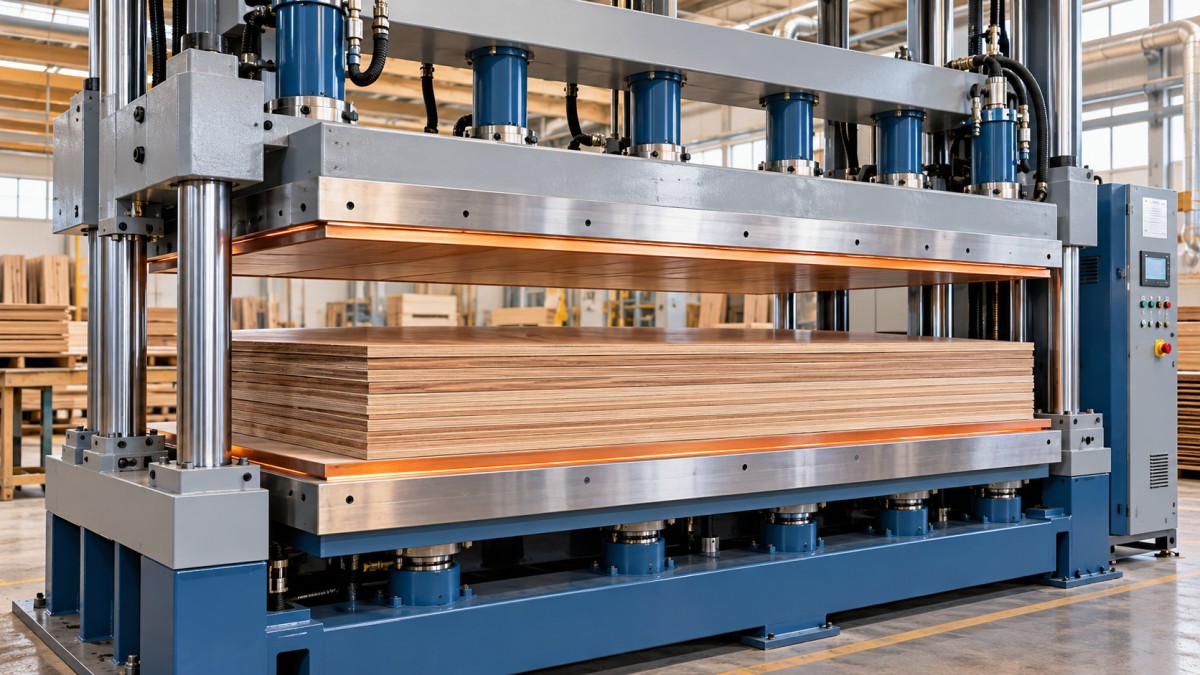
Platen parallelism is one of the most common foundations of uniform pressing. The upper and lower platens must close evenly across their working area. Even a small deviation can concentrate force along one edge, especially when pressing thin veneered panels or constructions that are sensitive to local compression. Parallelism can change over time because of wear in guides, loose fasteners, thermal movement, impact damage, or an unevenly loaded press.
Inspection should include more than a visual check. With the press isolated and made safe according to site procedures, maintenance personnel can examine guide columns, slide blocks, linkages, frame connections, and platen supports for wear or play. The actual checking method should follow the machine manufacturer’s service guidance. A machine may close squarely when empty but shift under load, so inspection needs to consider both mechanical condition and operating behavior.
The platens themselves also require attention. Scratches, dents, resin buildup, hardened adhesive, or damaged surface coatings can create localized high spots. Those high spots transfer pressure unevenly and may leave marks on decorative surfaces. Cleaning should use methods compatible with the platen material and surface treatment. Aggressive scraping or unsuitable chemicals can create a larger problem than the residue being removed.
Do not overlook the press foundation and installation environment. A machine that is not properly supported, or one subjected to repeated shock loading, may gradually lose alignment. This is particularly relevant when a press is relocated, installed on an unsuitable floor, or operated near equipment that causes substantial vibration. Alignment checks are best treated as scheduled preventive maintenance, not as an emergency response after a production run fails.
Check Hydraulic Balance Rather Than Assuming Gauge Pressure Tells the Full Story
A pressure gauge can confirm system pressure, but it does not automatically prove that force is distributed evenly at the platen. In multi-cylinder hot presses, unequal cylinder movement or pressure response can tilt the moving platen. Internal leakage, worn seals, restricted lines, contaminated hydraulic oil, valve problems, or air in the circuit can all contribute to irregular motion and load sharing.
Watch the closing sequence. Does the platen approach the work smoothly? Does one side appear to contact first? Is there a delay, jerk, or unusual sound before full pressure is reached? These observations are not a substitute for hydraulic testing, but they help maintenance teams focus their investigation. A recurring difference between cold startup and normal operating temperature may also point to fluid condition, valve response, or thermal effects in the hydraulic system.
Hydraulic oil should be maintained at the cleanliness and condition specified for the equipment. Filters, hoses, fittings, cylinders, seals, and control valves need inspection at intervals that reflect production hours and site conditions. Replacing a leaking seal without identifying why contamination or side loading occurred can lead to repeated downtime. For presses with electronic controls, calibration and sensor feedback should also be reviewed by qualified personnel rather than adjusted casually on the shop floor.
Prepare the Workpiece So the Press Can Do Its Job
A hot press cannot compensate for every inconsistency entering the line. Twisted core panels, unevenly sanded substrates, warped veneers, foreign particles, and mixed-thickness components make uniform compression difficult even when the machine is correctly aligned. The workpiece should sit flat before it enters the press. If it rocks on a flat reference surface, the press will have to force it into contact, often creating localized stress and variable glue-line thickness.
Moisture balance deserves particular care. Wood and wood-based panels react to moisture and heat, and uneven moisture can contribute to distortion during pressing. The acceptable condition depends on the panel type, adhesive system, veneer species, ambient environment, and final product requirements. Instead of relying on one universal target, plants should define material acceptance criteria that match their own validated production process.
Glue application is equally important. An inconsistent spread pattern can resemble a pressure problem because dry areas may fail while glue-rich zones can create bleed-through, starved edges after squeeze-out, or extended curing behavior. Verify the condition and setting of spreader rollers, applicators, pumps, and metering components. Also check whether open assembly time is being exceeded before the panel reaches the hot press. A properly maintained press cannot restore adhesive performance once the glue has moved beyond its workable process window.
Loading Position Changes the Result
The way panels are loaded matters more than many operators expect. A single small panel placed near one side of a large platen can create an asymmetric load. Repeated off-center loading may not only affect the current panel; it can increase wear on guides and moving components over time. Where the process allows, distribute the load symmetrically and use suitable cauls, carrier boards, or load-balancing arrangements to support the panel across the pressing area.
Cauls should be clean, flat, and suitable for the press temperature. A damaged or warped caul can introduce the same unevenness that it was intended to prevent. Their thickness and material should be selected for the panel construction and process, not chosen simply because they are available. If release sheets are used, inspect them for folds, debris, wear, and trapped adhesive. Small contaminants can leave a visible mark and create a misleading impression of platen damage.
Temperature Uniformity Cannot Be Separated From Pressure Quality
Hot press troubleshooting sometimes focuses too heavily on tonnage. Yet a panel needs sufficient heat transfer as well as mechanical compression. If one platen zone runs cooler than another, adhesive cure can vary even where nominal pressure is acceptable. This may show up as edge lifting, localized delamination, or different machining behavior from one part of the board to another.
Temperature verification should be carried out with appropriate instruments and a method suited to the press design. The goal is to compare actual surface behavior across the platen with the machine’s displayed or controlled value. Heating circuits, thermal-oil systems, electrical heating elements, insulation, and temperature sensors each have their own service considerations. Any investigation should also account for warm-up time; a press may reach its displayed setpoint before thermal conditions are fully stable across the working surface.
Cycle time, temperature, and pressure should be treated as a connected recipe. Reducing cycle time to increase output without confirming cure performance can make a marginal pressure issue more visible. Conversely, extending press time may mask a mechanical fault while consuming capacity and energy. The more durable solution is to establish a process window for each important panel construction and review it whenever materials, adhesive suppliers, veneer thickness, or production conditions change.
Build a Maintenance Routine Around Early Signs, Not Major Failures
Preventive maintenance for a hot wood press should combine daily operator checks with periodic technical inspection. Operators can look for oil leaks, unusual noise, damaged platen surfaces, residue, irregular closing movement, and changes in finished-panel quality. Maintenance teams can take responsibility for alignment checks, hydraulic-system condition, guide wear, electrical connections, heating performance, and control calibration according to the machine documentation and operating load.
The most useful maintenance records link machine observations to production results. Instead of recording only that a filter was changed or a cylinder was serviced, note whether a recurring defect disappeared, shifted, or remained unchanged. This creates a practical history for diagnosing the next issue. It also helps distinguish normal wear from a process upset caused by incoming materials or changes in panel construction.
At Qingdao Zhongding Machinery Co., Ltd., the emphasis in woodworking machinery support is not limited to supplying a press. With more than 20 years in the industry, the company’s work with furniture manufacturing, woodworking workshops, and industrial production lines has reinforced a basic lesson: stable output depends on machine condition, process discipline, available spare parts, and timely technical communication. A pressure complaint is best addressed by reviewing that complete chain rather than replacing components based on assumption.
A Practical Response When Uneven Pressure Appears
When defects begin, avoid immediately increasing pressure or changing several press parameters at once. Start by separating machine-related and material-related variables. Run a controlled test with flat, known material; inspect the platen surface and loading arrangement; observe platen movement; then review hydraulic and temperature performance. If the defect remains in the same physical location, mechanical alignment or heating uniformity becomes more likely. If it follows a material batch or panel design, focus on preparation and process settings.
For a new press, a relocated machine, or an older unit with recurring quality issues, it is sensible to confirm the expected panel sizes, loading pattern, adhesive system, heating method, production rhythm, power conditions, and service access before making major adjustments. These details influence both the diagnosis and the long-term maintenance plan.
Uniform pressure is not achieved by one adjustment. It is maintained through a press that closes squarely, hydraulics that respond evenly, platens that transfer heat consistently, and workpieces prepared to a controlled standard. Once those conditions are checked in a disciplined order, hot pressing becomes more predictable—and quality problems become easier to trace before they turn into waste or customer complaints.
Send Your Inquiry
We welcome your cooperation and we will develop with you.