


News & Exhibitions
Latest Factory Updates, Industry Trends & Global Exhibition Information
What Overseas After-Sales Service Should a Woodworking Machine Supplier Provide?
A woodworking machine can look excellent in a factory test video and still become a costly problem after it reaches another country. The difference is often not the machine itself, but the quality of the woodworking machine after-sales service overseas that supports it after delivery.
For an overseas buyer, after-sales service should not mean a generic promise to “provide support.” It should be a practical system that helps the machine arrive correctly, start safely, return to operation quickly after a fault, and remain serviceable years later. A supplier that cannot explain this system before the order is placed may be difficult to rely on once the machine is installed.
Service should begin before the machine leaves the factory
Good overseas support starts with preparation, not with a repair request. Woodworking equipment may involve electrical configuration, pneumatic connections, dust extraction, tooling setup, software settings, and production-line coordination. A machine that is correct for one workshop may require changes before it can operate properly in another.
The supplier should confirm the key operating conditions in advance: local power supply, factory layout, material type, expected production flow, available compressed air, dust collection arrangement, and the skill level of operators and maintenance staff. This is especially important for CNC routers, edge banders, panel saws, drilling machines, and automated lines, where an unsuitable configuration can create problems that no remote technician can fully solve later.
Pre-shipment support should normally include clear machine specifications, layout or foundation requirements where relevant, utility connection details, a packing list, and a record of the main purchased components. These documents give the buyer a practical basis for site preparation and future parts identification.
A useful question is simple: if the machine arrives next month, can the supplier tell the installation team exactly what must be ready before the crate is opened? If the answer is vague, the project risk is already higher.
Installation guidance must be usable on the workshop floor
Installation instructions should be written for the people who will actually position, connect, level, and commission the machine. A short manual with only basic safety statements is not enough. The guidance needs to show the order of work and the checks that prevent damage during startup.
For overseas deliveries, a capable supplier should provide installation drawings, electrical connection information, pneumatic diagrams when needed, lubrication points, and operating manuals in understandable English. Photos, annotated diagrams, commissioning videos, and remote video calls can be more useful than a long document when a technician is standing beside the machine.
Remote commissioning is often effective for standalone equipment when the buyer has a competent local electrician or technician. It is less suitable when a large production line has several linked machines, complex material handling, or uncertain site conditions. In those cases, buyers should discuss on-site commissioning options before purchase, including what work the local team must complete and what support the supplier can provide remotely or in person.
Commissioning should include more than proving that motors run. It should cover machine leveling, spindle or saw alignment where applicable, safety device checks, feeding direction, tooling setup, trial processing, parameter adjustment, and operator instruction. A machine can power on successfully while still producing poor edge quality, inaccurate drilling, burn marks, chipping, or unstable feeding.
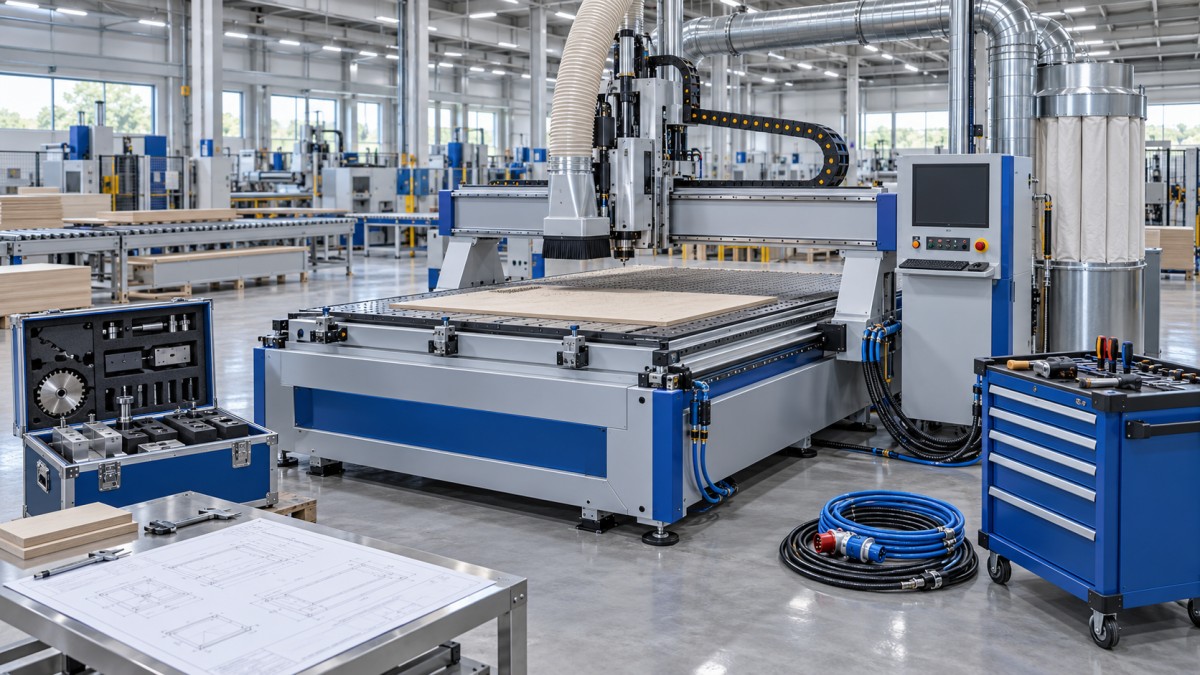
Remote troubleshooting needs a defined process
Most machine issues do not require an engineer to fly overseas. Sensors may be dirty or misaligned, an inverter may show a fault code, an air-pressure setting may be wrong, a parameter may have been changed, or a wearing part may need replacement. Fast remote support can solve these issues efficiently, but only when both sides can exchange the right information.
A supplier should have a clear troubleshooting path. The support team should be able to ask for specific photos, videos, alarm codes, controller screenshots, wiring-terminal images, or production samples. In return, the buyer should receive a structured response: what to inspect first, what can be safely adjusted, what parts may be involved, and when the machine should be stopped rather than repeatedly restarted.
Response speed matters, but response quality matters more. “Check the wiring” is not a useful instruction when an operator is facing a controller alarm. A helpful response identifies the relevant circuit, sensor, drive, or mechanical point and explains how to test it safely.
Before selecting a supplier, ask how technical requests are handled outside its local working hours, what communication channels are available, and whether support staff can communicate in a language your team can use comfortably. A dedicated service contact and traceable written records are generally more reliable than depending only on informal messages.
Spare parts availability is the real test of long-term support
Woodworking machinery includes both standard industrial components and machine-specific parts. Bearings, belts, contactors, pneumatic fittings, sensors, cutters, and switches may be obtainable locally in some regions. Custom covers, machined shafts, special control boards, formed pressure beams, proprietary fixtures, and model-specific assemblies usually are not.
A supplier should distinguish between these categories and help the buyer prepare for them. This includes providing an accurate parts list, part numbers, component brands where relevant, electrical schematics, and exploded diagrams that make identification possible without guesswork.
The most practical approach is to order a commissioning and critical-spares package with the machine, particularly when the workshop is far from major industrial supply channels. The right package depends on machine type, shift pattern, local maintenance capability, and how costly an unexpected stop would be. Buying every possible spare part is unnecessary; buying none is often a false saving.
Training should match the roles inside the factory
Operators, maintenance technicians, and production supervisors need different information. An operator needs to know correct loading, daily inspection, tool change procedures, cleaning points, alarm reporting, and safe operating limits. Maintenance personnel need a deeper understanding of lubrication, adjustment, electrical diagnosis, pneumatic circuits, and replacement procedures. Supervisors need to know what production symptoms indicate that the machine needs attention before quality loss becomes widespread.
Supplier training should therefore go beyond a quick demonstration. It should leave the factory with usable operating procedures and a clear division between tasks that the customer can perform and tasks that require supplier guidance. For example, routine cleaning and basic adjustments may be suitable for trained local staff, while servo parameters, safety-circuit changes, or major spindle work should not be treated as ordinary operator tasks.
Training also protects machine life. Poor dust removal, incorrect lubrication, unsuitable cutting tools, low air pressure, and rushed adjustments can cause faults that appear to be equipment defects but are actually operating-condition problems.
Warranty terms need operational detail, not broad wording
A warranty is valuable only when the buyer understands what happens after a fault is reported. The supplier should define the covered period, the process for identifying a defective part, whether photos or returned components are required, how replacement parts are dispatched, and which costs may sit with the buyer. It should also explain the treatment of consumables and wear parts, which are normally different from manufacturing defects.
Buyers should avoid treating warranty length as the only comparison point. A longer promise has limited value if the supplier has no spare-part process, no responsive technical team, or no documentation to identify the failed item. A shorter but clearly managed warranty can be more useful in daily operation.
Support for production quality is different from breakdown support
Many woodworking factories contact a supplier because the machine is running but the finished product is not acceptable. Panel edges may show glue-line issues, holes may shift, cutting surfaces may chip, doors may be inconsistent, or a CNC program may not produce the expected result. These are production issues, and they can involve material quality, tooling condition, machine settings, feeding speed, temperature, pressure, dust extraction, or operator setup.
A strong service team does not assume that every quality problem is a broken machine. It helps isolate the cause. The buyer may need to provide material details, tooling information, parameter screenshots, and samples or close-up images of the defect. This type of support is particularly valuable because it protects output quality before the problem develops into scrap, rework, or missed delivery schedules.
What to confirm before placing an overseas order
Service should be evaluated as part of the machine purchase, not as a separate issue to discuss after payment. Ask for the service scope in writing and assess whether it fits the actual operating environment.
- What documents, drawings, and videos will be supplied before shipment and during installation?
- Who provides commissioning support, and what qualifications or preparation are required from the local installation team?
- How are remote faults diagnosed, and what information should the workshop provide?
- Can the supplier provide part numbers, electrical schematics, and an initial spare-parts recommendation?
- Which components are standard items and which are specific to the machine model?
- What training is included for operators and maintenance personnel?
- How are warranty claims, replacement parts, and technical records handled?
Qingdao Zhongding Machinery Co., Ltd. positions its woodworking machinery offering around both equipment supply and long-term support, including technical assistance and spare parts service. For buyers evaluating an overseas supplier, this is the right area to examine in detail: not just whether assistance is mentioned, but whether it is connected to installation, troubleshooting, parts identification, and ongoing operation.
The supplier that provides the most useful overseas service is not necessarily the one making the broadest promise. It is the one that can show how it will help your team install the machine, diagnose a fault, obtain the correct part, restore production, and maintain the equipment over time. That level of preparation turns after-sales service from a sales statement into a workable part of the investment.
Send Your Inquiry
We welcome your cooperation and we will develop with you.