


News & Exhibitions
Latest Factory Updates, Industry Trends & Global Exhibition Information
How Many Critical Spare Parts Should Be Stocked for Woodworking Machines?
The right spare-parts inventory for a woodworking machine is rarely a fixed number of items. A small workshop running one edge bander for a few hours a day can operate safely with a focused kit of wear parts and one or two failure-prone components. A furniture factory whose panel saw, CNC router, or sanding line feeds several downstream operations needs a deeper inventory because one stopped machine can idle an entire production sequence.
A practical answer is to stock enough critical parts to cover the expected replacement interval plus the supplier lead time, with an additional buffer for parts that would stop production immediately. For many individual machines, that often means identifying roughly 10 to 20 part types as genuinely critical, then deciding the quantity of each according to usage and delivery risk. The number of part types matters less than whether the stocked parts can prevent the most expensive and likely interruptions.
The common mistake is treating every spare part as equally important. That creates a storeroom full of low-value items while a failed sensor, drive belt, pneumatic valve, or proprietary control component still has to be ordered after the machine is down. A useful spare-parts plan starts with the production consequence of a failure, not with the exploded-view drawing in the machine manual.
Start with downtime, not the parts catalogue
When deciding how many critical spare parts should be stocked for woodworking machines, ask one operational question first: what happens if this component fails during a normal production shift?
A part is usually critical when its failure either stops the machine completely, creates an unacceptable safety or quality risk, or forces production to move to a slower backup process. A spindle bearing on a CNC router, a pressure roller on an edge bander, a limit switch on an automatic panel saw, and a damaged conveyor belt on a sanding line can each have very different consequences depending on how the factory is organized.
Classifying parts into three groups makes the inventory decision easier:
- Production-stopping parts: Components without which the machine cannot run or cannot run safely. These deserve the highest stocking priority.
- Quality-critical parts: Components that allow the machine to operate but cause defective cutting, poor edge bonding, sanding marks, inaccurate drilling, or unstable feeding when worn or faulty.
- Routine consumables: Parts changed regularly through preventive maintenance, such as cutters, belts, filters, lubrication items, seals, and certain contact surfaces.
The first group should normally be available on site when replacement lead time exceeds the downtime the operation can tolerate. The second group may need a smaller buffer, particularly where quality inspection will detect deterioration before a large batch is affected. Routine consumables are managed primarily from consumption rates, although a sudden increase in usage can signal a machine setup or maintenance problem.
Do not automatically classify expensive components as non-stock items. A costly inverter, PLC module, servo drive, or spindle assembly may be too expensive to keep on every machine shelf, but it can still be justified where it is proprietary, has a long delivery time, and supports a bottleneck operation. Conversely, a low-cost pneumatic fitting may not deserve storage if it can be sourced locally within hours.
The four conditions that determine stock quantity
Once criticality is clear, the quantity decision comes down to four conditions: failure likelihood, replacement frequency, supplier lead time, and the cost of lost production. These conditions should be assessed for each part family, rather than averaged across the machine.
1. How often does the part wear or fail?
Parts with predictable wear should be stocked according to actual consumption. Belts, saw blades, cutterheads and inserts, sanding abrasives, brushes, seals, filters, chain components, and some contact rollers fit this category. Maintenance records are more useful than generic estimates because resin buildup, abrasive board materials, dust extraction performance, operator setup, and shift patterns can materially change service life.
For a recurring wear part, keep enough stock to cover the normal usage during replenishment lead time, plus a reasonable operating buffer. If a belt is normally replaced every two months and replenishment takes several weeks, one installed belt plus one spare may be enough for a lightly used machine. A high-utilization machine may need several replacements on hand because an unexpected belt failure will not wait for the planned maintenance date.
2. Can the part be obtained quickly?
Lead time is often more important than the unit price. Standard bearings, pneumatic fittings, contactors, fuses, and common sensors may be available from qualified local industrial suppliers. Parts tied to a particular machine model, electrical revision, control platform, or spindle configuration may require factory supply and international transport.
Before deciding not to stock an item, confirm the exact part number, applicable machine serial range, electrical specification, firmware compatibility where relevant, and whether an approved equivalent is acceptable. A component that looks standard may have a nonstandard mounting, connector, voltage, or control setting. Ordering only after a breakdown can expose these differences at the worst possible time.
3. Is this machine a bottleneck?
Machine importance must be judged in the context of the production route. A single CNC nesting router feeding cabinet production is usually more inventory-sensitive than a standalone drill press with alternative capacity elsewhere. An edge bander can also become a bottleneck when parts cannot move to assembly until edges are completed, even if cutting and drilling continue upstream.
A simple internal exercise is to estimate how long the operation can continue after the machine stops. If work can be rerouted to another machine, outsourced briefly, or resequenced without major disruption, stock can be leaner. If a failed component stops a line and prevents shipment, the inventory decision should account for the full cost of idle labor, delayed assembly, rework, and late delivery rather than the purchase price of the spare.
4. Can the failure be detected before it becomes urgent?
Some failures provide warning: increasing vibration, poorer cut quality, heat, unusual noise, inconsistent edge glue coverage, pressure loss, or repeated positioning alarms. These parts can often be planned and ordered before a complete failure if inspections are disciplined.
Other failures are abrupt. Electrical relays, sensors, power supplies, fuses, switches, solenoid valves, hoses, and certain electronic modules may fail with little notice. Where an abrupt failure stops a critical machine and the replacement is not readily available, keeping at least one compatible spare is usually sensible.
What a practical machine-level kit looks like
A useful spare-parts kit differs by machine, but it should be narrow and intentional. The following examples illustrate the logic rather than a universal purchase list.
For a panel saw, priority items may include saw blades or scoring units appropriate to the materials processed, drive belts, bearings where replacement is feasible in-house or through local service, emergency-stop and limit-switch components, pneumatic parts used in clamping or lifting systems, and selected electrical protection devices. If the saw uses electronic positioning, the relevant sensor or encoder arrangement deserves attention, especially when it is model-specific.
For an edge banding machine, the spare plan often needs to cover glue-system components, heating elements or temperature-related components where applicable, pneumatic valves and cylinders, pressure rollers, trimming and scraping cutters, chain or belt-driven feed elements, and sensors that control panel detection or sequence timing. These machines can produce large volumes of visibly defective work before an issue is recognized, so quality-critical wear parts deserve closer monitoring than their purchase price might suggest.
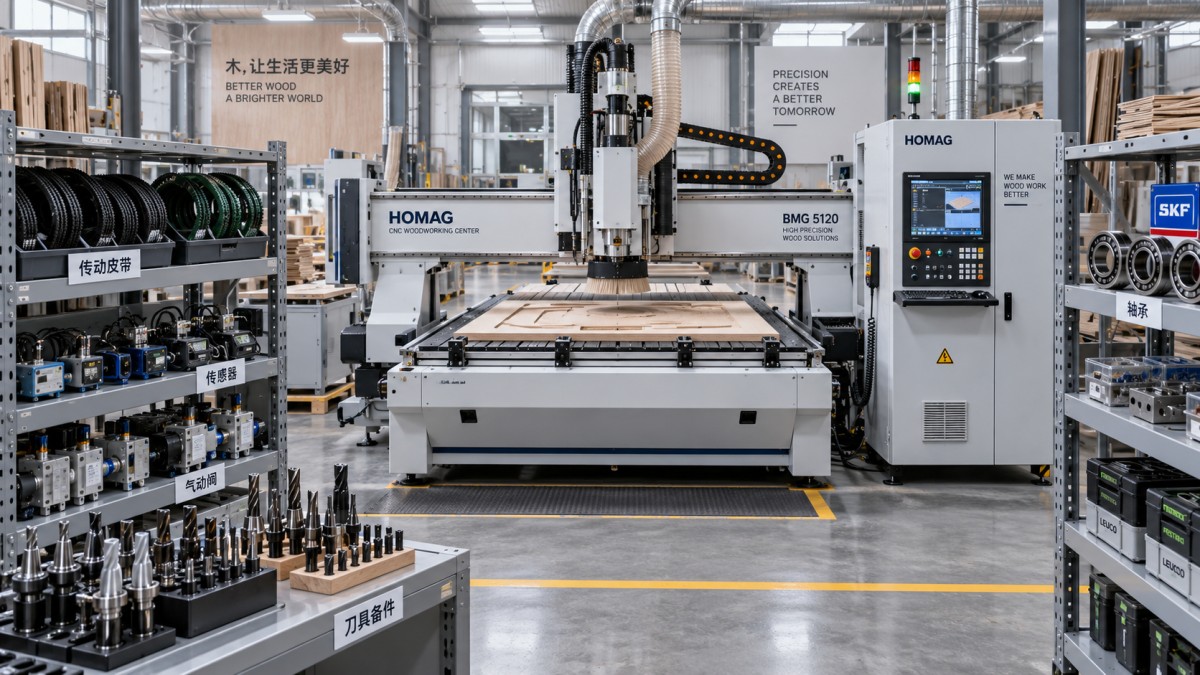
For a CNC router or machining center, production-stopping risks commonly include collets, tool holders used on essential operations, vacuum-system service parts, proximity switches, tool-change components, drive belts, lubrication-system items, and carefully selected electrical or motion-control spares. Complete spindles and servo drives require a more deliberate decision. They are costly, but their long replacement time may justify holding one for a high-output cell or arranging a supplier-supported emergency replacement path.
For a wide belt sander, abrasive belts are only one part of the equation. Conveyor belts, tracking and oscillation components, pressure elements, bearings, dust-extraction-related wear points, contact drums or pads, and safety switches can be equally important. A damaged or poorly adjusted component may also consume abrasives unusually quickly, which is why the stores record should be reviewed alongside maintenance observations.
Set quantities by risk, not by convenience
Many factories adopt “one spare of everything important.” It is a useful starting rule, but it fails in two opposite situations. One spare is insufficient when a component is consumed repeatedly during the supplier lead time. One spare is excessive when a part is robust, easily sourced, and can be shared across several compatible machines.
A more disciplined approach is to assign each critical item a stocking rule:
- Keep one installed plus one emergency spare: Suitable for low-failure, production-stopping components with moderate or long replenishment time.
- Hold a lead-time supply plus buffer: Suitable for predictable consumables and frequently replaced wear items.
- Share at site level: Suitable for compatible common items used across multiple machines, such as approved sensors, relays, fittings, bearings, or pneumatic valves.
- Order against condition monitoring: Suitable for high-value components whose deterioration can be identified early and for which a reliable service route exists.
- Keep supplier access rather than stock: Suitable only when confirmed delivery time, technical support, and part identification make emergency procurement realistic.
The inventory should also reflect whether parts are interchangeable. A factory with several machines from the same platform may reduce the number of individual stock keeping units by standardizing approved belts, sensors, cutters, valves, and electrical components where the machine design allows it. Compatibility must be verified, not assumed from appearance or nominal size.
Spare parts that are often overlooked
Consumables receive attention because they are visible and routinely purchased. Less obvious parts can create longer outages. Electrical cabinet cooling fans, power supplies, relays, contact blocks, cable connectors, sensor brackets, pneumatic hoses, vacuum seals, lubrication fittings, and machine-specific communication cables are frequently inexpensive compared with the delay caused by their absence.
Documentation belongs in the spare-parts system as well. Every stocked item should be traceable to a verified machine model and serial number, with the original manufacturer part number, technical description, quantity on hand, storage location, supplier source, and last purchase date. For electrical and electronic components, record voltage, current rating, connector type, parameter requirements, and firmware or software conditions when applicable.
Without this information, a stocked part can become unusable when the machine is down. Confusion between similar sensors, incorrect rotation direction on a motor-related part, an incompatible frequency rating, or an unrecorded revision change can turn an apparent spare into another procurement delay.
Storage can determine whether a spare is actually usable
Stocking a component is not the same as preserving it. Electronics should be kept dry, clean, labeled, and protected from static where appropriate. Rubber belts, seals, hoses, and vacuum components should be stored away from heat, direct sunlight, oil contamination, and deformation. Bearings need clean, controlled storage; abrasive materials need protection from moisture and damage.
Parts should also be inspected periodically. A sealed box that has sat for years may contain an obsolete electrical module, degraded rubber, corroded connector, or a component superseded by a machine modification. When a manufacturer changes a machine revision, a parts list should be reviewed before the old stock is assumed to remain compatible.
Build the inventory around maintenance discipline
Critical spare-parts stock works best when it supports preventive maintenance rather than replacing it. Repeated emergency use of the same item should trigger a review: is the component genuinely reaching normal end of life, or is alignment, dust control, lubrication, heat, voltage stability, pneumatic air quality, or operator adjustment causing premature failure?
Keep a short failure and replacement history for each machine. Over time, it will show which parts deserve a higher reorder point and which items are occupying storage without reducing real risk. It also gives procurement staff a clearer basis for discussing parts availability and technical support with the machine supplier.
For most woodworking operations, the sensible target is not a large inventory. It is a small, maintained collection of verified parts that protects the machines whose downtime the business cannot absorb. Begin with the production bottlenecks, secure the components that cannot be sourced quickly, and revise quantities after each meaningful failure or maintenance cycle. That approach keeps capital tied up in stock under control while making unplanned downtime far easier to manage.
Send Your Inquiry
We welcome your cooperation and we will develop with you.