


News & Exhibitions
Latest Factory Updates, Industry Trends & Global Exhibition Information
How Do You Find Compatible MDF Sander Conveyor Belts Your Supplier Dropped?
When your MDF sander’s conveyor belt wears out and the original supplier no longer stocks it, the replacement search can quickly become a production problem. Poor feeding can leave sanding marks, change material removal, or interrupt a scheduled run. The practical answer is to source the belt by its verified construction and operating requirements—not just its discontinued part number. Match dimensions, thickness, surface characteristics, backing, splice, and tracking requirements before approving an alternative.
“How do I find compatible conveyor belts when my MDF sander supplier stops stocking them?” Start by combining the machine documentation with measurements and photographs of the existing belt. Then ask a specialist conveyor belt fabricator or woodworking machinery parts supplier to confirm the proposed specification in writing. A belt that fits around the rollers is not necessarily suitable for feeding MDF consistently under sanding pressure.
Establish what the original belt actually needs to do
On a wide-belt sander, the feed conveyor carries the panel through the sanding zone while working with the machine’s hold-down components. Its upper surface must grip the panel, while its underside must suit the drive, support bed, and tracking arrangement. Changing one of these interfaces can create problems even when belt length and width are correct.
Before removing the old belt, record the machine manufacturer, model, serial number, and any conveyor assembly identification. Look for parts drawings, maintenance instructions, previous purchase orders, and belt markings. Ask the former supplier whether the belt was discontinued entirely, replaced by another specification, or simply removed from local stock.
A superseding part number is useful, but it still needs checking against your machine version. Machines sold under the same model name may have different conveyor assemblies. Also distinguish the feed conveyor from the abrasive sanding belt when requesting quotations; supplying the machine model alone can lead to confusion.
Document the belt before wear hides the evidence
Isolate and lock out the sander before measuring, removing guards, or accessing the conveyor. Follow the machine’s procedures for stored energy and belt tension release. Do not reach into the machine or attempt contact measurements while the conveyor is moving.
Photograph the whole conveyor arrangement, both belt surfaces, the splice, belt edges, drive and idler rollers, tensioning mechanism, and tracking components. Include a scale in close-up photographs where practical. An intact section can reveal the original surface pattern and construction more clearly than a heavily worn area.
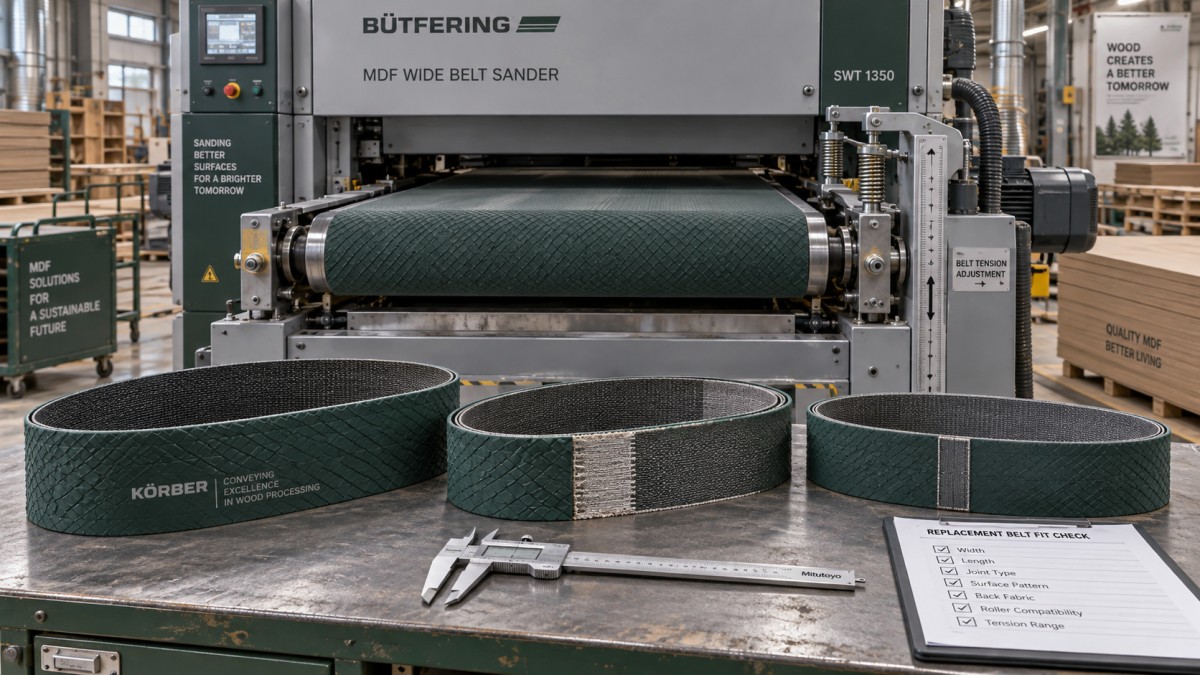
Build a specification sheet that separates confirmed information from measurements that still need verification:
Measure length without treating the worn belt as a perfect reference
An old belt may be stretched, unevenly worn, or held at an unknown tension. Label any measurement taken from it accordingly. Where safe and permitted, a removed belt can be marked and measured along its complete circumference without stretching it. An installed-belt measurement requires a controlled method, with the tensioner position recorded.
Do not order solely from roller center distance or a rough loop measurement. Ask the fabricator how it defines finished endless length, what measurement condition it uses, and which manufacturing tolerance it proposes. The required length must be checked against the machine’s installation clearance and take-up travel. If the belt cannot be measured reliably, provide conveyor geometry and request a technical review.
For thickness, use a suitable measuring tool without compressing a soft cover excessively. Compare several areas and identify whether readings include the texture peaks. A worn center section may significantly understate the original thickness.
Separate essential matches from acceptable substitutions
Not every feature has to come from the original belt manufacturer. However, any proposed difference needs a reasoned compatibility check. A substitute material may be acceptable; an unexplained change in construction is not.
Surface grip must remain consistent under sanding load
A surface that feels grippy by hand may behave differently with MDF dust present. Describe whether you process raw MDF, coated panels, small components, or larger sheets, and provide the normal feed-speed range. Explain any existing slipping, skewing, or marking rather than asking simply for “maximum grip.”
Excessively soft or aggressive textures may introduce unwanted compliance or marking, while a surface with insufficient grip may allow the panel to hesitate under load. Ask the supplier why its proposed cover and texture suit the application. A sample can help compare feel and finish, but cannot prove full-machine feeding performance.
Thickness and stiffness affect more than fit
A different total thickness can alter the relationship between the conveyor surface, sanding heads, and pressure elements. Compressibility also matters: two belts with the same nominal thickness may support a panel differently. Setup verification is therefore necessary even after a dimensionally correct replacement is installed.
Stiffness must suit the machine’s smallest pulley diameter and tensioning arrangement. A construction that bends poorly around the rollers may suffer premature damage or create running problems. Request the proposed belt’s minimum pulley diameter and recommended operating tension, then compare them with the machine’s requirements.
The underside deserves equal attention. Depending on the conveyor design, it must provide suitable drive traction while moving correctly over supporting surfaces. Substituting a different underside finish without checking these functions can change friction, heat generation, and drive load.
Confirm the splice and tracking arrangement explicitly
The finished splice should meet the application’s requirements for thickness uniformity, flexibility, and strength. A raised or stiff joint may create a periodic disturbance as it passes through the working area. Ask how the supplier controls joint thickness and whether the splice has a required running direction.
Do not accept a mechanical fastener as an automatic emergency replacement for a bonded endless joint. Clearances, panel contact, conveyor support, and operating loads must permit it. Likewise, do not add a tracking guide unless the machine has the corresponding provision and the design has been approved.
Send suppliers a package they can evaluate
A specialist belt fabricator can be a useful alternative to the original machinery supplier, particularly when it has experience with woodworking feed conveyors. Another route is a machinery service provider that can identify the conveyor assembly and obtain an equivalent belt. Neither route removes the need to verify the specification.
Send the same information to each candidate so that quotations describe comparable products:
- Machine identification and available conveyor drawings or original belt specifications.
- Measured dimensions, measurement conditions, photographs, and an old belt sample if available.
- Feed-speed range, panel types, operating environment, and normal production demands.
- Pulley sizes, take-up arrangement, support-bed details, and tracking features.
- Existing feeding problems and whether they appeared before or after belt deterioration.
Request a written proposal stating the belt construction, finished dimensions and tolerances, cover and underside materials, splice method, pulley limitations, and installation requirements. Ask the supplier to identify every departure from the original specification rather than describing the product only as “equivalent.”
A supplier that needs more information before confirming suitability is preferable to one approving a replacement from width and length alone. When original documents are unavailable, agreement on the remaining uncertainties becomes especially important.
Resolve uncertainty before committing to manufacture
A custom belt may be difficult to return once fabricated. Review the proposed drawing and specification before authorizing production, including any guide location, running direction, and dimensional measurement conventions. Resolve conflicting dimensions instead of allowing a supplier to choose between them without clarification.
Where the original construction remains unknown, a sample may help the fabricator identify likely materials and reinforcement. It does not necessarily establish the belt’s original properties after years of wear and contamination. Ask which characteristics have been identified confidently and which remain assumptions.
Also establish what happens if the belt meets the agreed dimensions but does not feed correctly. Technical review, inspection procedures, and responsibility for alterations should be discussed before ordering. This is more useful than a general assurance that the belt will fit.
Commission the replacement without confusing setup faults with belt faults
Inspect the new belt before installation. Check its identification, dimensions, surface, edges, splice, and any guide features against the approved specification. Installation should follow the machine’s belt-change procedure; some sanders require substantial disassembly. Avoid improvised stretching or forcing the belt over components.
Before tensioning, examine rollers, bearings, support surfaces, and tracking components. Packed dust, damaged rollers, or misalignment can make a suitable belt run badly. Set tension using the applicable instructions rather than copying the old tensioner position, which may reflect belt stretch.
- Check unloaded running. With guards restored, use the prescribed commissioning procedure to observe tracking, abnormal noise, splice behavior, and drive operation.
- Verify the working setup. Confirm the conveyor reference plane and relevant pressure or sanding adjustments after any thickness or construction change.
- Introduce representative material. Use controlled trials to check feeding, skewing, hesitation, surface marking, and sanding consistency.
- Evaluate under normal load. Increase demand only after stable operation, watching for slip or tracking changes as sanding resistance rises.
Stop testing if the belt moves toward an edge, rubs a frame, develops unusual heat, or feeds unpredictably. Do not compensate with repeated tension increases or unrelated machine adjustments. A disturbance repeating once per belt revolution suggests checking the splice or a localized belt defect; lateral drift also requires inspection of alignment and tracking components.
Keep the next replacement independent of one stock number
Once the belt has passed production trials, retain its approved specification, installation settings, inspection notes, and supplier reference alongside the machine records. Record any differences from the original belt and the setup changes they required. This gives the next purchaser a verified replacement specification rather than another unsupported cross-reference.
Before buying a spare, obtain storage instructions and consider expected usage, lead time, and storage conditions. A spare is useful only if its material and joint remain serviceable. Keeping a reproducible specification—and a supplier able to manufacture against it—can be more valuable than holding an unidentified belt on a shelf.
Send Your Inquiry
We welcome your cooperation and we will develop with you.