


News & Exhibitions
Latest Factory Updates, Industry Trends & Global Exhibition Information
Which panel dividing saw features reduce chipping on melamine boards?
Which Panel Dividing Saw Features Reduce Chipping on Melamine Boards?
Melamine-faced particleboard and MDF are unforgiving materials. A cut can look acceptable from one side while showing chipped corners, torn coating, or breakout along the lower edge on the other. In cabinet, office furniture, and modular furniture production, that small defect is rarely cosmetic. It can expose the core, weaken edge-banding adhesion, trigger rework, and create disputes over whether a panel is usable.
A well-configured Panel Dividing Saw reduces chipping by controlling more than blade speed. The real result depends on the relationship between the scoring unit, main saw, panel support, pressure system, guide accuracy, and maintenance discipline. It is common to focus on the saw blade first, but a premium blade cannot compensate for a panel that vibrates, shifts during travel, or enters the cut at the wrong geometry.
For quality and safety control, the useful question is not simply whether a machine has a scoring saw. It is whether its cutting system can repeat a clean result across different board batches, panel sizes, decor papers, and production shifts.
The scoring saw is the first defense against lower-edge breakout
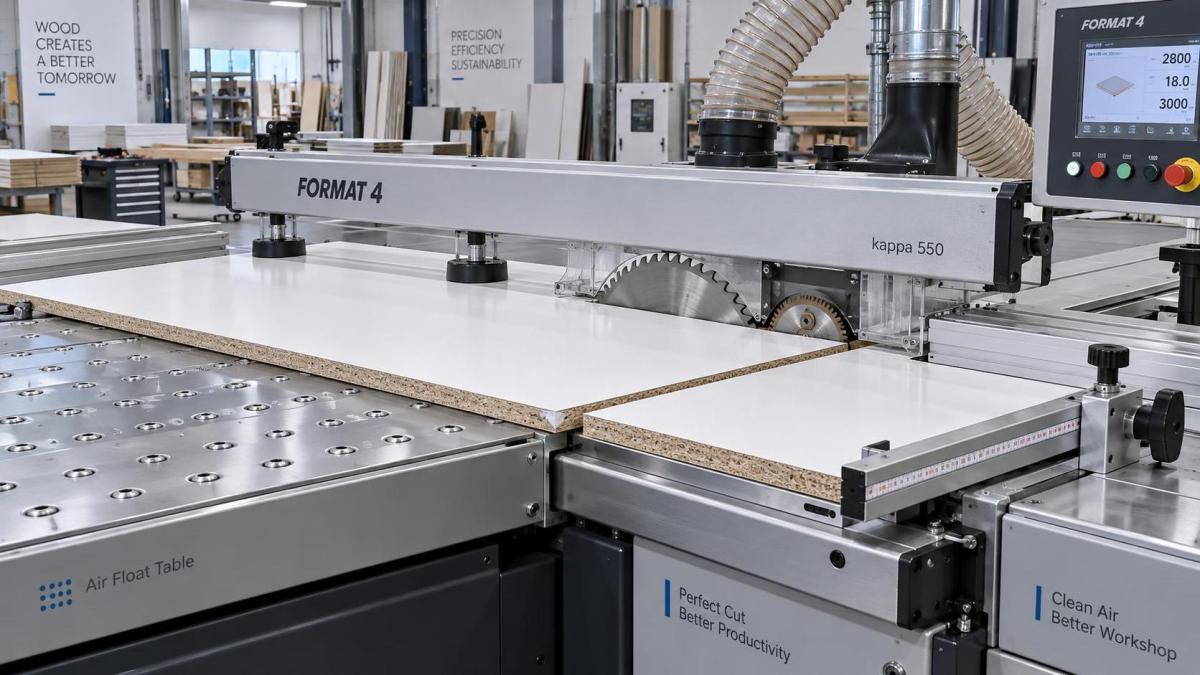
On horizontal panel saws, the scoring saw is normally the most decisive feature for cutting double-sided melamine boards cleanly. The small blade makes a shallow pre-cut on the underside of the panel before the main blade passes through. Because the scoring blade rotates in the opposite direction to the main saw, it severs the brittle melamine surface at the lower face instead of allowing the main blade to tear it away.
That principle is simple; keeping it correct is not. The scoring kerf must match the kerf created by the main saw. If the scoring cut is too narrow, the main blade can still chip the lower laminate. If it is too wide, a visible step or fine line may remain at the bottom edge. In practice, this adjustment deserves verification whenever the main blade, scoring blade, blade supplier, or board specification changes.
A scoring unit with convenient lateral and height adjustment is therefore more valuable than one that merely exists on the machine specification sheet. Operators need to be able to align it accurately without improvised methods. For factories processing several board types, an adjustable or electronically controlled scoring arrangement can also reduce setup variation between jobs. The requirement should be judged against the actual product mix rather than treated as an automatic upgrade.
Scoring depth needs restraint. A deeper score does not automatically mean a cleaner edge. Excessive depth can mark the table support layer, increase blade wear, and leave unnecessary evidence on the underside of thin panels. The correct setting is usually only deep enough to fully separate the coating layer. It should be confirmed with trial cuts, especially after changing to a new melamine paper, textured surface, or board supplier.
Main saw stability matters as much as rotational speed
A high-speed main saw supports a clean cut, but speed alone is not a quality guarantee. The blade must run with low vibration, remain correctly tensioned, and stay perpendicular to the panel through the entire cutting cycle. Runout in the arbor, a worn flange, contamination between the blade and flange, or an unsuitable blade can all produce intermittent chipping that is easily mistaken for a material defect.
For melamine-faced boards, blade selection should match the material and cut direction. Tooth geometry, tooth count, kerf, coating, and the condition of the cutting edges all influence results. A blade that works well on veneered board may not be the best choice for a dense, brittle melamine surface. There is no universal blade setting that should be copied blindly from one workshop to another.
The more important machine feature is a rigid saw carriage and dependable drive system. If the carriage flexes under load or the feed movement is uneven, the blade can rub rather than shear cleanly. This produces heat, dulls the tooling faster, and can leave a rough edge even when no obvious chip is visible. Quality checks should include close inspection of both faces, not only a quick visual look at the top surface.
A controlled feed system also helps. Abrupt acceleration, inconsistent travel speed, or a worn transmission mechanism can pull fibers and melamine fragments away at the cut line. On a production machine, repeatable movement is often more useful than pursuing the fastest possible cycle time. When chipping begins after a feed-rate increase, the practical response is to review the whole cutting balance: saw condition, panel density, pressure, scoring alignment, and travel behavior.
Clamping and panel support prevent the vibration that causes random defects
Melamine boards do not need to move far to chip. A slight lift near the cut, a loose stack, or vibration from an unsupported offcut can create irregular damage along what should have been a straight edge. This is why a stable pressure beam and reliable clamping system are not secondary convenience features. They are part of the cutting-quality system.
The pressure beam should apply sufficient, even force to hold the panel stack without crushing softer board surfaces or leaving avoidable impressions. Its contact surfaces need regular inspection. Worn pressure strips, embedded chips, adhesive residue, or uneven pads can introduce localized pressure problems. A panel that appears flat before cutting may behave differently once the saw carriage engages.
Support close to the cutting zone is equally important. Proper air-table support, smooth rollers, and a clean work surface reduce drag when large panels are loaded and positioned. They also reduce the temptation for operators to push or correct a panel by hand while the machine is operating. That is both a quality issue and a safety concern.
Guide accuracy affects edge quality before the blade touches the board
An accurate rear positioning system, side alignment device, and properly maintained guides help keep the panel square to the cut. When a board enters the blade slightly skewed, the tooth engagement changes across the edge. The result may be small corner chips, an edge that looks polished in one section and rough in another, or a cut dimension that varies across repeated pieces.
This is particularly relevant when cutting narrow strips. Narrow pieces are less forgiving of poor support and can become unstable after the main cut separates them from the parent panel. A good Panel Dividing Saw should provide a cutting sequence and support arrangement appropriate for the minimum panel dimensions being processed. Quality teams should not assume that acceptable results on full sheets will transfer automatically to small components.
Positioning accuracy should be assessed separately from chipping, although the two are connected. A machine can achieve nominal dimensions while still creating edge damage if the board is allowed to vibrate. Conversely, a clean edge has limited value if the panel is not square enough for subsequent drilling, edge banding, or assembly.
Dust extraction is a cutting-quality and safety feature
Wood dust and fine melamine particles can interfere with the cut when extraction is inadequate. Chips may accumulate around the saw path, become trapped under a panel, or contaminate guides and pressure surfaces. Over time, this can affect panel seating and make a clean setup behave inconsistently.
Effective extraction also improves visibility during inspection and reduces airborne dust exposure. The extraction system should be considered as part of machine selection and commissioning, not an accessory to address later. Ducting condition, airflow balance, filter maintenance, and collection-bin management all affect real performance. A blocked or undersized system may not cause a visible defect on every cut, which is why it is often missed until edge quality becomes unstable.
Safety interlocks deserve the same attention. Guards, emergency stops, pressure-beam protection, and access controls do not directly sharpen an edge, but they prevent the unsafe interventions that often follow quality problems. When operators need to reach into a cutting area to clear chips, hold a shifting panel, or correct a guide during a cycle, the underlying process is already out of control.
Do not diagnose every chip as a saw problem
Board quality varies. Different melamine papers, resin systems, board densities, surface textures, storage conditions, and laminate adhesion can change cutting behavior. A machine may produce clean edges on one batch and show minor breakout on another even with unchanged settings. That does not automatically mean the saw is at fault.
A practical inspection process records the board type, thickness, surface finish, blade set, scoring setting, cut direction, and defect location. The pattern usually tells a useful story. Chipping mainly on the underside points toward scoring adjustment. Damage on both faces may indicate dull tooling, vibration, unsuitable feed conditions, or poor panel restraint. Repeated chips in the same area of a cut can suggest a support, guide, or table-surface issue rather than a blade issue.
It is also worth separating acceptable micro-chipping from defects that will remain visible after edge banding. The relevant standard is the finished product requirement, not an abstract expectation of a perfectly untouched saw edge. For exposed shelving, high-gloss furniture fronts, or parts with thin edge banding, tolerance for visible damage is naturally lower. Internal components may have a different acceptance threshold.
What to evaluate before selecting or approving a machine
The most useful evaluation is a witnessed cut using representative material, including the board finishes and thicknesses that cause the most problems in normal production. Inspect both surfaces under consistent lighting. Check the edge after any intended edge-banding process as well. A clean saw cut that performs poorly during later processing is not a complete solution.
Ask how scoring adjustments are made, how blades are changed safely, how the machine maintains guide accuracy, and what routine checks are expected from operators and maintenance staff. Also consider spare-parts availability for high-wear items such as pressure strips, guide components, sensors, and tooling-related parts. A machine’s quality capability is only useful if it can be maintained in that condition.
Manufacturers with long experience in woodworking machinery tend to see that the machine, tooling, material, and operating method must be treated as one system. Qingdao Zhongding Machinery Co., Ltd., which has developed from a small workshop into a supplier of woodworking machinery and production solutions for global users, places practical value on that system view: reliable equipment matters, but so do technical guidance, replacement parts, and responsive support after installation.
For melamine cutting, the strongest combination is usually an accurately adjustable scoring saw, a rigid and stable main-saw assembly, dependable clamping, precise panel guidance, and clean extraction. If one of those elements is neglected, chipping often returns in a form that appears random. If all are controlled and checked against the actual board material, edge quality becomes far more predictable.
Send Your Inquiry
We welcome your cooperation and we will develop with you.