


News & Exhibitions
Latest Factory Updates, Industry Trends & Global Exhibition Information
Cut-to-size panel saw or beam saw for small-batch cabinet production?
For small-batch cabinet production, a beam saw is not automatically the more accurate or more productive choice. Its advantage appears when a shop can keep it fed with repeated cutting patterns, planned cutting batches, and a disciplined material-flow system. A cut-to-size panel saw—generally understood here as a sliding-table panel saw with scoring capability and programmable or manual stops—often produces a better overall result when order variation is high, parts require frequent adjustment, and the same operator must handle exceptions as well as standard panels.
The important distinction is not simply “manual versus automatic.” It is whether the cutting process must optimize for flexibility at the saw or for repeatability through batch processing. In cabinet work, that choice affects edge quality, drilling alignment, remakes, operator loading, floor layout, and the practicality of future automation.
Start with the actual cutting pattern, not the machine label
A technical evaluation should first separate the work into cutting families. A small-batch cabinet plant may process a modest total number of sheets per day while still generating a large number of distinct part sizes: side panels, tops, bottoms, shelves, stretchers, doors, fillers, toe kicks, and replacement components. The number of sheets alone does not reveal the difficulty of the operation.
A beam saw performs best when cut lists can be consolidated. Several sheets of the same décor and thickness are loaded together, ripped and crosscut according to an optimized pattern, then sent downstream in clearly identified stacks. This is effective when parts are sufficiently repeated to justify setup and when the production schedule avoids constant switching between materials.
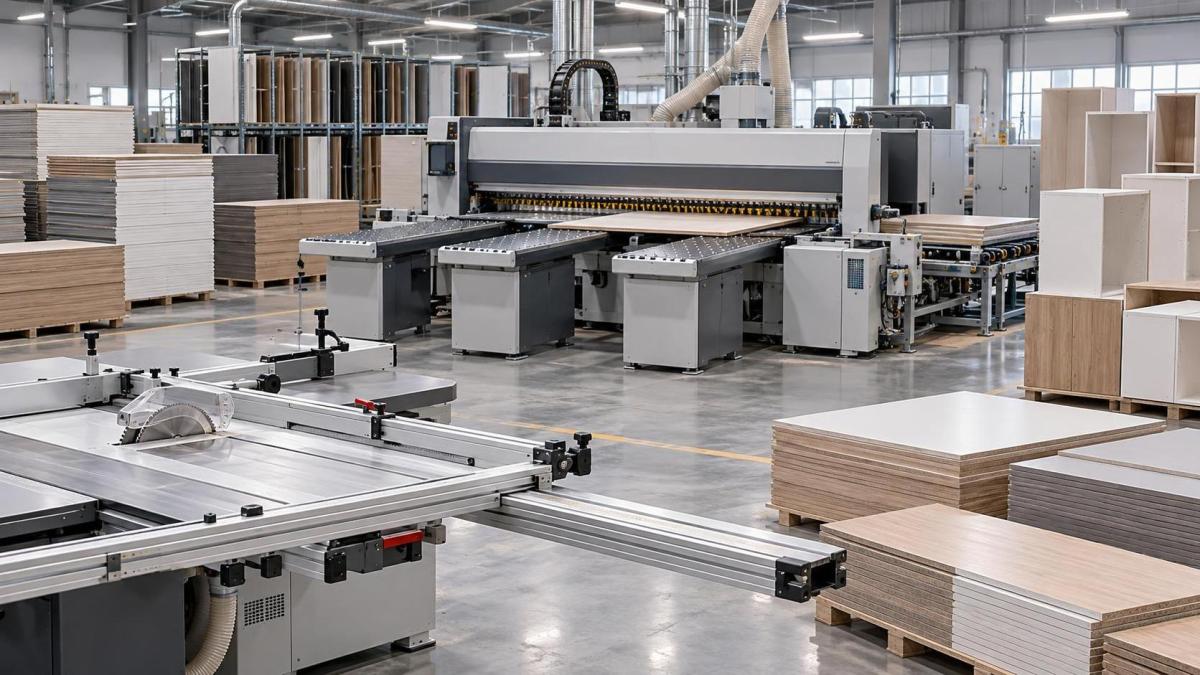
A sliding cut-to-size panel saw keeps more decisions close to the operator. A part can be measured, trimmed, re-cut, or verified immediately. That can be valuable for cabinet work involving custom dimensions, site-driven revisions, mixed panel specifications, and short orders that cannot wait for a cutting batch to accumulate. The trade-off is that productivity depends more directly on operator technique, handling discipline, and the quality of fences or positioning systems.
The term Cut-to-Size Panel Saw can be used broadly in the market, sometimes including beam-saw configurations. For a useful comparison, the practical distinction is between a sliding-table panel saw, where an operator positions and feeds the workpiece, and a beam saw, where a pressure beam clamps one or more sheets while the saw carriage executes programmed cuts.
Accuracy is a system outcome, not a catalogue figure
Both machine types can produce cabinet-grade panels when correctly specified, installed, maintained, and operated. Published cutting tolerances should therefore not be treated as direct evidence of finished-part accuracy. The more relevant question is where variation enters the process.
On a beam saw, positional repeatability is supported by CNC-controlled movement, clamping, and a defined cutting sequence. This reduces variation associated with manually reading scales or resetting a fence. For repeated dimensions, especially across multiple sheets, the advantage can be significant. However, the final result still depends on panel stability, correct reference edges, clean pressure-beam contact, properly maintained saw and scoring blades, and accurate program data. A perfect program will repeatedly make the wrong part if the cut list, grain direction, or finished-size allowance was entered incorrectly.
On a sliding-table saw, accuracy is influenced by table travel, fence rigidity, squareness, stop repeatability, operator loading, and the method used to reference the panel. A well-built machine with a calibrated crosscut fence and digital positioning can be highly capable for cabinet components. Yet manual handling creates more opportunities for small errors: a panel may not seat fully against the stop, a long narrow strip may deflect, or an operator may reference a different edge after an intermediate cut.
The comparison should extend beyond a single measured cut. Evaluate a full cabinet part set: paired side panels, matching shelves, narrow fillers, and components requiring both rip and crosscut operations. Then examine dimensional consistency, diagonal error, edge chipping, and whether labels or stack identities remain reliable after cutting. Cabinet assembly reveals problems that individual sample cuts can hide.
Material type often changes the answer
Melamine-faced particleboard and MDF are common in cabinet production, but they do not behave identically. Surface quality depends on board density, laminate properties, feed conditions, blade geometry, scoring alignment, and support of the panel during cutting. A scoring unit is especially important when clean lower-face edges are required on coated sheet goods.
Beam saws typically provide controlled cutting conditions and support a repeatable scoring relationship, making them well suited to long runs of coated panels. Their clamping method also helps control full sheets during the cutting cycle. But an evaluator should verify whether scoring width adjustment, saw projection, and blade changes are practical for the actual variety of materials being processed. A machine optimized around one common panel construction may require more attention when decorative surfaces, core densities, or thicknesses change frequently.
A cut-to-size panel saw can be more forgiving operationally when the shop handles mixed materials in low quantities. An operator can inspect sheet quality before cutting, alter the sequence for a damaged corner, and make a one-off adjustment without disrupting a programmed batch. This does not remove the need for correct blade selection and scoring calibration; it simply makes exceptions easier to manage at the point of cutting.
Part geometry also matters. Beam saws are efficient for rectangular panel breakdown, particularly when many components derive from the same sheet. They are less decisive when the work includes frequent angled cuts, irregular shapes, scribing operations, or small corrective trims. Those operations may require a secondary machine regardless of whether a beam saw is installed. A sliding-table saw is usually more versatile for this mixed work, provided safe support and clamping methods are available for narrow or awkward pieces.
Batch size should be measured by stable repetition
“Small batch” is often interpreted as a low order quantity. That is incomplete. An order for ten custom kitchens may still contain repeated cabinet modules and standardized sheet materials. Conversely, a workshop with many individual orders may have almost no repetition if every cabinet is dimensioned differently.
The useful measure is the amount of stable repetition available before the cutting deadline. A beam saw becomes easier to justify when the schedule consistently provides enough sheets of the same material and enough repeated component dimensions to build efficient cutting programs. It becomes less attractive when urgent additions, design revisions, and mixed decors force the operator to interrupt planned sequences repeatedly.
There is also a hidden batch issue downstream. Beam saw output tends to arrive as organized stacks of parts. If edge banding, CNC nesting, drilling, or assembly cannot consume those stacks in sequence, work-in-process accumulates. Small parts become harder to identify, surface damage risk rises, and a capacity gain at cutting may become a handling problem elsewhere. The saw should be evaluated against the pace and buffering capacity of the entire cell, not as an isolated source of sheet throughput.
Labor requirements differ in kind, not only in headcount
A beam saw reduces repetitive positioning and cutting tasks, but it does not eliminate labor. Full sheets still need loading, programs need to be prepared and checked, offcuts need to be managed, cut parts need labels, and material flow must remain orderly. Depending on panel size, stack height, and loading method, an effective installation may require lifting equipment, automated feeding, or at least an ergonomic loading arrangement.
The labor profile shifts toward planning and control. Someone must ensure that the program reflects the current revision, that material codes match the loaded sheets, and that parts remain traceable after cutting. If this discipline is missing, a beam saw can convert a data error into a large quantity of unusable parts at high speed.
A sliding panel saw demands more direct operator involvement. That can limit output, but it also places judgment where variation occurs. A skilled operator can adapt to a warped sheet, an urgent replacement panel, an unusual grain requirement, or a dimensional correction without creating a new program and re-sequencing a batch. For low-volume custom production, that responsiveness has operational value.
The correct labor comparison therefore asks whether the business has the capability to support programmed cutting. If cut-list generation, revision control, and part labeling are immature, buying a beam saw before establishing those controls may expose rather than solve process weaknesses.
Floor space and material flow can outweigh nominal capacity
A beam saw requires more than the footprint in its layout drawing. Space is needed for sheet staging, loading access, outfeed handling, offcut storage, maintenance clearance, and potentially a label printer or sorting area. The route for full sheet delivery must also be considered. A machine that fits physically may still be difficult to operate if sheet stacks cannot approach it safely and if finished parts obstruct the outfeed area.
A sliding-table saw also needs significant working space because the sliding table and large panels extend beyond the machine body. Its layout is often easier to integrate into a flexible workshop, especially where the same area supports varied cutting tasks. However, the table travel path must remain clear, and the operator needs adequate room to turn, support, and stack panels safely.
Dust extraction is not a secondary requirement. Poor extraction affects visibility, cut quality, cleanup time, and machine maintenance. Technical reviews should confirm duct dimensions, airflow requirements stated by the equipment supplier, available static pressure, and whether the existing extraction system can maintain performance when other machines run simultaneously. Electrical supply, compressed air where required, and floor levelness should be assessed with equal care.
The quality risk is different on each platform
With a beam saw, the main risk is often a process-wide error: incorrect optimization settings, wrong sheet selection, incorrect grain assignment, an outdated program revision, or faulty label logic. Because the machine cuts quickly and consistently, the resulting loss can be concentrated into one batch. Controls should include program approval, material verification before loading, first-piece checks, label reconciliation, and a clear rule for handling remnants.
With a cut-to-size panel saw, the risk is more often distributed across individual cuts. Fence calibration drift, inconsistent reference practices, improper scoring adjustment, worn blades, and manual measurement errors can create intermittent defects. These are less likely to affect an entire batch at once but may appear as assembly mismatch, exposed chips after edge banding, or a gradual rise in rework.
Neither risk profile is inherently preferable. The better choice is the one whose controls fit the factory’s actual operating discipline. A shop with strong data management and repeatable order engineering may gain more from beam-saw automation. A shop that relies on rapid technical decisions at the machine may manage a sliding-table process more reliably.
Lifecycle cost should include changeover and recovery, not just cutting speed
A beam saw generally carries a higher capital requirement and may bring additional costs for software integration, installation, material handling, maintenance, and operator training. Its economic value depends on converting its capacity and repeatability into useful output. If it spends substantial time waiting for suitable batches or is used mainly for isolated sheets, the investment logic weakens.
A sliding panel saw normally has a lower entry cost and simpler operating model, but its labor content can remain high as volume grows. Its practical limit may emerge not as a failure to cut panels, but as queueing around the machine, reduced attention to verification, fatigue from sheet handling, or difficulty maintaining repeatability across shifts.
Recovery after disruption deserves explicit attention. Consider a wrong cut, a damaged panel, a late design change, or a customer request for one replacement component. On a sliding saw, recovery is often immediate if the material is available. On a beam saw, recovery may be equally easy for a known part, but only if the program, material data, and label rules make the replacement traceable. The time needed to move from a correction request to a verified replacement part is a meaningful measure for custom cabinet work.
A practical decision boundary
A cut-to-size panel saw is generally the stronger fit where cabinet production is characterized by mixed materials, frequent dimensional variation, short lead times, one-off adjustments, and a need for operations beyond straight rectangular breakdown. It offers a direct, visible process and preserves flexibility, particularly when fitted with accurate stops, a scoring unit, dependable extraction, and appropriate panel-support accessories.
A beam saw is more compelling where repeated modules, standardized board formats, and planned batch release create steady cutting patterns. Its value increases when connected to reliable cut-list preparation, labeling, downstream routing, and safe sheet-loading arrangements. The machine should not be selected solely because it has higher theoretical output; it should be selected because the production system can keep it productively loaded and can absorb its output without confusion.
For a small-batch cabinet operation, the deciding question is simple but demanding: can the factory standardize information and material flow before it standardizes cutting? If the answer is yes, a beam saw may provide a durable platform for repeatable growth. If the answer is no, a capable sliding cut-to-size panel saw may deliver better real-world performance by matching the variability that defines the work.
Send Your Inquiry
We welcome your cooperation and we will develop with you.