


News & Exhibitions
Latest Factory Updates, Industry Trends & Global Exhibition Information
What Is a CNC Wood Panel Saw Used for in Cabinet Making?
A CNC wood panel saw is used to cut large sheets of plywood, particleboard, MDF, and other panel materials into the rectangular parts needed for cabinets. Those parts include cabinet sides, tops, bottoms, shelves, doors, and drawer components. The machine follows programmed dimensions and cutting sequences, helping produce parts that fit together consistently.
Its main role is sizing panels, not completing every machining operation. A cabinet shop may use the saw to prepare accurately dimensioned blanks, then send those parts to other equipment for edge banding, drilling, routing, and assembly. How much work the saw performs automatically depends on its configuration and the production process around it.
What the saw actually does
A CNC wood panel saw combines a circular saw blade with a computer-controlled positioning system. An operator enters or imports cutting information, and the machine positions the panel or cutting mechanism according to the programmed dimensions. Depending on the design, the material may be held against a fence and moved by a programmable pusher while the saw blade travels through the sheet.
Many machines used for cabinet panels are beam saws. On these machines, a pressure beam holds the panel down during cutting, while the blade assembly travels along a guided path. Some configurations can cut several sheets in a stack, provided the combined thickness, material, and blade setup remain within the machine’s limits.
CNC control does not mean the machine independently handles every task. Loading sheets, turning material for cuts in the other direction, separating finished pieces, and moving them to the next operation may still require an operator. Automated loading and unloading equipment can be added to some systems, but it is not inherent to every CNC panel saw.
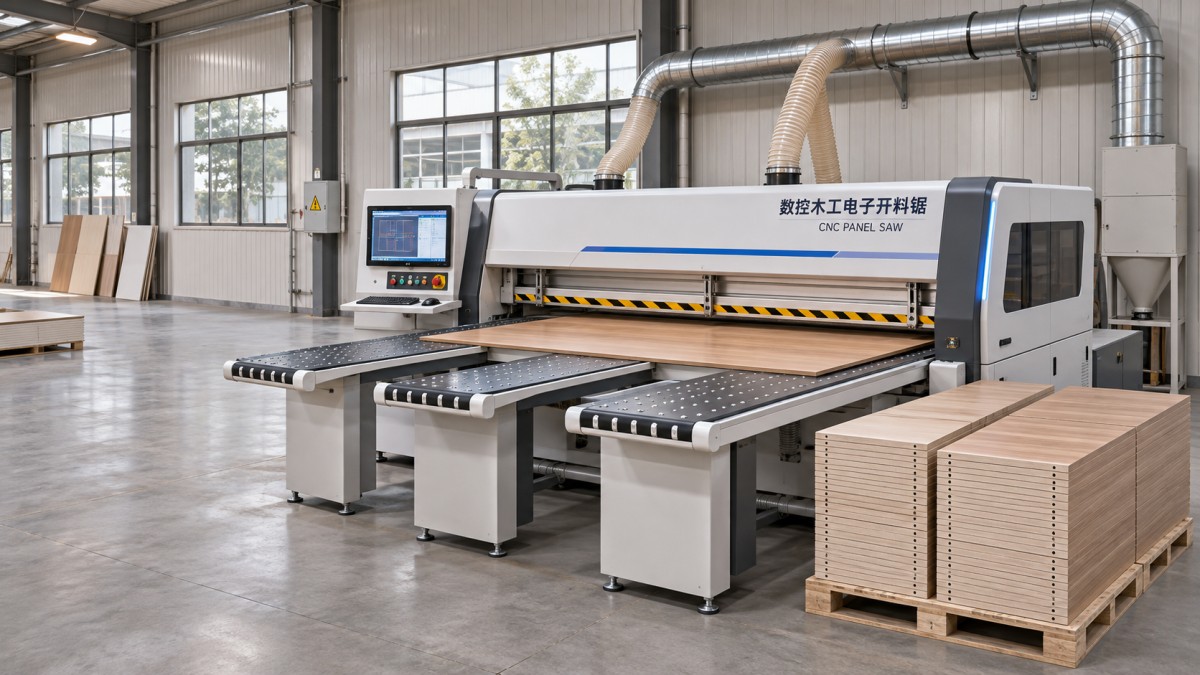
The distinction matters because a cutting plan is only part of the workflow. Even when a saw positions each cut automatically, the time spent handling sheets and identifying parts can affect how much work the machine completes during a shift.
Turning sheets into cabinet components
Cabinet construction relies heavily on flat, rectangular parts. A base cabinet, for example, can require two side panels, a bottom, a top or supporting rails, a back, and one or more shelves. The exact construction varies, but many of those pieces start as full-size sheets that must be cut to controlled dimensions.
A programmed cutting list tells the saw which sizes are required and how many of each to produce. A sheet may first be divided into long strips; those strips are then crosscut into individual parts. The sequence depends on the cutting plan and the machine’s capabilities. Because a panel saw makes straight cuts across the material, the plan must be compatible with that method of cutting.
The resulting pieces are used in several ways:
- Cabinet carcasses: Side panels, tops, bottoms, and partitions form the main box. Consistent dimensions help keep assemblies square and reduce problems when adjoining parts are joined.
- Shelves and dividers: Repeated pieces can be cut to the same nominal size for a run of cabinets, subject to the accuracy of the machine and the cutting setup.
- Doors and drawer fronts: The saw prepares rectangular blanks. Additional machining or finishing may be needed, particularly for shaped profiles or decorative details.
- Drawer parts and backs: Thin panels and smaller components can also be cut, although their size and material characteristics must fall within the machine’s handling limits.
The saw cuts to the dimensions it receives; it does not determine whether those dimensions make sense for the cabinet design. A door blank, for instance, may need an allowance for edge banding or a specified clearance around the opening. If the cut list ignores those requirements, an accurately cut part can still be the wrong size.
Which materials can it cut?
CNC panel saws are suited to sheet goods used in cabinet production. Common examples include particleboard, MDF, plywood, and panels faced with melamine or laminate. The appropriate blade, feed settings, and support arrangements depend on the material and the finish required.
Faced panels deserve particular attention. A melamine surface can chip where the blade exits the material, leaving an edge that may be visible or difficult to finish cleanly. Some saws use a scoring blade to make a shallow preliminary cut along the underside of the panel before the main blade passes through. Blade condition, alignment, feed rate, and panel support also affect the result; a scoring blade alone does not guarantee a clean edge.
Plywood introduces a different set of considerations. Its layered construction and surface veneers can produce tear-out if the blade or cutting conditions are unsuitable. Sheet flatness also matters: a warped panel may not sit consistently against the reference surface or under the pressure beam, affecting both cut quality and dimensional consistency.
Solid wood can be cut on suitable equipment, but a panel saw intended for sheet processing is not necessarily the best machine for every solid-wood operation. Narrow, irregular, or unstable pieces may be difficult to secure or feed safely. The machine’s documentation and tooling specifications should govern which materials, thicknesses, and part sizes it can handle.
Why cutting plans matter
A cutting plan arranges the required parts on available sheets. The objective is not simply to pack as many rectangles as possible into the panel outline. The plan must also account for the width of material removed by the blade, known as the kerf, as well as any trim needed to establish clean, square reference edges.
Grain and decorative pattern direction can further restrict the layout. If adjacent cabinet doors must have a consistent woodgrain direction, rotating a part to save material may not be acceptable. A layout that appears efficient on screen can therefore produce unusable or visually inconsistent components if orientation rules are omitted.
Some systems use optimization software to generate a cutting pattern from a parts list and sheet dimensions. The result can reduce unnecessary offcuts, but savings depend on the mix of part sizes, panel format, grain restrictions, and whether usable remnants can be stored and identified. Optimization software cannot recover material consumed by an incorrect part list or a cutting setup that damages the panel face.
Part identification is another practical concern. Several pieces can look alike while differing slightly in length or purpose. Labels, cut-sequence records, or a disciplined sorting method help keep a left cabinet side from being confused with a similar-looking partition. Some systems can print labels automatically; others rely on manual identification.
How it fits into the cabinet-making workflow
The saw is generally an early-stage machine. The process begins with a cabinet design or cutting list, followed by sheet selection and cutting. Finished blanks then move to the operations required by the design. Exposed edges may be edge banded; hinge cup holes, shelf-pin holes, connector holes, or grooves may be machined separately before assembly.
This separation helps explain why dimensional consistency is valuable. If a row of hinge holes is positioned relative to an edge, variation in the cut panel can affect the final relationship between the hinge and the cabinet opening. Likewise, panels that are not square can create alignment issues when boxes are assembled. Accurate cutting supports later operations, but drilling accuracy, edge-band thickness, hardware adjustment, and assembly practices also affect the finished cabinet.
A CNC router can take a different approach. In a nesting workflow, it cuts parts from a sheet and may also machine holes, grooves, or profiles during the same setup, depending on its configuration and tooling. A panel saw is focused on straight cuts and can be useful when production consists largely of rectangular parts. A router’s ability to combine operations can be valuable for more complex parts, but its material-handling and cutting process differs. Neither method is automatically the better choice for every cabinet shop.
What affects accuracy and cut quality?
Programmed positioning improves repeatability only when the rest of the cutting system is controlled. The blade must be suitable for the material and sharp enough to cut cleanly. Fences, guides, and measuring systems need proper alignment. Sheets must be seated against the intended reference surfaces, and the machine must hold them securely during the cut.
Material behavior can also limit results. Panels vary in thickness and flatness, and a damaged sheet edge can make a poor reference. Stacking sheets can increase output per cutting cycle on a compatible machine, but the stack must remain stable and within the permitted height. Excessive stack height or an unsuitable blade can compromise cut quality or create unsafe conditions.
Dust extraction is part of the process rather than a cosmetic addition. Cutting wood-based panels creates dust and chips that must be controlled with a suitable extraction system. Accumulated debris can interfere with clean working surfaces and machine operation, while airborne dust presents health and housekeeping concerns. Guards, extraction, and safe operating procedures remain necessary even when positioning and cutting cycles are automated.
When is a CNC panel saw useful?
The equipment is especially relevant where cabinet production involves substantial quantities of rectangular sheet parts and a need to repeat dimensions reliably. It can also support custom work: a changing cut list can be programmed without manually setting a fence for every individual dimension. The benefit, however, depends on how quickly the information can be prepared and how efficiently sheets and finished parts move through the shop.
For a small volume of varied jobs, a simpler panel-cutting method may be sufficient if setup, floor space, and material handling make a CNC system difficult to justify. At the other end of the scale, a saw may be integrated with software, labeling, and handling equipment to support a larger flow of parts. Between those conditions, the key question is whether programmable straight-line cutting addresses a significant portion of the work.
A useful way to judge its role is to examine the cut list rather than the cabinet as a finished product. If most components begin as rectangular sheet blanks, the saw can perform a central preparation task. If the work depends heavily on curved outlines, intricate routing, or machining several features into each part, the saw may still prepare material, but other equipment will carry more of the production workload.
Send Your Inquiry
We welcome your cooperation and we will develop with you.