


News & Exhibitions
Latest Factory Updates, Industry Trends & Global Exhibition Information
CNC Drilling Machine for Cabinet Panels: When to Choose Multi-Spindle vs. Single Spindle + ATC Based on Hole Density & Tolerance
Selecting the right cnc drilling machine for cabinet panels hinges on two tightly coupled variables: hole density per square meter and positional tolerance requirements. Unlike general-purpose CNC routers, cabinet panel drilling demands consistent repeatability across thousands of identical holes—often in MDF, particleboard, or plywood—where even 0.15 mm deviation can compromise hinge alignment, drawer runner fit, or cam-lock engagement. Multi-spindle and single-spindle + ATC configurations respond differently to these constraints—not because one is inherently superior, but because their mechanical architecture imposes distinct physical limits on tool path sequencing, thermal stability, and axis rigidity.
Hole density determines how many drill points must be executed within a given area without repositioning the panel. At densities below 8 holes/m² (e.g., basic shelf-pin layouts), both configurations achieve comparable cycle times. But above 12 holes/m²—common in full-overlay door panels or modular kitchen carcasses—the multi-spindle’s parallel execution becomes decisive. A 6-spindle head drilling 6 holes simultaneously cuts total spindle travel by ~83% compared to sequential drilling. However, this advantage collapses when hole positions vary significantly in depth, diameter, or angular orientation. Multi-spindle units typically lock all spindles to a fixed Z-axis plane; they cannot independently adjust depth per hole or switch between 3-mm dowel pins and 5-mm hinge cups mid-cycle. That limitation forces either multiple setups or compromised tolerance stacking—especially problematic when ±0.1 mm positional accuracy is required across mixed-diameter features.
Single-spindle + ATC systems excel where flexibility outweighs raw speed. With automatic tool change, a single high-precision spindle can execute diverse operations—drilling, countersinking, chamfering, tapping—without manual intervention. More critically, it maintains consistent thermal expansion behavior: only one spindle heats up during extended operation, and its position is actively compensated via linear scale feedback on the X/Y axes. Multi-spindle heads, by contrast, introduce differential thermal drift across multiple motorized spindles mounted on a shared casting. Even with identical motors and cooling, minor variations in bearing preload or lubrication lead to non-uniform expansion—resulting in measurable drift (up to 0.08 mm over 4 hours) between outer and center spindles. For cabinet panels requiring tight stack-up tolerances across 3+ adjacent holes (e.g., European-style hinge mounting plates), that drift directly impacts functional fit.
Material interaction further narrows the decision space. Panels thicker than 25 mm or containing embedded hardware (like aluminum extrusions or steel inserts) generate variable cutting resistance. A multi-spindle unit applies uniform feed rate and RPM across all tools—risking chatter on dense zones while underutilizing torque elsewhere. A single-spindle + ATC system dynamically adjusts feed rate and spindle load monitoring per tool, adapting in real time to material inconsistencies. This responsiveness matters most when processing laminated panels where core density fluctuates beneath veneer layers—a common cause of breakout or oversized holes at exit surfaces.
Machine footprint and integration also constrain selection. Multi-spindle machines require larger gantry structures to accommodate simultaneous tool movement, often exceeding 3,000 mm in width. That makes retrofitting into existing lines challenging, especially where overhead conveyors or automated loading systems occupy limited ceiling height. Single-spindle systems like the ZDV6 integrate compactly with sliding table workflows, supporting precise panel registration through hardened cast iron workbenches (1006×580 mm) and extended support surfaces (1050×840 mm). Its manual tilting saw group (45°–90°) and scoring saw capability (120 mm blade, 8000 rpm) allow pre-cutting and edge profiling before drilling—reducing handling steps and minimizing cumulative positioning error from repeated clamping.
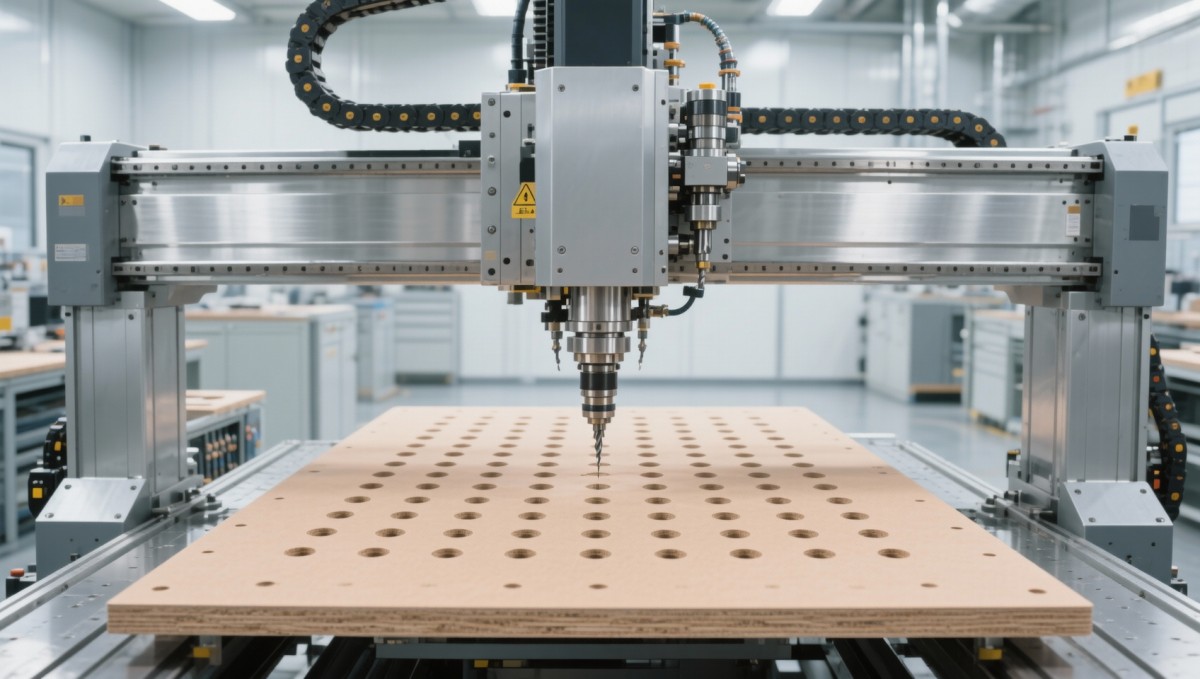
Tolerance validation reveals another divergence: measurement methodology. Multi-spindle performance is typically verified using static gauge blocks placed under each spindle—testing nominal positioning but not dynamic repeatability under load. Single-spindle + ATC validation requires full-cycle testing: drilling 100+ identical holes across the entire working envelope (3200 mm gross cut capacity), then measuring positional deviation using coordinate metrology. Real-world data from furniture factories shows single-spindle systems maintain ≤0.07 mm max deviation across 2000 mm travel when equipped with glass scale feedback and servo-driven ball screws—while multi-spindle units average 0.12–0.18 mm under identical test conditions, primarily due to coupling stiffness limitations in the spindle carrier.
Operational scalability adds a third dimension. When production shifts from standardized cabinet lines to custom configurations—requiring frequent program changes, mixed-panel batches, or small-lot runs—the ATC’s ability to load 12+ tools in sequence eliminates setup downtime. Multi-spindle machines demand dedicated tooling for each hole pattern; changing from a 32-mm hinge layout to a 27-mm soft-close variant requires physical spindle reconfiguration, often taking 45–90 minutes. That delay becomes prohibitive when lot sizes drop below 50 panels.
Ultimately, the choice isn’t binary—it’s contextual. If your workflow processes >500 identical panels/day with uniform hole patterns and tolerance bands ≥±0.2 mm, multi-spindle delivers throughput advantages. But if you routinely handle mixed-spec cabinets, require ≤±0.1 mm positional fidelity across multi-feature panels, or operate in environments where thermal stability and material variability are uncontrolled, single-spindle + ATC provides deterministic precision—not just theoretical specs. The decision rests not on spindle count, but on which architecture aligns with your actual panel geometry, material consistency, and tolerance chain requirements.
Send Your Inquiry
We welcome your cooperation and we will develop with you.