


News & Exhibitions
Latest Factory Updates, Industry Trends & Global Exhibition Information
When is woodworking equipment selection consultation worth paying for?
Paying for woodworking equipment selection consultation is worthwhile when a wrong purchase could cost more than the advisory fee—and the consultation can resolve specific uncertainties before you commit. When expanding a furniture factory or upgrading a workshop, those uncertainties often involve actual production capacity, installation costs, staffing, and compatibility with existing processes rather than the machine’s advertised specifications.
Paid advice is less useful for a straightforward replacement with a proven specification and adequate supplier support. It becomes more valuable when competing proposals use different assumptions, a new machine could shift a bottleneck elsewhere, or nobody internally can verify the proposed configuration. The decision should depend on what the adviser will investigate and deliver, not simply on the size of the equipment order.
Start with the decision that supplier quotations cannot settle
Consider a workshop comparing a panel saw with a CNC nesting machine. Both may support panel processing, but the purchase decision involves more than cutting speed. Material handling, drilling requirements, part labeling, software preparation, tool changes, and downstream edge banding can change the economics of either route.
A quotation may accurately describe each machine while leaving the process comparison unresolved. That gap is where consultation can earn its fee: translating your production requirements into comparable operating assumptions and identifying which configuration fits them.
Before requesting paid advice, write down the unresolved decision in one sentence. For example: “Can this proposed cutting and drilling arrangement handle our product mix without adding another shift?” A question such as “Which machine is best?” is too broad to produce a useful, accountable answer.
Pay for a defined investigation, not for access to general equipment knowledge. If the supplier can already answer the question with documented specifications, representative trials, and a clear installation proposal, a separate consultation may duplicate work.
Purchases where independent analysis has more value
Adding capacity without a verified bottleneck
A cutting machine may appear to limit output because unfinished orders accumulate nearby. Yet the underlying constraint could be material staging, programming delays, rework, or insufficient edge-banding capacity. Buying a faster cutting machine can simply move the queue.
A useful assessment examines the flow from incoming material to finished components, including waiting time and manual handling. It should distinguish machine cycle time from sustained production output and identify whether equipment, scheduling, maintenance, or staffing is the actual constraint.
Changing production methods
Moving from conventional machines to CNC processing changes how work is prepared and controlled. The business may need programming skills, reliable design data, tooling management, and different workholding methods. Those requirements can outweigh apparent labor savings if they are absent from the purchase plan.
Consultation is justified when the decision depends on these changes and internal staff lack experience with the proposed workflow. The assignment should cover implementation requirements, not stop at recommending a machine model.
Connecting several machines or suppliers
For a line involving cutting, edge banding, drilling, and material transfer, individual machine capacity is not enough. Part orientation, buffer space, labeling, data exchange, and handling responsibilities must align. Different suppliers may each assume that another party will resolve an interface.
Here, a paid reviewer can define integration responsibilities before orders are placed. The value lies in exposing gaps between proposals, especially where no supplier accepts responsibility for overall line performance.
Buying for an unfamiliar site or operating environment
Electrical supply, extraction, compressed air, floor loading, access routes, and service availability can make an otherwise suitable machine expensive to operate or install. Cross-border purchases may also require additional coordination for commissioning, documentation, spare parts, and technical support.
An equipment adviser can identify issues requiring verification, but specialist judgments remain separate. Electrical design, structural suitability, dust-extraction engineering, and applicable safety requirements should be confirmed by appropriately qualified parties where necessary.
Compare the fee with avoidable exposure—not just purchase price
An expensive machine does not automatically justify consultancy. A well-understood replacement may carry less decision risk than a smaller purchase introducing an unfamiliar production method.
Use this relationship as a screening tool:
Potential consultation value = reduction in expected selection losses + credible operating improvements − consultation and internal implementation costs.
This is a decision framework, not a promise of savings. Estimate the exposure using your own records and identify which parts the adviser can realistically influence.
Avoid assigning precise probabilities where no credible basis exists. Instead, compare realistic operating scenarios: expected demand, a less favorable product mix, and a slower ramp-up. Ask whether the preferred machine remains financially acceptable under those conditions.
Also separate cash savings from released capacity. Saving operator time does not necessarily reduce payroll, and additional output has value only if the business can sell it or avoid another cost. These distinctions prevent an attractive payback calculation from overstating the benefit of either the equipment or the advice.
Separate paid analysis from ordinary sales support
Suppliers should normally explain their machines, clarify specifications, identify installation requirements, and describe training and after-sales arrangements. Paying merely to receive a catalog explanation or a standard quotation adds little value.
A paid engagement should go further. It might reconcile competing offers against one production brief, analyze the current workflow, assess alternative process routes, or develop acceptance criteria. The scope should state which activities are included and what information the buyer must provide.
A supplier can offer technically valuable advice, particularly about its own equipment. However, that advice is not automatically an independent comparison of the market. Ask whether the adviser receives sales commissions, referral payments, or other compensation tied to the recommendation. Commercial involvement does not make the analysis useless, but it affects how its conclusions should be checked.
Where one issue drives the entire decision, commission a narrow review first. A layout assessment or representative production trial may resolve the uncertainty without requiring a broader consultancy assignment.
Require evidence that connects the recommendation to your work
Machine selection becomes unreliable when average feed speed or a demonstration cycle is treated as normal production output. A useful assessment accounts for loading, unloading, setup, tool changes, inspection, stoppages, and the actual variety of parts.
Prepare representative drawings or part files, material specifications, batch sizes, quality requirements, and current production records. Include difficult but routine work, not only the easiest products. For solid wood, moisture variation and workpiece condition may affect evaluation; for panel processing, board dimensions, surface requirements, and part identification may be more relevant.
Missing information should appear as an explicit assumption or an action to investigate. An adviser who quietly fills gaps with optimistic estimates is transferring uncertainty into the recommendation rather than resolving it.
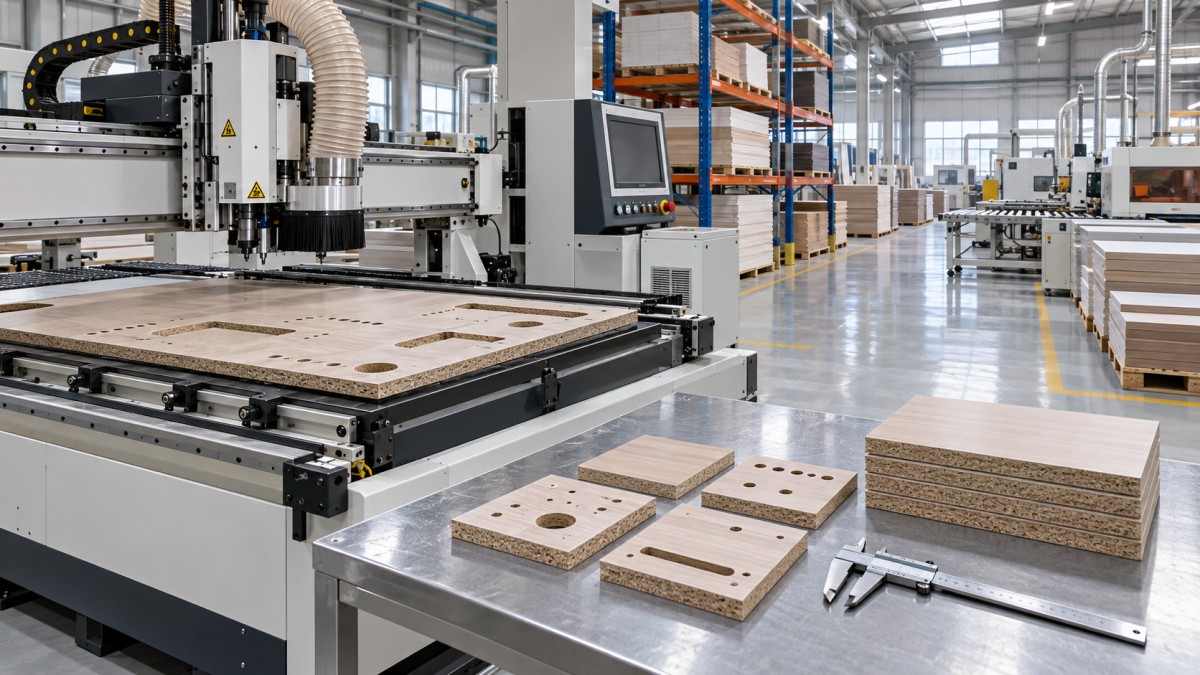
Where testing is practical, agree on the test conditions before it begins. Specify materials, tooling, operators, software preparation, quality checks, and what time measurement includes. A result recorded from the first cut to the last cut answers a different question from the time required to produce an accepted batch from start to finish.
The written recommendation should distinguish verified facts, supplier statements, calculations, and unresolved items. That separation lets the purchasing team see which conclusions are ready for approval and which still depend on evidence.
Define deliverables before approving the engagement
The deliverable should be something the business can use in a purchasing decision or contract discussion. A presentation naming a preferred machine is rarely enough.
- A requirements brief: products, materials, capacity targets, quality expectations, staffing assumptions, and site constraints.
- A comparable options assessment: the same workload, cost boundaries, and evaluation criteria applied to each proposed configuration.
- A documented cost model: installation, tooling, software, training, maintenance, consumables, and relevant support costs, with assumptions visible.
- An interface and responsibility list: who supplies, installs, connects, tests, and supports each part of the arrangement.
- Acceptance-test recommendations: measurable checks for output and quality, agreed with the supplier before the order becomes binding.
Set boundaries around the assignment. Clarify whether site visits, supplier meetings, trial supervision, travel, and revisions are included. Ask who owns the resulting files and whether another engineer can review the calculations. A recommendation that cannot be checked or reused has limited procurement value.
The adviser should also explain what would change the recommendation. For example, a different batch profile, restricted floor space, or reduced staffing availability may favor another configuration. This makes the advice useful if commercial conditions change during negotiations.
When to proceed without a separate consultant
Paid consultation is often unnecessary when you are replacing a machine with a well-understood equivalent, the process remains unchanged, and the internal team can verify capacity and installation requirements. Clear supplier documentation, a suitable production trial, and a complete commissioning proposal may provide enough evidence.
It is also premature when the business has not established its product range, likely demand, budget boundary, or available space. An adviser can help develop these inputs under a defined planning assignment, but cannot responsibly produce a precise equipment recommendation from an undefined production brief.
Before authorizing a fee, require answers to three questions: Which purchase decision could change? What evidence will be collected? What usable output will be delivered? If the answers are specific and the unresolved exposure is material, paid advice has a defensible role. If the proposed work only repeats supplier explanations or confirms a predetermined choice, spend the effort on better quotations, clearer specifications, or targeted testing instead.
Send Your Inquiry
We welcome your cooperation and we will develop with you.