


News & Exhibitions
Latest Factory Updates, Industry Trends & Global Exhibition Information
Ordering Woodworking Machine Voltage Configuration: Specs to Send First
Ordering Woodworking Machine Voltage Configuration: Specs to Send First
Ordering a woodworking machine with the wrong electrical specifications can delay installation, increase modification costs, and disrupt production plans. Before requesting a woodworking machine voltage configuration service, confirm the installation site’s supply voltage, phase, frequency, and available electrical capacity—not just the machine model. Sharing these details early helps the manufacturer assess compatibility and select suitable motors, drives, and control components.
The expensive misunderstanding is often quite small: a quotation says “three-phase,” someone assumes the local supply is suitable, and the discrepancy appears when the electrician opens the cabinet. A useful purchasing specification removes that assumption before production begins.
Start with the supply at the installation point
Do not use a country’s common voltage as the final specification. Industrial sites can have different distribution arrangements, older transformers, or dedicated supplies for particular production areas. The relevant information is what will be available at the machine’s connection point.
Ask the site electrician to confirm the following information. If the facility is still under construction, identify which details are approved design values and which remain provisional.
Be precise about voltage measurement. A line-to-neutral reading is not interchangeable with a line-to-line reading. If purchasing staff are forwarding information from maintenance, retain the measurement labels rather than reducing everything to one unexplained voltage figure. Measurements inside electrical panels should be taken only by qualified personnel using appropriate procedures.
Why a motor nameplate does not answer the whole question
A woodworking machine is rarely one electrical load. An edge bander may include feed motors, a glue heating system, trimming units, extraction connections, and electronic controls. A CNC router can add spindle drives, servo systems, a vacuum pump, and cooling equipment. Each needs to fit the agreed electrical design.
A motor marked for two voltages may support different winding connections, but that does not mean the complete machine can be switched between those supplies. Contactors, overload protection, transformers, heaters, and variable-frequency drives still need checking. Nor is a star-delta starter a general-purpose voltage converter; its suitability depends on the motor and supply arrangement.
Frequency deserves its own confirmation. Changing frequency can change the speed of a directly connected induction motor, with consequences for cutting speed, feed relationships, cooling, or pump performance. A transformer changes voltage, not frequency. A drive may resolve a particular motor requirement, but it does not automatically make every component in the cabinet compatible.
The useful question is therefore: “Will the complete machine, including all quoted auxiliaries, operate on this supply?” That is a stronger purchasing requirement than asking whether the main motor is available in a particular voltage.
Send documents that settle questions, not just photographs
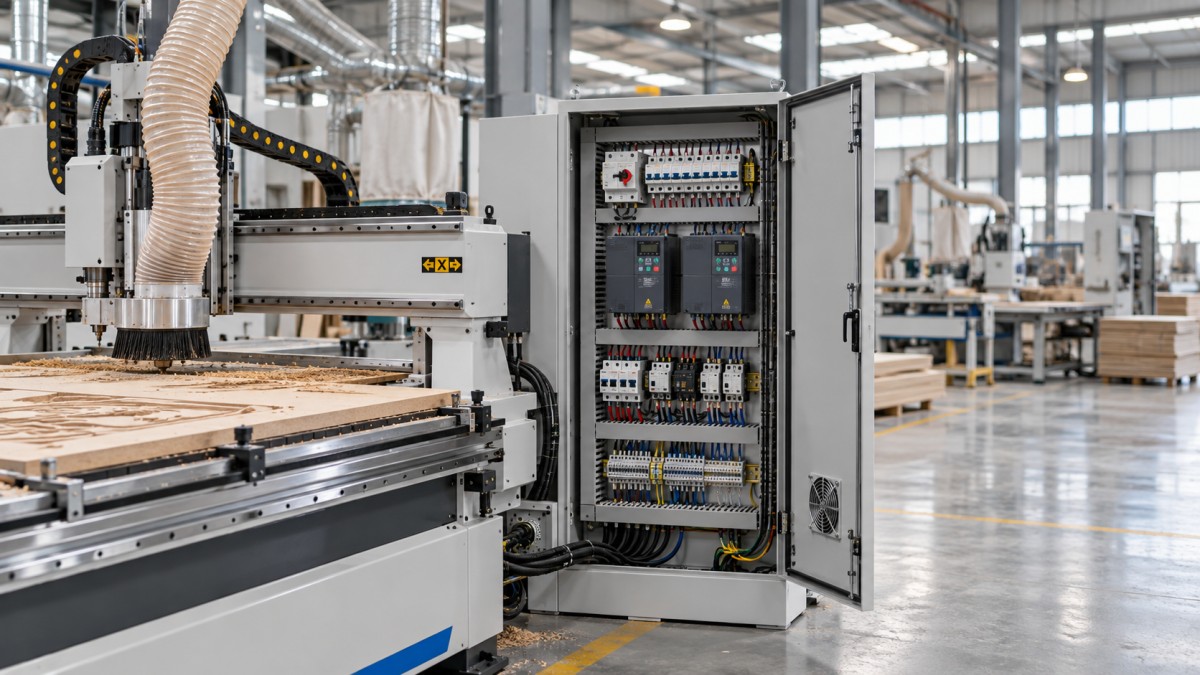
A clear electrical information package can prevent several rounds of clarification. Start with the site’s single-line diagram, if available, and a written supply confirmation from the electrician. Photographs of the distribution board labels and existing equipment nameplates can support that information, but they should not replace it. An adjacent machine may be fed through a transformer that is not immediately visible.
Include the exact machine model, selected options, and a list of separately supplied equipment. State whether the extraction system, vacuum pump, compressor, or chiller is included in the manufacturer’s electrical scope or will be purchased locally. Otherwise, the supplier may calculate one machine’s demand while the installation team expects capacity for an entire working cell.
Also describe the operating sequence. Will extraction start before the saw? Will several machines restart after an outage? Will a vacuum pump run continuously while the spindle cycles? These details help distinguish normal running demand from the more demanding starting condition.
Where the site has recurring voltage dips, generator operation, or unexplained protective trips, disclose them before configuration is agreed. The manufacturer may need additional information, while the site engineer may need to investigate the supply itself. A different machine voltage specification cannot repair an inadequate distribution system.
Check capacity before choosing the cheapest configuration
Installed motor power, operating demand, and required supply capacity are related, but they are not the same figure. A machine’s total kilowatt rating alone is not enough to select the feeder. Current depends on the electrical design, efficiency, power factor, operating sequence, and starting method.
Ask the manufacturer for rated input current, maximum simultaneous demand, and starting information where relevant. The site electrician should then assess cable sizing, protective devices, voltage drop, and coordination with upstream protection under applicable local requirements. Available fault current and protective-device ratings may also need engineering review.
If the site has only single-phase power, say so immediately. Do not approve a three-phase machine on the assumption that a low-cost converter can be added later. Feasibility depends on the complete load, including controls and auxiliaries, and conversion equipment may introduce capacity or operating limitations.
A configuration built for the destination supply is often simpler to install and maintain. An external transformer can be a reasonable alternative when properly engineered, but it adds space, protection, heat losses, installation work, and another service item. Compare the installed cost and maintenance implications—not just the factory surcharge.
Make the quotation describe the delivered electrical build
“Voltage customized” is too vague for purchase approval. The quotation or technical agreement should identify the incoming voltage, phase, frequency, required conductors, and any transformer or conversion equipment included. It should also state the configuration of separately shipped accessories.
For a woodworking machine voltage configuration service, request written answers to these order-specific questions:
- Which motors, drives, heaters, and control-power components change from the standard build?
- Is a neutral required, and what incoming connection arrangement will be provided?
- What supply tolerance and operating conditions does the manufacturer specify?
- Are cabinet cooling, enclosure selection, or component ratings affected by the installation environment?
- Does the configuration change price, production lead time, testing scope, or spare-parts availability?
- Which installation tasks and protective devices remain the buyer’s responsibility?
Clarify destination-market electrical documentation and conformity requirements before ordering, rather than assuming that voltage compatibility establishes compliance. Any required assessment, marking, or certification must be checked against the actual machine, destination, and contractual scope.
For a manufacturer and exporter such as Qingdao Zhongding Machinery Co., Ltd., with more than 20 years in woodworking machinery, this discussion belongs alongside machine selection. Its focus on technical support and spare-parts supply is relevant here: a custom electrical build needs documentation that remains useful after installation, not merely a compatible plug-in voltage.
Approve the configuration once, then control changes
Before releasing production, obtain a signed electrical specification linked to the order and machine model. Have the site’s electrical representative review it. If the installation location changes later, reopen that review; moving a machine to another building can change the supply assumptions even within the same company.
Before shipment, request the final wiring diagrams, incoming terminal details, nameplate information, component list, and agreed factory test records. Confirm what supply was used for testing and whether it represented the ordered configuration. Where it did not, ask what was verified and what remains for commissioning. Photographs can help check identification and cabinet layout, but they do not prove electrical performance.
Keep replacement-part details with the maintenance records, especially for nonstandard motors, transformers, and drives. The next technician should not have to reconstruct the original order from email correspondence.
The practical approval rule is straightforward: release the order when the site supply, complete machine load, and delivered electrical configuration agree in writing. If any one remains uncertain, resolve that specific gap before fabrication—not when the machine reaches the workshop.
Send Your Inquiry
We welcome your cooperation and we will develop with you.