


News & Exhibitions
Latest Factory Updates, Industry Trends & Global Exhibition Information
Custom-Voltage Woodworking Machines vs. Transformers: Which Fits Your Shop?
A woodworking machine can suit your production perfectly and still create an expensive installation problem if its electrical requirements do not match your shop’s supply. Comparing custom woodworking machine voltage options with an external transformer means looking beyond purchase price to motor compatibility, starting current, control circuits, protection, and maintenance.
Neither approach automatically resolves differences in frequency or phase. The right choice depends on the complete electrical system—not simply whether two voltage numbers can be made to match. For technical evaluators, the goal is a machine that starts reliably, performs as specified, and remains straightforward to service years after installation.
Start with the supply you actually have
Before requesting a quotation, establish the electrical conditions at the proposed installation point. A building’s nominal supply designation is useful, but it does not describe available capacity, voltage variation, grounding arrangements, or the effect of other equipment starting nearby.
Ask your electrical contractor or facilities team to confirm:
- Nominal voltage and measured operating range: especially line-to-line voltage for three-phase equipment.
- Frequency and phase: 50 Hz or 60 Hz, and single-phase or three-phase service.
- Available capacity: feeder rating, existing demand, and headroom for machine starting.
- Distribution details: grounding system, neutral availability, and available fault current.
- Installation conditions: cable distance, ambient temperature, dust exposure, and space for additional equipment.
A shop with a suitable three-phase supply but the wrong voltage faces a different decision from a workshop with only single-phase service. A conventional transformer can address the first situation. It does not, by itself, solve the second.
What are you comparing: a factory configuration or a voltage interface?
A custom-voltage woodworking machine is configured by the manufacturer for an agreed incoming supply. Depending on the machine, this may involve different motors, winding connections, contactor coils, control transformers, power supplies, drives, and protective devices. It should be treated as a coordinated electrical configuration—not a replacement nameplate.
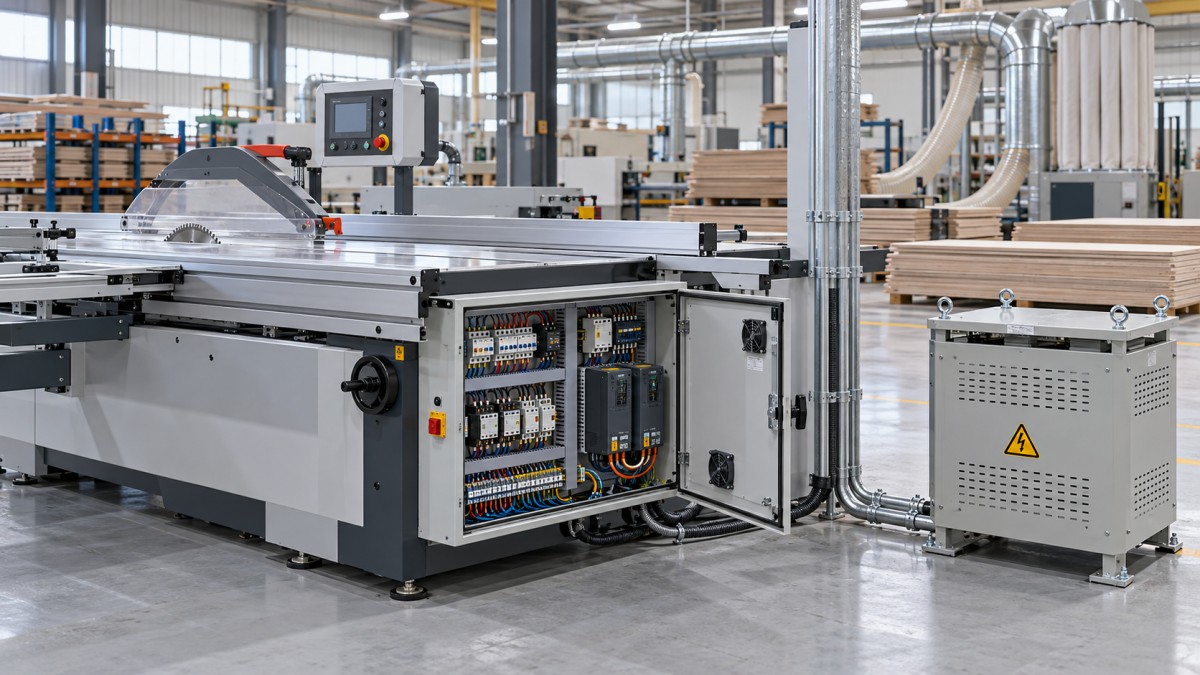
An external transformer leaves the machine at its specified input voltage and converts the shop’s supply voltage to that level. This can be practical when buying a standard machine, relocating existing equipment, or supporting several compatible machines from one distribution arrangement.
The compatibility checks that decide whether either option works
Voltage is only one part of motor compatibility
A motor marked for two voltages may support reconnection, but only in the arrangements shown on its nameplate and wiring diagram. Do not assume every motor can change from star to delta to match a different supply. Starting arrangements, winding ratings, and terminal access all matter.
Frequency needs separate attention. Running a 50 Hz motor on 60 Hz, or the reverse, can affect speed, magnetic loading, cooling, and available torque. A transformer does not correct those effects. Manufacturer approval is necessary, including confirmation that the driven mechanism remains within its design limits.
For woodworking equipment, speed changes can affect cutting quality and safety. Saw blades, cutterheads, sanding drums, bearings, and feed mechanisms have operating limits. A motor that runs without tripping is not proof that the machine is performing correctly.
Follow every electrical branch, not just the main motor
A panel saw, edge bander, or multi-head machine may contain several independent loads. Check feed motors, extraction auxiliaries, heaters, lubrication pumps, brakes, solenoid valves, cabinet fans, lighting, and control power supplies.
Variable-frequency drives and servo drives also have defined input-voltage and frequency ranges. Their output settings do not make every incoming supply acceptable. Where drives are involved, confirm any requirements for line reactors, filtering, grounding, and transformer compatibility with the relevant manufacturers.
The acceptance question is simple: has every circuit been checked against the proposed supply, or has only the largest motor been considered?
Starting performance can overturn a seemingly correct selection
A transformer sized only from normal running demand may allow excessive voltage dip when a large motor starts. That dip can prevent acceleration, release contactors, or reset controls—even if the transformer appears adequately rated during steady production.
Evaluation should include the starting method, expected starting current, acceleration time, starting frequency, and simultaneous loads. A direct-on-line saw motor presents a different demand from a drive-controlled motor with a managed acceleration ramp.
The supply upstream of the transformer matters too. A larger transformer cannot compensate for an undersized feeder or a weak utility connection. Starting performance should be checked across the complete supply path.
How to assess a transformer without guessing its size
For a balanced three-phase load, apparent power can be estimated as kVA = √3 × line voltage × line current ÷ 1,000. This is a starting point for reviewing running demand, not a complete transformer-sizing method.
If the available information is motor output power in kilowatts, efficiency and power factor must also be considered. Adding motor shaft-power ratings and treating the total as transformer kVA can underestimate the electrical requirement.
Give the transformer supplier the machine’s load schedule, operating sequence, largest starting load, and acceptable voltage-dip limits. Include ambient conditions and any nonlinear loads such as drives. Ask for a selection supported by the actual duty rather than an unexplained sizing multiplier.
Transformer type also affects the installation. An autotransformer can be compact and economical for suitable applications, but it does not provide galvanic isolation. An isolation transformer offers electrical separation, while still requiring a correctly designed grounding and bonding arrangement. Neither type is universally preferable.
Finally, verify primary and secondary protection, disconnecting means, enclosure suitability, and available fault-current coordination. The installation must meet applicable local requirements, and the machine’s short-circuit rating must be appropriate for the proposed supply arrangement.
When custom woodworking machine voltage is the stronger choice
Factory configuration often makes sense for a new machine intended to remain at one site for many years. It removes an extra conversion stage and gives the manufacturer an opportunity to coordinate electrical components before dispatch.
This is especially valuable where the machine has multiple motors, electronically controlled feeds, heating circuits, or integrated automation. Resolving compatibility at the design stage can be cleaner than adding equipment after the machine arrives.
However, “custom voltage available” is not a complete technical answer. Request confirmation of:
- The permitted incoming voltage range, frequency, phase, and neutral requirement.
- The rated input current, largest starting demand, and recommended upstream protection.
- Motor ratings, drive input ratings, and control-circuit voltages.
- Updated electrical drawings and a voltage-specific bill of materials.
- Functional testing at the specified supply, or a clearly documented alternative verification method.
- Replacement-part availability and identification of any nonstandard components.
Ask what has actually changed. Reconnecting a suitable motor is different from replacing motors and redesigning control power. That distinction affects lead time, spare parts, and future troubleshooting.
When retaining the machine voltage makes more sense
An external transformer deserves serious consideration when an existing machine is mechanically sound and already supported with familiar electrical parts. It may also suit a standard machine available on a shorter schedule, provided the full installation cost remains attractive.
There can be advantages in a shop with several machines designed for the same secondary voltage. A shared transformer may simplify voltage conversion, but it also creates a common dependency. Its sizing must reflect concurrent operation and starting sequences; a fault or maintenance shutdown can affect multiple production stations.
Space is another practical constraint. The transformer should not become an obstruction beside sheet storage or be placed where cooling is compromised by dust accumulation. Enclosure selection, access, and cleaning arrangements belong in the installation plan.
If the real mismatch is single-phase versus three-phase, evaluate a suitable phase-conversion solution separately. A drive may be appropriate for certain individual motor applications, but it is not automatically a suitable supply for an entire machine containing controls, heaters, and multiple motors.
Compare installed cost over the same operating period
A fair quotation comparison includes more than the machine surcharge on one side and the transformer purchase price on the other.
For factory configuration, include engineering charges, any schedule impact, commissioning, and voltage-specific spare parts. For the transformer option, include delivery, mounting, cables, protection, disconnects, installation labor, ventilation provisions, and commissioning.
Operating losses also belong in the calculation. Transformers have no-load losses while energized and load-dependent losses during use. Request loss data for the proposed unit and apply your expected energized hours, loading pattern, and electricity tariff. Avoid relying on a generic efficiency claim.
Downtime exposure can outweigh a modest purchase-price difference. Consider whether local technicians can diagnose the arrangement, whether spare components are accessible, and who takes responsibility if the machine trips during startup. A low initial price offers little comfort when production and electrical contractors are waiting for each other to identify the fault.
Put the decision into an acceptance-ready specification
Before ordering, combine the supply survey, machine load schedule, starting assessment, and installed-cost comparison into one approved electrical specification. Assign responsibility for the machine, transformer if needed, upstream distribution, and site commissioning. Keep interface assumptions visible rather than scattered across quotation emails.
For discussions with Qingdao Zhongding Machinery Co., Ltd., provide these details alongside the required woodworking process and production capacity. With more than 20 years in woodworking machinery manufacturing and export, the company’s technical support and spare-parts discussions can form part of the evaluation. Any proposed electrical configuration should still be confirmed against the particular machine and destination requirements.
Choose factory-configured voltage when coordinated integration and a stable long-term installation justify it. Choose a transformer when retaining the machine’s electrical configuration offers a practical advantage and the supply, starting behavior, protection, and installation conditions have been verified. In either case, the winning option is the one with a documented path from shop supply to dependable production—not merely matching voltage labels.
Send Your Inquiry
We welcome your cooperation and we will develop with you.