


News & Exhibitions
Latest Factory Updates, Industry Trends & Global Exhibition Information
What delivery lead time should you expect for machines to the UAE?
A realistic delivery plan for woodworking machinery to the UAE should separate the order into four clocks: specification freeze, factory production, pre-shipment inspection and packing, and ocean transport with destination handling. Treating these as one supplier “lead time” is the main source of missed installation dates. A standard machine already in a stable configuration moves through these stages differently from a machine requiring voltage changes, additional conveyors, special tooling, or a coordinated shipment of several machines.
For project scheduling, use the supplier's confirmed production completion date as only one milestone. The machine is not ready for site work until export packing is finished, documents are issued, the cargo has a vessel booking, and arrival handling at the UAE port has been considered. The final installation date should also allow time for unloading, positioning, electrical connection, dust extraction connection, commissioning, and trial processing.
Build the lead time from the actual machine configuration
Machine configuration affects timing before any metal is cut or any crate is built. A common error is to compare two quotations by a single delivery promise while overlooking differences in electrical standard, working width, sanding head arrangement, safety options, automation interfaces, or accessory scope. A machine described as “standard” may still require confirmation of the motor voltage and frequency, control-language requirements, dust extraction port layout, and consumables supplied with the equipment.
For a calibration sanding line, the working width alone can change transport and production planning. A compact machine and a wider model may use different frames, belts, motors, pressure systems, or packaging dimensions. The requested material range also matters. Processing thin veneer calls for attention to feed stability and contact pressure, while thick MDF, plywood, or solid wood panels can affect the selected motor configuration, conveyor design, and test material used before dispatch.
When reviewing a quotation, distinguish between production lead time and ready-to-ship lead time. Production can be complete while the machine remains unavailable for collection because final testing, wooden-case construction, export markings, or missing purchased components have not been completed. A useful written schedule identifies each handover point rather than giving only an estimated shipment month.
Where time is commonly added after the order is placed
Order release is often delayed by incomplete technical confirmation. This is especially common when the commercial description is accepted before the final layout drawing, electrical data, or auxiliary equipment list is agreed. The result is not always a major redesign; even a late decision on a dust collector interface, conveyor direction, or spare sanding belts can interrupt the production sequence or postpone final packing.
Custom work deserves its own planning allowance. Examples include non-standard panel widths, a special infeed or outfeed table, a different control arrangement, integration with an existing production line, or extra protective features requested after the main design has been approved. Such requirements should be recorded as part of the confirmed scope. Verbal additions made near completion are particularly disruptive because they may require re-testing after installation.
Order quantity creates a different pattern. A single machine may be built and tested as one unit, whereas several machines intended for one production area must be coordinated around shared accessories, electrical cabinets, conveyors, tooling, and packing. Sending the main machine ahead of its linked equipment can look faster on paper but may leave the installation site unable to commission the line. Where the machines must operate together, plan shipment readiness around the last essential component, not the first finished machine.
Capacity also has to be interpreted carefully. A factory may have assembly space available while a critical purchased component, such as a motor, inverter, bearing assembly, pneumatic part, or electrical device, is still subject to its own delivery schedule. Asking whether the quoted period includes all key components is more useful than asking only whether the factory is busy.
Production completion is not the departure date
Before a woodworking machine is released for shipment, it should pass the agreed inspection and test sequence. For sanding equipment, this normally involves checking the mechanical movement, belt tracking, conveyor operation, thickness adjustment, safety functions, and the surface result on relevant panel material. Test expectations should match the intended process. A satisfactory result on ordinary MDF does not automatically confirm the same finish on veneer-faced panels or solid wood with variable grain.
Inspection timing should be arranged early enough to avoid a vessel booking conflict. If the inspection identifies an issue requiring adjustment, the schedule needs room for correction and repeat testing. Pressure to ship immediately after a first inspection can create a false choice between accepting an unresolved point and missing a loading window. It is better to define the acceptance criteria, documents, and witness arrangements before final assembly starts.
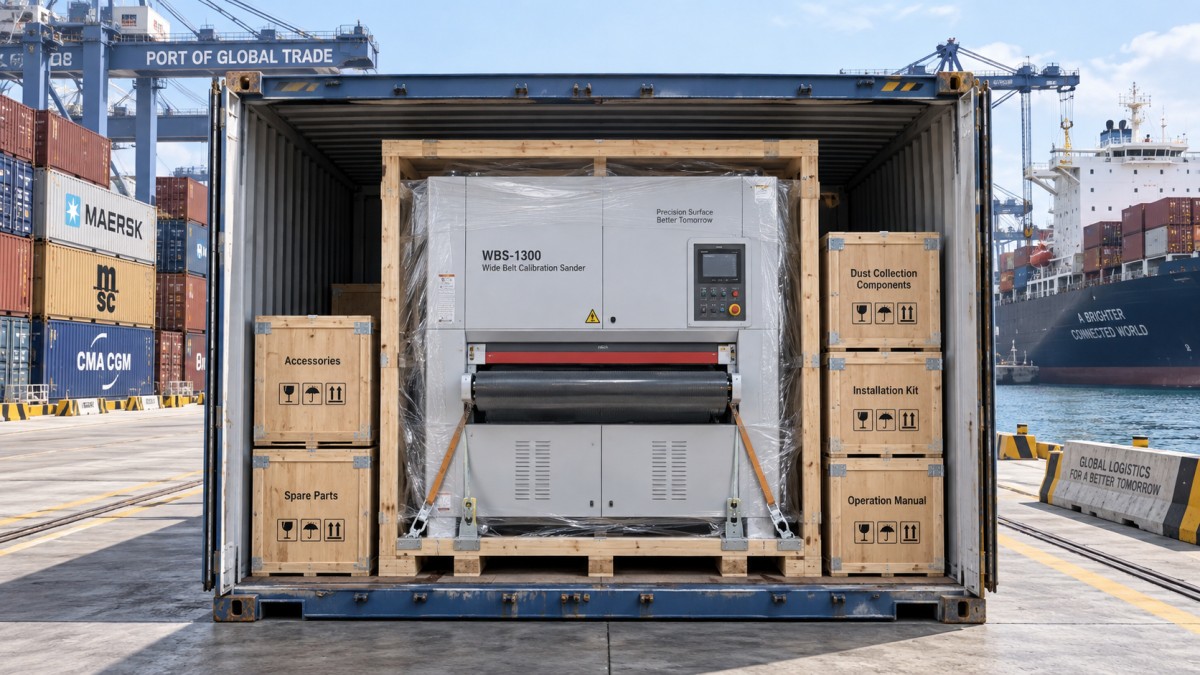
Packing is a technical stage, not a paperwork formality. Machinery bound for sea transport needs protection against movement, moisture exposure, and handling impacts. Loose accessories, spare belts, tools, manuals, electrical parts, and optional units should be identified against the packing list before the crates are closed. For large machines, the selected container type, loading sequence, lifting points, and crate dimensions must be aligned with the shipment plan. A machine that fits the production floor may still need partial disassembly or a revised packing design to fit a chosen container safely.
Documentation should progress in parallel with packing. Commercial documents, packing details, transport records, and machine identification should describe the shipment consistently. A mismatch between the packing list and the actual number of cases or accessory cartons can slow destination processing even when the vessel has arrived on schedule. Serial numbers, package marks, gross weights, and dimensions deserve a final cross-check.
Sea freight to the UAE needs a buffer outside the factory schedule
Ocean transit is only one part of the transport phase. The freight forwarder first needs a confirmed cargo-ready date, final dimensions and weight, pickup location, and container requirement. A booking is then subject to the selected route, carrier schedule, equipment availability, port operating conditions, and transshipment arrangements. The date a booking is requested is not the same as the date cargo is loaded on board.
For a woodworking machine delivery to UAE, the delivery term changes which activities remain within the supplier's scope and which are controlled at destination. This distinction should be clear in the purchase contract. Port arrival does not equal delivery to the factory. Cargo release, customs procedures, terminal handling, local trucking, delivery appointments, and site access can all sit between vessel arrival and unloading.
Containerized cargo usually offers a more controlled path for machinery that can be packed within container limits. However, the actual decision depends on crate size, weight distribution, loading method, and whether several machines or accessories are traveling together. A machine close to a container's internal dimensions needs accurate packing measurements, not nominal machine dimensions. The crate, base, lifting clearance, and securing arrangement determine fit.
For out-of-gauge equipment, transport planning becomes more sensitive. Flat-rack or breakbulk arrangements may involve different booking lead times, port handling requirements, and protection measures. Do not assume that a wide or tall machine can follow the same timing as a standard enclosed container. The freight plan should be established while the packing design is still adjustable.
Use the machine data to prevent installation-driven delay
Shipping readiness has limited value when the receiving site is not prepared. The arrival plan should be checked against the machine's footprint, access route, floor capacity, power supply, compressed-air line, dust collection arrangement, and available lifting equipment. This is particularly important for sanding machinery because commissioning depends on both the machine and the connected extraction system.
Consider the configuration of the Wide Belt Calibration Sanding Machine as an example. The ZDR-RP630 specification lists a 630 mm maximum working width, material thickness from 2.5 mm to 120 mm, a 350 mm minimum working length, feeding speed from 6 to 30 m/min, and a machine dimension of 1700 x 1100 x 2050 mm. Those figures are useful for production planning, but they are not a complete unloading plan. The packed dimensions, crate weight, forklift capacity, doorway clearance, and route from the unloading point to the final location must be confirmed separately.
The same machine lists a 0.5 MPa working air pressure and dust-collection demand of 5000 m3/h, with collection speed stated at 25 to 30 m/s. These requirements should be reviewed before dispatch, not after the crate reaches the workshop. An extraction system with inadequate airflow can delay trial production or compromise the sanding result, even though the machine itself has arrived on time. Electrical supply must likewise match the confirmed motor and control specification rather than assumptions based on other equipment already installed.
Questions that turn an estimated date into a usable schedule
- What event starts the production clock? Confirm whether it begins after deposit receipt, final technical approval, receipt of drawings, or all of these items.
- Which components are included in the quoted completion period? Ask specifically about motors, electrical parts, pneumatic components, conveyors, tooling, and optional accessories.
- What evidence marks factory completion? This could include test records, inspection photos or video, agreed test material results, packing photos, and a final packing list.
- When can freight booking begin? The answer should identify when final crate dimensions and gross weights will be available, since preliminary figures may not support a reliable container plan.
- What must be ready at the destination before delivery? Site drawings, door clearances, lifting method, electrical connection points, compressed air, and extraction ducting should be considered alongside the sea shipment.
A schedule becomes more dependable when it includes a target date and a separate contingency period for events that cannot be controlled by assembly alone, such as booking changes, port congestion, document corrections, or a re-test after an inspection finding. The contingency should protect the installation milestone rather than being hidden inside an optimistic factory lead time.
How to interpret late-stage updates
Not every date change has the same significance. A short movement in a packing-completion date may be manageable if the vessel booking remains open and destination installation has slack. A change caused by a missing electrical component, a failed functional test, or a revised machine configuration is more consequential because it can affect production, inspection, packing, and shipment together. The right response is to ask which milestone moved and what downstream dates have been recalculated.
Likewise, a machine described as “finished” needs clarification. It may mean mechanical assembly is complete, that internal testing is underway, that the unit has passed final inspection, or that it is crated and available for pickup. These are materially different states. Recording them in the order communication prevents an arrival forecast from being built on an ambiguous status word.
Reliable timing comes from locking the technical scope early, treating inspection and packing as scheduled work, and planning sea freight and site readiness as connected stages. That approach gives the delivery date a practical meaning: not merely when a machine leaves the factory, but when it can be unloaded, connected, tested, and placed into the intended woodworking process.
Send Your Inquiry
We welcome your cooperation and we will develop with you.